What was the NEET 2024 Thermodynamics question on vibrational modes f in terms of gamma?
The NEET 2024 question asked for the number of vibrational modes f for a polyatomic gas expressed solely in terms of γ = Cp/Cv. The polyatomic gas has translational, rotational and vibrational contributions to internal energy. The four options were A) (4 + 3γ)/(γ − 1), B) (3 + 4γ)/(γ − 1), C) (4 − 3γ)/(γ − 1), and D) (3 − 4γ)/(γ − 1).
The official answer is C. The derivation rests on equipartition linked directly to the γ relation.
What is the official step-by-step solution for the NEET 2024 Thermodynamics vibrational modes question?
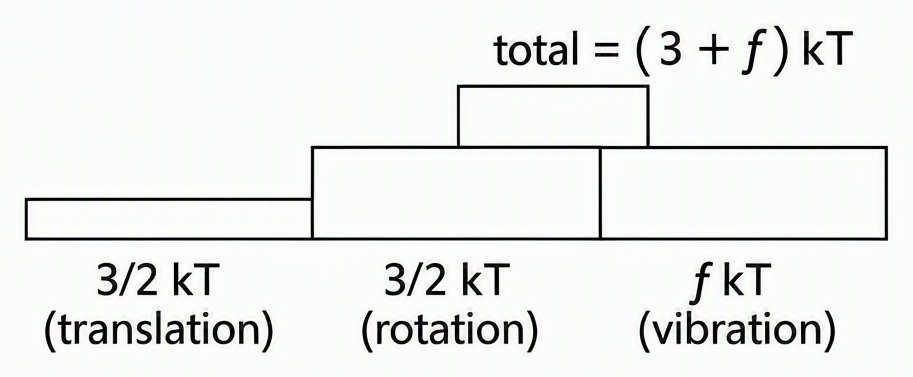
The official NEET 2024 solution begins from internal energy per molecule.
U = (3/2)kT trans + (3/2)kT rot + (f kT vib) simplifies to U = (3 + f)kT.
For one mole, Cv = (3 + f)R. Then Cp = Cv + R gives Cp = (4 + f)R.
Thus
Cross-multiply:
Rearrange:
Solve:
This matches option C.
What is the common method mistake that produces a wrong option in the NEET 2024 Thermodynamics gamma question?
The precise slip is inverting the γ fraction at the start or swapping the placement of 4 and 3 before cross-multiplying. This error is algebraic rearrangement from the same initial equation γ = (4 + f)/(3 + f).
From 3γ + fγ = 4 + f, swapping the constants and mishandling signs while shifting terms yields f(γ − 1) = 4 + 3γ. Solving produces
which is option A. The equipartition setup with three translational, three rotational and f vibrational modes stays untouched. The mistake is purely procedural in the algebra.
What are related practice questions from Thermodynamics on gamma and degrees of freedom?
These three questions apply the same official algebra immediately.
Question 1: Calculate γ for a diatomic gas at room temperature where vibrational modes are frozen.
Diatomic molecules have 5 total degrees of freedom. Cv = (5/2)R, Cp = (7/2)R, so γ = 7/5 = 1.4.
Question 2: For a polyatomic gas with γ = 1.33, find total degrees of freedom and the number of active vibrational modes.
Substitute into the formula:
Zero vibrational modes are active. Total degrees of freedom equal 6.
Question 3: Derive Cv in terms of γ for a gas where f = 6 vibrational modes.
First obtain γ from the relation:
Then Cv = R/(γ − 1) = R/(1/9) = 9R. This matches Cv = (3 + 6)R.
What are the key formulas and quick revision points for vibrational modes and gamma?
The general relation f = (4 − 3γ)/(γ − 1) must be memorised in this exact form.
- For polyatomic gas without vibration: total dof = 6, γ = 4/3.
- Each vibrational mode contributes kT (two quadratic terms) to the energy per molecule.
- Monatomic: γ = 5/3.
- Diatomic: γ = 7/5.
- Polyatomic: γ approaches 1 as f increases.
Revise these five lines in the final week before NEET 2025.
How do you solve this Thermodynamics question in 90 seconds on exam day?
Start directly from U = (3 + f)kT instead of counting individual dof. This yields Cv = (3 + f)R and Cp = (4 + f)R at once. Write γ = (4 + f)/(3 + f) and solve for f by cross-multiplication. The algebra finishes in 30 seconds.
NEET 2025 is on 2025-05-04. Practise this exact type from the past-paper archive to remove the rearrangement trap. If a mock test variation still trips the signs, photograph the doubt for a step-by-step solution.
Next step: the past-paper archive on NEET JEEnius AI and search past NEET papers by year, subject or chapter, each with a worked solution (100 free searches a month).
For a worked example of the same idea, see Lac Operon NEET 2026: Only Statement A is Correct.
Frequently asked questions
What was the NEET 2024 thermodynamics question on vibrational modes f in terms of gamma?
The question asked for the number of vibrational modes f for a polyatomic gas expressed only in terms of γ = Cp/Cv. The correct choice is C) (4 − 3γ)/(γ − 1). It is obtained directly from the equipartition relation linking internal energy contributions to γ.
How to derive f = (4-3γ)/(γ-1) for the NEET 2024 thermodynamics question?
Begin with internal energy U = (3 + f)kT per molecule. This gives Cv = (3 + f)R and Cp = (4 + f)R for one mole. Then γ = (4 + f)/(3 + f). Cross-multiplying and rearranging yields f(γ − 1) = 4 − 3γ, so f = (4 − 3γ)/(γ − 1).
What is the common mistake in the NEET 2024 thermodynamics gamma question?
Most students invert the γ fraction or swap signs while shifting terms after cross-multiplication. From γ = (4 + f)/(3 + f), this produces the wrong expression f = (4 + 3γ)/(γ − 1), which is option A. The initial equipartition setup is never the source of error.
What is the formula relating vibrational modes f and gamma for polyatomic gases?
The exact formula to memorise is f = (4 − 3γ)/(γ − 1). For γ = 4/3, f equals zero, matching no vibrational modes. As f increases, γ approaches 1. This relation is derived from Cv = (3 + f)R and Cp = Cv + R.
How to solve the thermodynamics vibrational modes question in 90 seconds in NEET?
Directly write U = (3 + f)kT, obtain Cv = (3 + f)R and Cp = (4 + f)R, then set γ = (4 + f)/(3 + f). Solve the linear equation for f by cross-multiplication and rearrangement. Avoid counting individual degrees of freedom to save time.