Which Statement About the Lac Operon Was Tested in NEET 2026?
Only statement A is correct: gene i is constitutively expressed. The NEET 2026 question presented four claims in multiple-choice format. This medium-difficulty (tier 2) Biology question was worth 4 marks and tested exact distinctions between regulator and structural genes.
These four testable claims cover the regulator gene, inducer action, promoter sharing, and possible alternative sugars. The question matches your search because it isolates the precise separators that separate correct recall from partial diagrams.
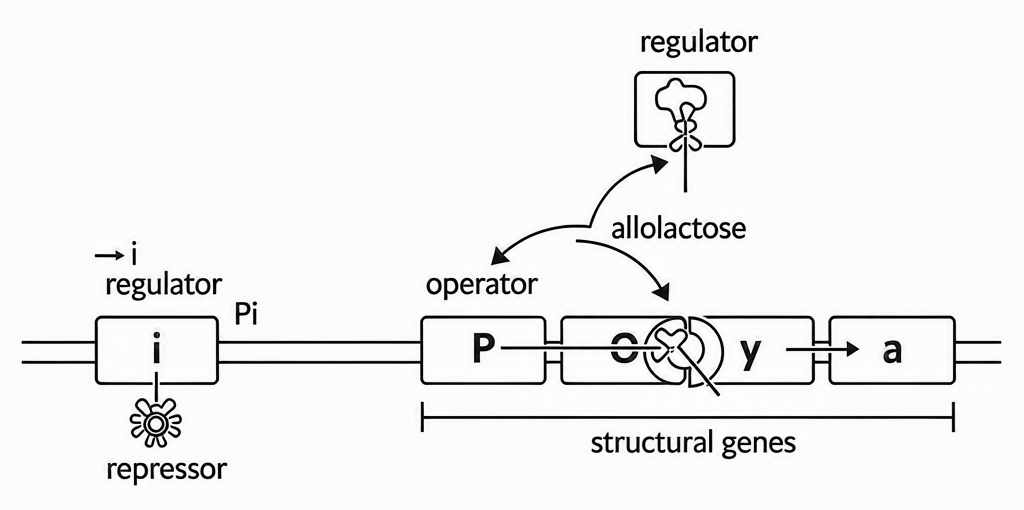
What Is the Official Step-by-Step Solution for This Lac Operon NEET 2026 Question?
Option A is correct. The regulator gene i is constitutively expressed because it continuously forms repressor protein regardless of lactose presence.
Lactose is converted to allolactose which binds repressor and inactivates it, not activates it to bind operator. This eliminates B. Only structural genes z, y and a share one common promoter. Regulator gene i has its own independent promoter, so C is incorrect. Galactose cannot act as inducer of the lac operon, ruling out D.
Therefore only the statement about constitutive expression of gene i is correct. Run every option against these four components and the answer appears in under 45 seconds.
Why Do Students Pick the Wrong Option When Solving Lac Operon Questions?
Students select C because they treat the regulator gene i as part of the operon unit and assume it shares the single promoter with z, y and a.
This method error arises from not distinguishing the separately transcribed repressor gene from the polycistronic structural message. The i gene is always on at low level from its own promoter to keep repressor available. The z, y and a message is produced together only when the repressor is removed by allolactose.
Once this separation is fixed in memory, option C stops looking attractive. The official solution emphasises this boundary every time.
What Practice Questions Test the Same Gene Regulation Concepts?
These three questions apply the same four checks immediately after the official solution.
Question 1: What happens to repressor protein when allolactose is absent?
The repressor remains active, binds the operator and blocks RNA polymerase from transcribing the structural genes. No enzymes are made until allolactose inactivates it.
Question 2: Which gene in lac operon produces a product that is not an enzyme?
The regulator gene i produces the repressor protein. Genes z, y and a code for β-galactosidase, permease and transacetylase, all enzymes. This directly tests the regulator versus structural distinction.
Question 3: In the absence of lactose, which component binds to the operator region?
The repressor protein binds the operator. This binding prevents transcription. Allolactose removes the repressor; galactose never participates.
If you get stuck on these or similar questions, photograph a doubt to receive a step-by-step solution.
What Key Distinctions From This PYQ Should I Revise Before NEET 2027?
These four facts from the 2026 PYQ let you evaluate any lac-operon statement in NEET 2027 by direct matching and spot the correct option.
- i gene → own promoter → constitutive repressor synthesis
- True inducer = allolactose (lactose isomer) → inactivates repressor
- Promoter for z-y-a is common and distinct from i promoter
- Galactose has no role as inducer
Regulator gene versus structural genes (z, y, a):
- Regulator (i): separate promoter, makes repressor protein, constitutively expressed.
- Structural (z, y, a): one shared promoter, make enzymes, transcribed together only when inducer is present.
Review this list before every mock test. It counters the exact confusions on promoter sharing, inducer action and galactose.
How Does This Lac Operon Question Fit Into the NEET Biology Paper?
This PYQ represents the repeated operon-based statement questions that appear in Genetics and Evolution, a consistent high-weightage area. Biology constitutes 90 out of 180 questions and 360 out of 720 marks.
The distinctions transfer directly to other regulation systems across the paper. Read the Biotechnology Practice Questions set already published on this site for further practice.
Search the past-paper archive by chapter to see every previous lac operon variant with its worked solution. Use these four facts on any new statement and the correct option becomes obvious.
Next step: photograph a doubt on NEET JEEnius AI and photograph any question you are stuck on and get a step-by-step solution across Physics, Chemistry and Biology (20 free a month).
If that step was the hard part, work through Alkynes - Reactions NEET 2025: Propyne Assertion-Reason Solved.
Frequently asked questions
Which statement about the lac operon was tested in NEET 2026?
Only statement A is correct. Gene i is constitutively expressed because it has its own promoter and produces repressor protein continuously regardless of lactose presence. Statements B, C and D are wrong: allolactose inactivates the repressor, only z y a share one promoter, and galactose cannot induce the operon.
Is gene i constitutively expressed in lac operon?
Yes, gene i is constitutively expressed. It possesses an independent promoter and keeps producing repressor protein at a basal level at all times. This keeps the repressor ready to bind the operator whenever allolactose is absent.
Do genes i z y a share a single common promoter?
No, they do not. Only the structural genes z, y and a share one common promoter and are transcribed as a polycistronic mRNA. Regulator gene i has its own separate promoter and is transcribed independently. This distinction was tested directly in the NEET 2026 question.
What is the inducer of the lac operon NEET 2026?
The actual inducer is allolactose, an isomer formed from lactose. Allolactose binds the repressor protein and prevents it from binding the operator, allowing transcription. Galactose has no role as an inducer and lactose itself does not directly activate the repressor.