
Which Alcohols, Phenols and Ethers practice route should I start with?
For Alcohols, Phenols and Ethers practice questions for NEET, start with the timed mixed diagnostic if you have completed one chapter reading. If basic reagents and NCERT reactions are unclear, begin with NCERT recall. If you know the facts but miss conversions, product prediction or acidity orders, choose reaction application. All 15 questions and worked solutions are free and require no download.
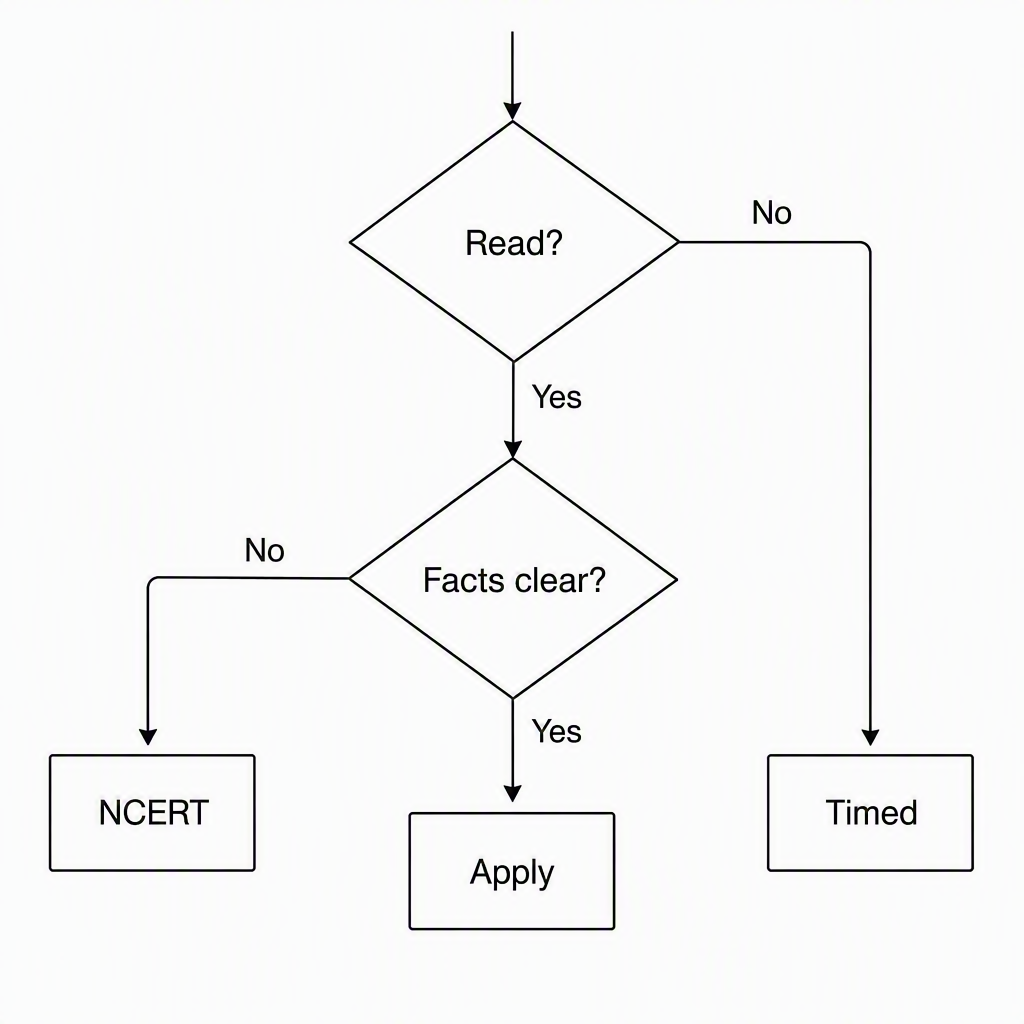
Verdict: A timed mixed set is the best default because it exposes the type of mistake before you spend time on another random 100-question PDF.
A large question count is not useful if you do not review why each wrong option looked attractive. No chapter weightage or expected NEET question count is claimed here because none has been supplied from an official source.
How do NCERT recall, reaction application and timed mixed practice compare?
NCERT recall checks whether facts and reactions are available in memory. Reaction application checks whether you can use them on a new substrate. Timed mixed practice checks recall, selection and speed together. These are complementary routes, not competing books, apps or coaching platforms.
- Practice route: NCERT recall
- Best for: First reading, weak reagent memory and confused textbook observations
- Question style: Direct facts, reagents, named reactions, exceptions and NCERT observations
- Difficulty: Low to moderate
- Time pressure: No strict timer initially
- What the score reveals: Missing facts and reactions that need direct revision
- Practice route: Reaction application
- Best for: Students who remember facts but cannot choose the correct reaction
- Question style: Major-product prediction, acidity order, conversions, oxidation, dehydration, Williamson synthesis and ether cleavage
- Difficulty: Moderate
- Time pressure: Light timing after accuracy improves
- What the score reveals: Weak electronic-effect logic, substrate analysis or mechanism selection
- Practice route: Timed mixed practice
- Best for: Chapter revision after at least one complete reading
- Question style: Interleaved single-correct MCQs covering the whole chapter
- Difficulty: Moderate, with a few discriminating questions
- Time pressure: Exam-like uninterrupted timing
- What the score reveals: Which errors remain when topics are mixed and decisions must be quick
A large question count is not automatically better. Attempt fewer questions if that gives you enough time to correct and classify every error.
Who should choose each Alcohols, Phenols and Ethers practice route?
Choose by preparation stage and observed errors. A Class 11 learner needs stable facts first. A Class 12 student revising organic chemistry needs reaction application. A dropper with a completed syllabus should attempt the timed set first, then return only to the weak bucket exposed by the result.
- Class 11 first-time learner: Complete the theory, then use NCERT recall. Postpone aggressive timing until basic reagents, reactions and observations are stable.
- Class 12 revision student: Use reaction-application questions to reconnect electronic effects, intermediates and product formation.
- Dropper with completed syllabus: Attempt the full timed diagnostic, classify every error and revise only the weak category.
Use your score as a decision rule:
- Below 50%: Reread the relevant NCERT sections and rebuild short reaction notes before attempting another large set.
- 50% to 75%: Practise the dominant error category, especially reagent confusion, acidity logic or product prediction.
- Above 75%: Focus on speed, close options and mixed organic-chemistry practice instead of repeating elementary definitions.
Parents should judge progress through corrected errors and repeat accuracy, not merely the number of MCQs attempted.
Where can I find free Alcohols, Phenols and Ethers practice questions for NEET?
Attempt these 15 original NEET-style questions in one uninterrupted sitting. Use no notes and do not check answers midway. A suggested limit is 15 minutes, but this short diagnostic does not reproduce the full examination. It is designed to identify the practice route you need next.
NCERT-recall questions
- Which compound is a tertiary alcohol?
- A. CH3CH2CH2OH
- B. CH3CH(OH)CH3
- C. (CH3)3COH
- D. C6H5CH2OH
- Ethanol has a higher boiling point than CH3OCH3 mainly because ethanol:
- A. Has a higher molar mass
- B. Forms intermolecular hydrogen bonds
- C. Contains a more polar carbon atom
- D. Is an ionic compound
- Which statement about oxidation is correct?
- A. A secondary alcohol gives a ketone on controlled oxidation
- B. A tertiary alcohol readily gives an aldehyde
- C. A primary alcohol directly gives a ketone
- D. Every alcohol gives the same oxidation product
- Phenol gives which observation with neutral ferric chloride solution?
- A. Silver mirror
- B. Violet coloration
- C. Brick-red precipitate
- D. Rapid hydrogen evolution
- Sodium ethoxide reacts with bromoethane to form ethoxyethane. This is:
- A. Reimer–Tiemann reaction
- B. Kolbe reaction
- C. Williamson ether synthesis
- D. Friedel–Crafts acylation
Reaction-application questions
- What is the correct decreasing order of acidity?
- A. Ethanol > p-cresol > phenol > p-nitrophenol
- B. p-Nitrophenol > phenol > p-cresol > ethanol
- C. Phenol > p-nitrophenol > ethanol > p-cresol
- D. p-Cresol > phenol > p-nitrophenol > ethanol
- The major alkene formed by acid-catalysed dehydration of 2-methyl-2-butanol is:
- A. 2-Methyl-2-butene
- B. 2-Methyl-1-butene
- C. But-2-ene
- D. But-1-ene
- Controlled oxidation of propan-1-ol and propan-2-ol gives, respectively:
- A. Propanone and propanal
- B. Propanal and propanone
- C. Propanoic acid and propane
- D. Propane and propanoic acid
- Which combination is most suitable for preparing anisole by Williamson ether synthesis?
- A. C6H5ONa and CH3I
- B. C6H5Br and CH3ONa
- C. C6H5OH and CH3OH
- D. C6H5Cl and CH3OH
- C6H5OCH2CH3 reacts with excess HI on heating. The main organic products are:
- A. Iodobenzene and ethanol
- B. Phenol and iodoethane
- C. Benzene and ethanal
- D. Phenyl iodide and ethene
Timed mixed-practice questions
- Phenol treated with CHCl3 and aqueous NaOH, followed by acidification, mainly gives:
- A. Benzoic acid
- B. 2-Hydroxybenzaldehyde
- C. Benzaldehyde
- D. 2-Hydroxybenzoic acid
- Sodium phenoxide treated with CO2 under pressure and then acidified mainly gives:
- A. 2-Hydroxybenzoic acid
- B. Benzoic acid
- C. Benzyl alcohol
- D. 2-Hydroxybenzaldehyde
- Phenol reacts with bromine water to give:
- A. Bromobenzene
- B. Mainly 3-bromophenol
- C. 2,4,6-Tribromophenol
- D. No reaction without a Lewis acid
- Nitration of anisole mainly produces:
- A. Meta-nitroanisole only
- B. Ortho- and para-nitroanisole, with para usually favoured
- C. Nitrobenzene only
- D. 2,4,6-Trinitroanisole exclusively
- Which reagent can convert propan-2-ol into propanone?
- A. Acidified K2Cr2O7
- B. NaBH4
- C. Sodium metal
- D. Aqueous NaOH
What are the correct answers and the chemistry behind them?
The numbered key gives the correct option for all 15 questions and the chemistry that decides it. Read the explanation for every error, including questions guessed correctly. Focus on the substrate class, electronic effect, bond cleavage or reagent rule behind each answer.
![A reaction map with “1° ROH”, “2° ROH”, and “3° ROH” branching under “[O]” to products labelled “RCHO”, “RCOR”, and “no rxn”](https://ujplikzsxzjwvwckfbpj.supabase.co/storage/v1/object/public/blog-media/seo-agent-figures/20da8273-737f-424a-bdcc-db25c2b86c50.png)
- C. In (CH3)3COH, the carbon carrying OH is bonded to three other carbon atoms. Option D is a primary alcohol because OH is on the CH2 group, not directly on the benzene ring.
- B. Ethanol molecules form intermolecular hydrogen bonds through their OH groups. Dimethyl ether lacks an O–H bond and cannot form the same network between its own molecules.
- A. A secondary alcohol has one hydrogen on the carbon carrying OH and forms a ketone on oxidation. The aldehyde option for a tertiary alcohol is a common alcohol-classification error.
- B. Phenol gives a violet-coloured complex with neutral ferric chloride. Silver mirror and brick-red precipitate are commonly confused aldehyde tests, not phenol tests.
- C. An alkoxide reacting with a suitable alkyl halide to form an ether is Williamson ether synthesis. Reimer–Tiemann and Kolbe reactions belong to phenol or phenoxide chemistry.
- B. Phenoxide is resonance-stabilised, while ethoxide is not, so phenol is more acidic than ethanol. The nitro group withdraws electron density and stabilises phenoxide further. The methyl group donates electron density and reduces phenoxide stability.
- A. This tertiary alcohol forms a stable tertiary carbocation during dehydration. Loss of a proton mainly forms the more substituted and more stable alkene, 2-methyl-2-butene.
- B. Propan-1-ol is primary and gives propanal under controlled oxidation. Propan-2-ol is secondary and gives propanone, so the substrate class decides the carbonyl product.
- A. Williamson synthesis works best through substitution at a methyl or primary alkyl halide. Aryl halides such as bromobenzene resist this substitution. Tertiary halides favour elimination instead of ether formation.
- B. Iodide attacks the ethyl group and breaks the alkyl–oxygen bond, producing iodoethane and phenol. The aryl–oxygen bond is not cleaved because its carbon is sp2 hybridised and the bond has partial double-bond character.
- B. CHCl3 and NaOH introduce a formyl group mainly at the ortho position of phenol. This is the Reimer–Tiemann reaction.
- A. Carboxylation of sodium phenoxide followed by acidification gives mainly salicylic acid, or 2-hydroxybenzoic acid. This is the Kolbe reaction of phenoxide.
- C. The OH group strongly activates the ring and directs substitution to ortho and para positions. Bromine water therefore gives 2,4,6-tribromophenol without a Lewis acid.
- B. The methoxy group donates electron density by resonance and directs electrophilic substitution to ortho and para positions. The para product is usually favoured because it has less steric crowding.
- A. Propan-2-ol is a secondary alcohol, so oxidation with acidified potassium dichromate forms propanone. NaBH4 is a reducing agent and causes the opposite type of conversion.
For another worked oxygen-containing organic chemistry problem, use Organic Compounds Containing Oxygen NEET 2026: Full Solution.
How should I use my mistakes to choose what to revise next?
Classify every wrong answer before attempting more Alcohols, Phenols and Ethers practice questions for NEET. Use four labels: NCERT fact, reagent or named reaction, electronic-effect logic, and product or mechanism. This error pattern tells you what to revise more clearly than the raw score.
For each incorrect question, record:
- The option you chose
- The correct option
- The reason for the error
- One rule that would prevent repetition
Use the dominant label to select your next task:
- Mostly NCERT facts: Revise textbook reactions, conditions, exceptions and observations before attempting another set.
- Mostly acidity or orientation errors: Revise resonance, inductive effect, and activating or deactivating effects.
- Mostly product errors: Redraw the substrate, identify the bond being broken or formed, and write the relevant intermediate before checking the solution.
- Mostly reagent errors: Group reagents by purpose, such as oxidation, dehydration, cleavage or ring substitution, instead of memorising an unconnected list.
After a short revision gap, reattempt only the incorrect questions. Then take a fresh mixed set to check the same rules on unfamiliar options.
Do not memorise reagent–product pairs without checking the substrate structure. That method is unreliable in Alcohols, Phenols and Ethers.
Frequently asked questions
Where can I find free Alcohols, Phenols and Ethers questions for NEET?
This article provides 15 free NEET-style single-correct MCQs with complete answers and explanations. No download or registration is required.
How much time should I take for these 15 NEET questions?
Use a suggested limit of 15 minutes and attempt the set without notes or checking answers midway. The set is a short diagnostic, not a reproduction of the full NEET examination.
Which practice route should I start with for this chapter?
Start with NCERT recall if reagents, observations and textbook reactions are unclear. Choose reaction application for conversion or product errors, and timed mixed practice after completing at least one full chapter reading.
What should I revise if I score below 50%?
Reread the relevant NCERT sections and rebuild short notes on reactions, reagents and observations. Correct and classify your errors before attempting another large question set.
Why is phenol more acidic than ethanol?
Phenol forms a resonance-stabilised phenoxide ion after losing a proton. Ethoxide lacks comparable resonance stabilisation, so ethanol is less acidic.