What is the correct answer to the Bt crops NEET 2026 question?
Option A, crylAc and crylAb, is correct for the Bt crops NEET 2026 question. Choose the pair of Bacillus thuringiensis toxin genes whose proteins act against cotton bollworms first and corn borer second.
This is a single-correct Biology question from Biotechnology and Its Applications. The question bank classifies it as medium difficulty, not an official NTA difficulty rating. It sets 30 seconds as its expected solving time, not a measured student average.
“Respectively” fixes the target order. Recognising familiar gene names is not enough: each gene must fit its assigned pest. The gene spellings here retain the bank’s lowercase l characters exactly.
Which Bt genes match cotton bollworms and corn borer?
The supplied solution associates crylAc and crylIAb with cotton bollworms, and crylAb with corn borer. The gene encodes the toxin protein; the protein acts against the insect. Calling something a “bollworm gene” is shorthand for this gene-to-protein-to-target relationship.
- Step 1: Identify the source and use. Bt toxin genes are isolated from Bacillus thuringiensis and introduced into crop plants such as cotton. The introduced gene allows the plant to produce the corresponding toxin protein.
- Step 2: Apply toxin specificity. Most Bt toxins are insect-group specific. Gene selection therefore depends on the intended crop and target pest, rather than simply choosing any gene from the bacterium.
- Step 3: Recall the required associations. The toxin-coding genes are named cry. Use these matches:
- Cotton bollworms: proteins encoded by crylAc and crylIAb.
- Corn borer: protein encoded by crylAb.
These are the associations needed for this question, not an exhaustive classification of Bt toxins. The supplied solution gives two valid genes for the cotton-bollworm position.
How does “respectively” make option A correct?
The first gene must match cotton bollworms and the second must match corn borer. A passes both checks. A correct first entry cannot rescue an incorrect second entry.
Step 4: Check the required order: first gene → cotton bollworms; second gene → corn borer.
- A passes: crylAc matches cotton bollworms, and crylAb matches corn borer.
- B fails: crylAc passes the first check, but crylIAb is associated with cotton bollworms in the supplied solution, not the required corn-borer position.
- C fails: crylIAb fits the first position, but crylAc also belongs to the cotton-bollworm association. Its second entry fails.
- D fails: its second entry is crylIIAb, not the required crylAb. Reject it using the supplied corn-borer mapping; no target for crylIIAb is needed.
Step 5: Final answer: A, crylAc and crylAb.
With four marks for a correct answer and one mark deducted for an incorrect answer, selecting A earns four marks; selecting B loses one mark. The score difference is:
Use this procedure: recall the target associations, preserve their order, and verify both entries before marking.
Why does option B fail even though both entries are Bt genes?
B supplies two genes associated with cotton bollworms in the official solution, rather than the required cotton-bollworm/corn-borer pair. Its first entry is correct, but the second must encode the toxin associated with corn borer. Being another insecticidal Bt gene does not satisfy that condition.
The faulty method is:
- Identify crylAc as a cotton-bollworm gene.
- Recognise crylIAb as another Bt gene.
- Stop checking and accept the pair.
The missing test is the target in the second position. Membership in the cry family does not make the encoded proteins interchangeable across target pests.
Label both pest positions before evaluating the genes: cotton bollworms first, corn borer second. This two-slot check is better than recognition alone because it tests the exact condition that B fails.
Can you solve three related Biotechnology and Its Applications questions?
Test yourself on reversed target order, insect specificity and protoxin activation below. These are original related practice questions, not additional verified NEET PYQs. Identify the condition being tested before choosing a gene or explaining a mechanism.
Using crylAb and crylAc, which gene comes first if corn borer is listed before cotton bollworms?
Question 1 answer: crylAb followed by crylAc. Reversing the pests reverses the required gene order. The biological associations stay unchanged: crylAb matches corn borer, while crylAc matches cotton bollworms. Only their positions in the answer change.
Why can’t a gene selected for one Bt crop be assumed suitable for every insect pest?
Question 2 answer: Most Bt toxins are insect-group specific. Gene selection must match the intended target pest. A gene’s bacterial source identifies where it came from, but does not establish that its protein acts against every insect.
Why does the Bt toxin precursor become harmful after a susceptible insect eats it?
Question 3 answer: The alkaline insect gut activates the inactive protoxin. The active toxin binds to midgut epithelial cells and forms pores, causing cell swelling and lysis and ultimately insect death.
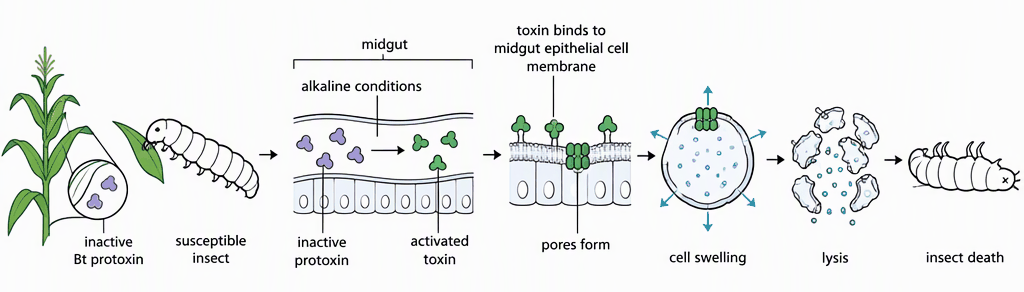
Gene expression in the crop produces the protein; activation occurs after ingestion in the insect gut. Alkaline conditions do not change which cry gene the plant contains.
Cover the answers and write the reversed gene pair, the specificity rule and the toxin-action sequence from memory. Check each against the answers before moving on.
Next step: photograph a doubt on NEET JEEnius AI and photograph any question you are stuck on and get a step-by-step solution across Physics, Chemistry and Biology (20 free a month).
Keep going with Redox Reactions and Electrochemistry NEET 2003: 2.14 V.
Frequently asked questions
What is the correct answer to the Bt crops NEET 2026 question?
Option A, crylAc and crylAb, is correct for the supplied question. Using the question bank’s spellings, these genes encode proteins acting against cotton bollworms and corn borer, respectively.
How does 'respectively' affect the Bt gene answer?
The first gene must match cotton bollworms, and the second must match corn borer. Both positions must be correct; recognising just the first gene is not enough. If the pest order is reversed, the required gene order also reverses.
Why is option B wrong in the Bt crops question?
In the supplied solution, both crylAc and crylIAb are associated with cotton bollworms. Option B therefore fails the second-position check, which requires the corn-borer association, crylAb. Being a Bt toxin gene does not make it suitable for every insect pest.
How is Bt protoxin activated in an insect?
Alkaline conditions in a susceptible insect’s gut activate the inactive Bt protoxin. The active toxin binds to midgut epithelial cells and forms pores, causing cell swelling, lysis and ultimately insect death.