What is the answer to the cloning vectors NEET 2026 pBR322 question?
Tetracycline resistance is lost, while ampicillin resistance remains. In the supplied cloning vectors NEET 2026 question, foreign DNA is ligated into pBR322 at its BamHI restriction site. You must identify which antibiotic resistance the recombinant loses.
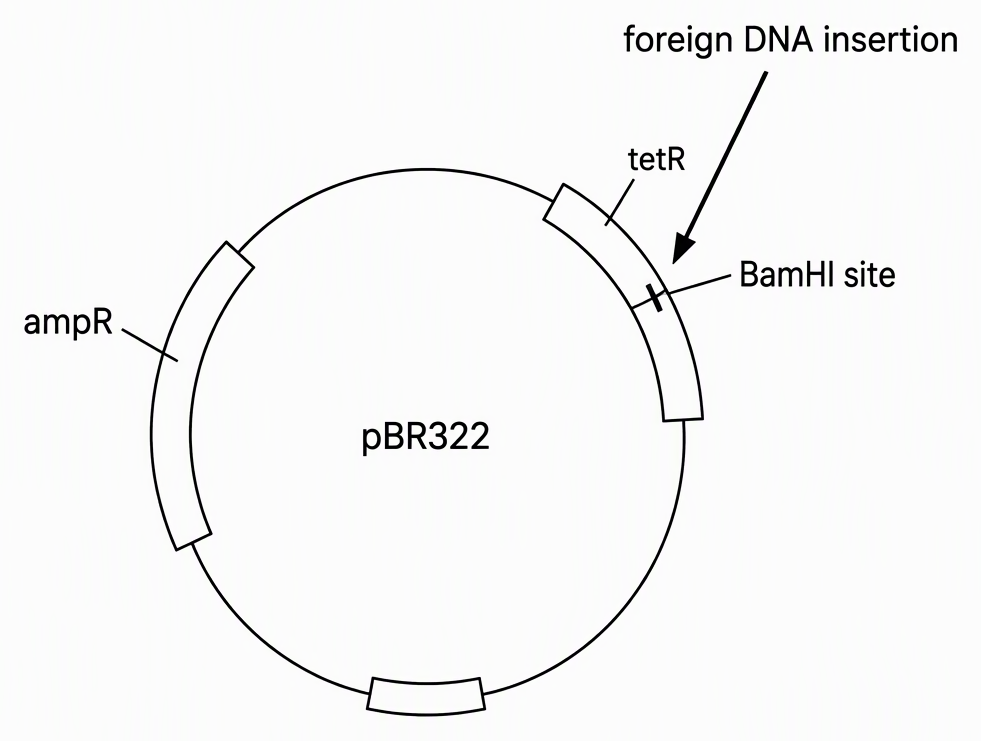
This is NEET 2026, Code-11, Biology, a single-correct question. The question bank classifies it as medium difficulty, not an official exam-wide rating.
Answer: C, tetracycline. The bank’s expected solving time is 30 seconds. Treat that as a target, not a measured student average.
How do I solve the cloning vectors NEET 2026 question step by step?
The BamHI site lies within the tetracycline-resistance gene, so insertion there disables that marker, not ampicillin resistance. Follow the official solution’s insertional-inactivation method: locate the site, identify the disrupted gene, then infer the lost resistance.
- Identify the selectable markers. The two relevant pBR322 markers are ampicillin resistance and tetracycline resistance. Each provides resistance to a different antibiotic.
- Locate BamHI. The insertion site is within the tetracycline-resistance gene, labelled tetR in the schematic.
- Apply insertional inactivation. Ligating foreign DNA at this site disrupts the tetracycline-resistance gene. Loss of gene function through an insertion is called insertional inactivation.
- Infer the lost trait. Tetracycline resistance is lost because its gene is disrupted, not because of the foreign DNA’s identity or supposed function.
- Check the unaffected marker. This insertion does not disrupt the separate ampicillin-resistance gene. Ampicillin resistance therefore remains.
The resulting marker phenotype is AmpR TetS: R means resistant; S means sensitive. An otherwise antibiotic-sensitive E. coli host carrying this recombinant grows on ampicillin but not on tetracycline under the standard selection conditions assumed here.
BamHI within tetR → insertional inactivation → tetracycline resistance lost → option C.
Why is option A a reasoning error?
Option A wrongly treats disruption of one gene as inactivation of every gene on the plasmid. Its faulty argument is: pBR322 carries two resistance genes; foreign DNA interrupts the plasmid; therefore both resistance traits disappear.
Insertional inactivation is gene-specific. The question does not describe destruction of the whole vector.
- Incorrect prediction: AmpS TetS, sensitivity to both antibiotics.
- Correct prediction: AmpR TetS, ampicillin resistance and tetracycline sensitivity.
Before selecting an antibiotic, name the gene containing the insertion site. Do not infer the phenotype from “foreign DNA inserted” alone.
If the following marking scheme applies, the difference between correct and wrong responses is:
That is a five-mark swing between responses, not a five-mark award for the question.
Which antibiotic plate supports growth of this recombinant?
Ampicillin-only medium supports growth. Tetracycline-containing medium does not, because the insertion has disabled tetracycline resistance. This is original chapter practice, not another verified NEET PYQ.
Question: An initially ampicillin- and tetracycline-sensitive E. coli cell receives pBR322 containing foreign DNA at the BamHI site. On which antibiotic-containing medium should it grow?
Answer: A, ampicillin only. First, tetR is disrupted, causing tetracycline sensitivity. Next, ampR remains intact, preserving ampicillin resistance.
A plate containing both antibiotics would not support this recombinant. Tetracycline still prevents growth despite ampicillin resistance.
Can ampicillin alone identify the recombinant colonies?
No. Both intact and recombinant pBR322 can support growth on ampicillin. Assume the host initially lacks both resistance traits and the only relevant vector alteration is the stated BamHI-site insertion.
Original chapter practice: After transformation with a mixture of intact pBR322 and BamHI-site recombinant pBR322, does growth on ampicillin alone distinguish recombinant colonies?
Answer: C, both plasmid types can support growth. Intact pBR322 gives AmpR TetR; the recombinant gives AmpR TetS.
Colonies growing on the ampicillin master plate but failing to grow at corresponding positions after replica plating onto tetracycline show the expected recombinant phenotype. Ampicillin selects plasmid-bearing transformants here; tetracycline sensitivity helps distinguish recombinants. Keep the master plate to recover those colonies.
What happens if only the ampicillin-resistance gene is disrupted?
The phenotype becomes AmpS TetR: ampicillin sensitivity with tetracycline resistance retained. This is an original hypothetical chapter-practice question, not a claim about the BamHI site.
Question: A different insertion disrupts only the ampicillin-resistance gene of pBR322 while leaving the tetracycline-resistance gene functional. What marker phenotype results?
Answer: C, AmpS TetR. Disrupted ampR means loss of ampicillin resistance; functional tetR means tetracycline resistance remains.
In the supplied question, the BamHI insertion disrupts tetR, not ampR. For your next vector question, locate the insertion, identify the affected gene, then predict the phenotype.
Next step: photograph a doubt on NEET JEEnius AI and photograph any question you are stuck on and get a step-by-step solution across Physics, Chemistry and Biology (20 free a month).
Read next: Compounds of Manganese NEET 2026: KMnO₄ Decomposition.
Frequently asked questions
Which antibiotic resistance is lost when foreign DNA is inserted at the BamHI site of pBR322?
Tetracycline resistance is lost because the BamHI site lies within the tetracycline-resistance gene. Insertion disrupts this gene while leaving the ampicillin-resistance gene functional. The recombinant phenotype is AmpR TetS: ampicillin-resistant and tetracycline-sensitive.
What is insertional inactivation in pBR322?
Insertional inactivation is the loss of a gene's function when foreign DNA is inserted within it. In the pBR322 BamHI question, the insertion disables the tetracycline-resistance gene. It does not inactivate every gene on the plasmid.
Can recombinant pBR322 grow on a plate containing both antibiotics?
An initially antibiotic-sensitive E. coli host carrying the BamHI-site recombinant cannot grow on medium containing both ampicillin and tetracycline. Although ampicillin resistance remains, tetracycline sensitivity prevents growth. Ampicillin-only medium supports growth under the stated selection conditions.
How does replica plating identify pBR322 recombinants?
For an initially ampicillin- and tetracycline-sensitive host, both intact pBR322 and the BamHI-site recombinant support growth on an ampicillin master plate. Colonies that fail to grow at corresponding positions after replica plating onto tetracycline show the expected recombinant phenotype, AmpR TetS. Keep the master plate to recover those colonies.