Which statements about Loop of Henle permeability and reabsorption are correct?
The correct choice matches statements a, b and d only. This human physiology question tests whether you separate water reabsorption (descending limb only) from Na+ reabsorption (ascending limb only). After this walkthrough you will evaluate any Loop of Henle statement in under 45 seconds, correctly eliminate the option that wrongly bundles Na+ and water reabsorption, and apply the same method to two related chapter questions.
The question asks which combination of four claims holds up. The claims cover the descending limb being permeable to water but almost impermeable to electrolytes, the filtrate getting concentrated inside the loop, Na+ and water undergoing reabsorption together inside the loop, and the ascending limb carrying out active or passive transport of electrolytes. The four answer choices mix these claims into groups of two or three statements each. Only the choice that selects the first, second, and fourth claims matches the verified facts.
How do you evaluate each statement on loop of Henle permeability and reabsorption?
Start with statement a. The descending limb of Henle’s loop is permeable to water but nearly impermeable to electrolytes, so statement a is correct. Water therefore exits the descending limb into the medullary interstitium and the filtrate becomes more concentrated, confirming statement b.
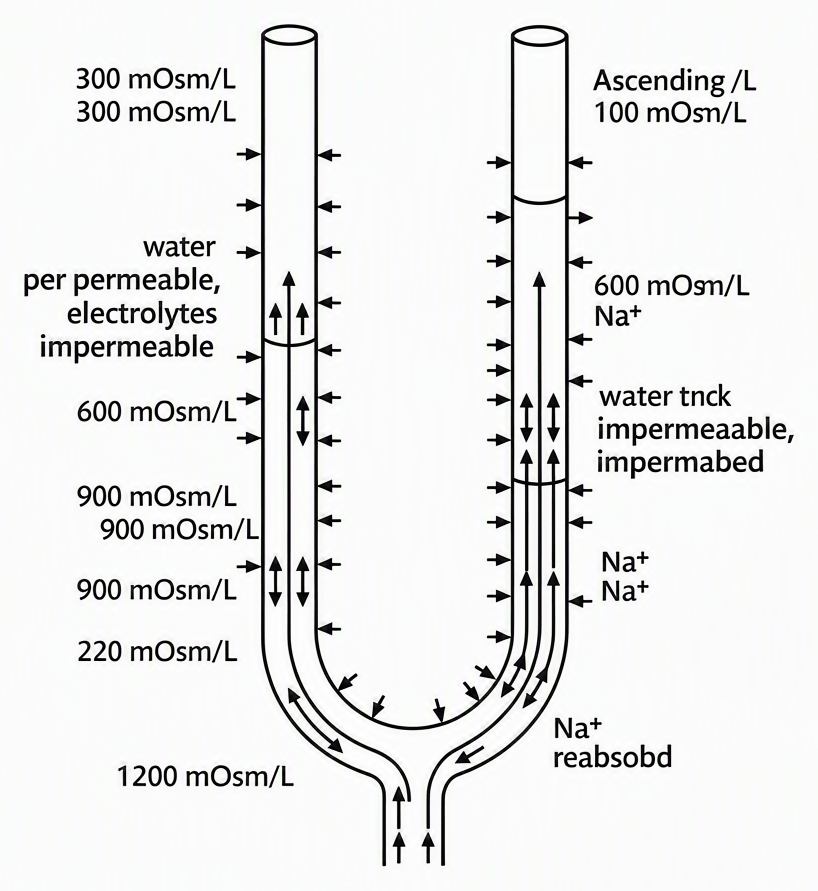
In the ascending limb, Na+ is reabsorbed by passive transport in the thin segment and active transport in the thick segment while water is not reabsorbed, confirming statement d. To see the numbers clearly, consider filtrate entering at 300 mOsm/L: water loss in the descending limb raises it to 1200 mOsm/L at the hairpin bend, then Na+ removal in the ascending limb lowers it below 300 mOsm/L by the time fluid reaches the distal tubule. This matches the official method exactly.
Statement c is false because Na+ and water are not reabsorbed together throughout Henle’s loop: water is reabsorbed mainly in the descending limb, while Na+ is reabsorbed in the ascending limb. Therefore the correct option is the one listing a, b and d only.
What reasoning error produces the wrong option in Loop of Henle questions?
The precise mistake is treating reabsorption of Na+ and water as occurring uniformly across the entire loop instead of separating the two limbs. This leads to marking statement c as true and selecting the option that includes c along with a and b. The error collapses two opposite processes into one vague claim and costs the mark under timed pressure.
You avoid it by checking each limb’s permeability independently before combining statements. Read the exact wording of c, note the phrase “in Henle’s loop” without limb specification, then recall the descending limb handles water only and the ascending limb handles Na+ only. Apply the same split to any similar question and the trap disappears.
What two related questions from kidney physiology test the same concepts?
Practice Question 1 (vasa recta role): The vasa recta maintains the medullary osmotic gradient because it acts as a counter-current exchanger that removes water and solutes without washing out the gradient.
Correct answer: It functions as a counter-current exchanger. One-line explanation: Slow blood flow in vasa recta equilibrates with the interstitium, preserving the 300–1200 mOsm/L gradient created by the loop of Henle.
Practice Question 2 (water reabsorption sites): Maximum obligatory water reabsorption occurs in the proximal convoluted tubule while facultative reabsorption under ADH occurs in the collecting duct. Which statement is correct?
Correct answer: 70–80 % of water is reabsorbed obligatorily in PCT; the rest is facultative. One-line explanation: PCT reabsorbs water passively following solute transport regardless of ADH, whereas collecting duct permeability depends on aquaporins inserted under ADH control.
Use the past-paper archive to search similar kidney questions by chapter and see their worked solutions.
Why does human physiology carry weight in NEET 2026?
Human Physiology is a high-weightage unit within the 90 Biology questions that account for 360 marks. Loop of Henle and urine concentration routinely appear as statement-based MCQs worth 4 marks each.
Students already behind should follow the structured approach in the linked resource. Read the NEET 90 Day Strategy for Students Already Behind and map the loop-of-Henle topic into the remaining timeline so the concepts stay fresh until exam day.
What revision checklist locks Loop of Henle facts for quick recall tonight?
- Descending limb: water permeable, electrolytes impermeable → filtrate concentrates.
- Ascending limb: electrolytes reabsorbed (passive thin + active thick), water impermeable → filtrate dilutes.
- Counter-current multiplier creates medullary osmotic gradient but does not allow simultaneous Na+ and water reabsorption in same segment.
- Urine concentration occurs primarily due to water loss in descending limb and collecting duct under ADH.
Run through this list once before sleep, then test yourself on the two practice questions above. That single pass turns the official wording trap into an automatic elimination the next time you meet it. If a similar doubt appears while revising, photograph the question and get a step-by-step solution.
Next step: photograph a doubt on NEET JEEnius AI and photograph any question you are stuck on and get a step-by-step solution across Physics, Chemistry and Biology (20 free a month).
Frequently asked questions
Which statements about loop of Henle are correct?
Statements a, b and d are correct. The descending limb is permeable to water but nearly impermeable to electrolytes, concentrating the filtrate. The ascending limb reabsorbs Na+ via passive and active transport but is impermeable to water. Statement c is wrong because Na+ and water are not reabsorbed together throughout the loop.
Is Na+ and water reabsorbed together in Henle’s loop?
No. Water is reabsorbed in the descending limb while Na+ is reabsorbed in the ascending limb. The two processes occur in separate segments with opposite permeability. Treating them as simultaneous is the common error that leads students to select the wrong option in NEET questions.
What is the permeability of descending limb of loop of Henle?
The descending limb is permeable to water but almost impermeable to electrolytes. Water exits into the medullary interstitium, raising filtrate concentration from 300 to 1200 mOsm/L at the hairpin bend. This is a core fact tested in human physiology NEET 2026.
Where does maximum obligatory water reabsorption occur?
Maximum obligatory water reabsorption of 70-80% occurs in the proximal convoluted tubule. It is passive and follows solute transport, independent of ADH. Facultative reabsorption under ADH influence occurs later in the collecting duct.