What is the answer to the ecological pyramids NEET 2026 question?
Marine biomass is generally inverted, but pond energy is always upright. This distinction makes D correct in the ecological pyramids NEET 2026 question.
This single-correct Biology question belongs to Ecology and Environment. The question bank tags it medium and gives an expected solving time of 30 seconds.
Which of these combinations of pyramid type and ecosystem generally has an inverted shape?
Correct answer: D, pyramid of biomass in the sea.
What should I identify before deciding whether a pyramid is inverted?
Identify the measured quantity first, then consider the ecosystem. Producers form the base of an ecological pyramid, while consumers occupy successive trophic levels. The pyramid compares these levels using a specific measure.
Keep these three measures separate:
- Number: The count of organisms at each trophic level.
- Biomass: The mass of living material present at each trophic level at a given time.
- Energy: The energy passing through trophic levels over time.
An inverted biomass pyramid means that a smaller standing producer biomass supports a larger consumer biomass. “Standing” means present when measured, rather than everything produced over a period.
The word “aquatic” therefore cannot decide the answer. A biomass pyramid and an energy pyramid describe different quantities, even when both refer to the same water body.
Why are A, B and C wrong, while D is correct?
Only D describes a generally inverted pyramid: biomass in the sea. Follow the official solution’s method by testing each option separately. Do not group the pond and sea options together merely because both are aquatic.
A, number of organisms in grassland: This pyramid is generally upright. Numerous producers support fewer organisms at higher trophic levels. The producer level therefore forms a broad base, so reject A.
B, energy in a pond: An energy pyramid is always upright. Energy available decreases at successive trophic levels because organisms use energy for life processes and dissipate some as heat. Being aquatic does not reverse this loss, so reject B.
C, biomass in grassland: This pyramid is upright because producer biomass exceeds consumer biomass. Grasses and other producers provide its broad base, so reject C.
D, biomass in the sea: Phytoplankton can have a smaller standing biomass than the consumers they support, including zooplankton and fish. This producer-consumer relationship explains the generally inverted marine biomass pyramid.
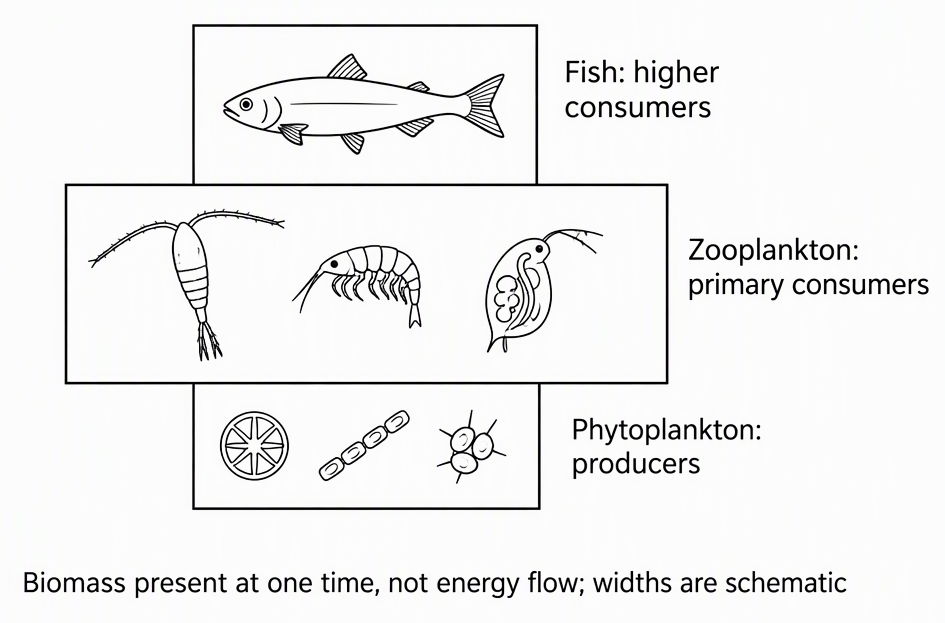
Phytoplankton grow and are replaced rapidly, so their standing stock can remain small while continued production feeds consumers. This explains the biomass comparison; it does not mean every successive consumer level must have more biomass than the level below it.
Final answer: D.
Why does choosing B confuse standing biomass with energy flow?
Choosing B transfers a biomass observation to an energy pyramid. The faulty rule is: “Aquatic pyramids are inverted, so the pond energy pyramid must be inverted.” This applies an observation about standing biomass to a different quantity, energy flow.
Rapid producer replacement explains how a small biomass present now can supply food repeatedly over time. It cannot reverse energy loss between trophic levels. Standing biomass is a snapshot; energy flow tracks transfer over time.
The corrected decision rule is: identify number, biomass or energy first; then consider the ecosystem. Use the question bank’s 30-second expectation as a practice target, not as evidence of actual student performance. Practise identifying the measured quantity before judging the pyramid’s shape.
Can I apply the same distinction to three related Ecology and Environment questions?
Apply the same method: identify the quantity before judging the shape. These are original related practice questions, not verified past-paper questions. Only the main ecological pyramids NEET 2026 question above is supplied as a sourced exam question.
Question 1: Which pyramid remains upright in both terrestrial and aquatic ecosystems?
Answer: C, energy. Energy availability decreases at successive trophic levels. Numbers and biomass can have different orientations depending on the ecosystem, so “all three” is incorrect.
Question 2: What allows phytoplankton with a small standing biomass to support a larger consumer biomass?
Answer: A, rapid growth and replacement. Biomass measured at one moment is not the same as biomass produced over time. Repeated replacement supports consumers without requiring energy to increase or respiration to stop.
Question 3: Which pair is generally upright in grassland?
Answer: A, numbers and biomass. Numerous producers form the base of the numbers pyramid, and their combined biomass exceeds consumer biomass. These are the reasons for rejecting options A and C in the original question.
Before your next attempt, write this distinction from memory: marine biomass is generally inverted; energy pyramids are always upright.
Next step: the past-paper archive on NEET JEEnius AI and search past NEET papers by year, subject or chapter, each with a worked solution (100 free searches a month).
Keep going with Chemical Thermodynamics NEET 2003: Graphite to Diamond.
Frequently asked questions
What is the correct answer to the ecological pyramids NEET 2026 question?
The correct answer is D: the pyramid of biomass in the sea is generally inverted. Grassland numbers and biomass pyramids are generally upright, while the energy pyramid in a pond is always upright.
Why is the biomass pyramid in the sea generally inverted?
Phytoplankton can have a smaller standing biomass than the consumers they support. Their rapid growth and replacement allow this small stock to keep supplying food over time. This does not mean that every successive consumer level must have more biomass than the level below it.
Can the energy pyramid in a pond be inverted?
No, an energy pyramid is always upright, including in a pond. Energy available decreases at successive trophic levels because organisms use energy for life processes and dissipate some as heat.
What is the difference between standing biomass and energy flow?
Standing biomass is the mass of living material present at a trophic level at a given time. Energy flow tracks energy transfer through trophic levels over time. A small standing producer biomass can support larger consumer biomass through rapid replacement, but this cannot reverse energy loss.