Why are C and D correct in gene cloning tools NEET 2025?
The gene cloning tools NEET 2025 question has one official classification: DNA mutase and DNA recombinase are not essential basic enzymes for standard gene cloning. The answer is Option A, C and D only. This was a hard Biology multiple-statement question from NEET 2025, held on 4 May 2025.
Five enzymes are listed:
- A: Restriction enzymes
- B: DNA ligase
- C: DNA mutase
- D: DNA recombinase
- E: DNA polymerase
You must identify the pair not required as basic enzymes in the standard gene-cloning workflow. The word NOT changes which group you select.
The four answer combinations are:
The expected solving time is 75 seconds because this requires five enzyme classifications followed by one option check. No figure is needed because this is a conceptual classification question with no physical arrangement to visualise.
How should each enzyme be tested against the cloning workflow?
Classify all five enzymes before checking the option pairs. Standard gene cloning needs enzymes for three central jobs: cutting DNA, joining DNA fragments and synthesising or amplifying DNA. Restriction enzymes, DNA ligase and DNA polymerase perform these jobs. DNA mutase and DNA recombinase do not belong to this essential basic set.
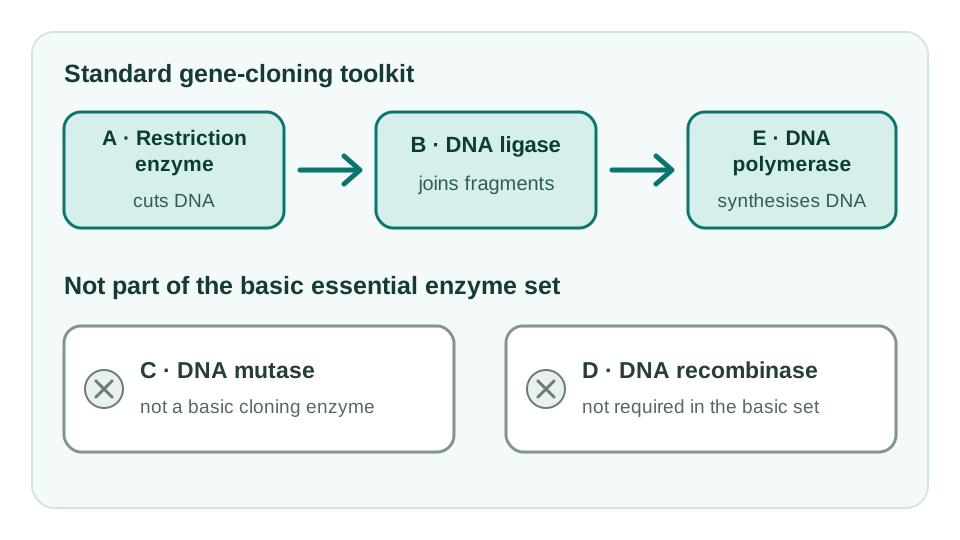
- Enzyme: A, restriction enzymes
Role: They cut DNA at specific recognition sequences, generating the required DNA fragments in standard restriction-based cloning.
Classification: Essential.
- Enzyme: B, DNA ligase
Role: It forms phosphodiester bonds in the sugar-phosphate backbone and joins the DNA insert with vector DNA.
Classification: Essential.
- Enzyme: C, DNA mutase
Role: It is not a basic enzyme required in the standard gene-cloning workflow.
Classification: Not essential. C belongs in the requested set.
- Enzyme: D, DNA recombinase
Role: It participates in recombination and may be used in specialised recombination-based cloning systems.
Classification: Not essential as a basic enzyme for standard cloning. D belongs in the requested set.
- Enzyme: E, DNA polymerase
Role: It performs DNA synthesis and is required in synthesis or amplification steps included in the official cloning framework.
Classification: Essential. E must not enter the non-essential set.
Judge each enzyme by its role in the standard workflow. An enzyme used in a specialised method is not automatically compulsory for standard gene cloning.
How does the word NOT decide the correct option?
The essential group is A, B and E, while the non-essential group is C and D. The question asks for the non-essential group. C and D match Option A, so the final answer is Option A, C and D only.
For the gene cloning tools NEET 2025 question, use this quick-check sequence:
- Cut: Restriction enzyme
- Join: DNA ligase
- Synthesise or amplify: DNA polymerase
Then apply the negative word in the stem:
- Essential: A, B and E
- Not essential: C and D
- Matching option: Option A
Identifying the enzyme functions without reversing the final selection is incomplete because the question asks which enzymes are not essential. Circle or underline NOT before classifying the statements.
How can you divide the expected 75 seconds?
A practical 75-second split is 45 seconds to classify the five enzymes, 15 seconds to match the pair and 15 seconds to check the negative wording. This keeps the final option check separate from the biological classification, where reversal errors occur.
The three essential actions make the classification quick: cut, join and synthesise.
Why is option C, D and E only, incorrect?
Option C, D and E only is incorrect because it excludes DNA polymerase along with DNA recombinase. Polymerase is required for DNA synthesis or amplification in the official cloning framework. Recombinase may operate in specialised systems, but possible use does not make it a basic mandatory tool for standard gene cloning.
Excluding DNA polymerase merely because the recombinant vector later replicates inside a host confuses host replication with the synthesis or amplification steps included in the official cloning framework.
Treating DNA recombinase as essential because its name contains “recombination” causes a second error. Recombinant DNA can be produced through the standard restriction-ligation workflow without DNA recombinase as a basic enzyme.
Use this corrective method:
- Judge each enzyme by its function in the standard workflow.
- Mark it essential or not essential.
- Match the option pair.
- Recheck the word NOT.
“Not essential” does not mean “never used.” Recombinases can have specialised uses without being compulsory for every standard gene-cloning procedure.
Which related gene-cloning questions test the same rule?
These three questions use the same function-first rule: identify what the enzyme does, then decide whether that role is basic or specialised. Answer from the standard cloning workflow, not from every biotechnology method. This approach also helps in DNA-based questions such as the Genetics and Evolution NEET 2021 DNA Probe PYQ.
Which enzyme seals the sugar-phosphate backbone between vector and insert?
Answer: DNA ligase. DNA ligase forms phosphodiester bonds and joins the insert DNA with the vector DNA. It seals breaks in the sugar-phosphate backbone, making it the joining enzyme in the standard gene-cloning workflow.
Which enzyme recognises a specific DNA sequence and cleaves DNA?
Answer: Restriction endonuclease. A restriction endonuclease recognises a specific DNA sequence and cuts DNA at or near that site. This produces the required insert and vector fragments for standard restriction-based cloning.
Does use in a specialised recombination system make an enzyme essential to every cloning procedure?
Answer: No. Possible use and basic necessity are different claims. DNA recombinase can be used in specialised recombination-based cloning, but it is not an essential basic enzyme in the standard workflow used for this NEET question.
Revision rule: Restriction enzyme cuts, ligase joins, polymerase synthesises; mutase and recombinase are not essential basic enzymes in the context of this NEET question.
Frequently asked questions
What is the correct answer to the gene cloning tools NEET 2025 question?
The correct answer is Option A: C and D only. DNA mutase and DNA recombinase are not essential basic enzymes in the standard cloning workflow. Restriction enzymes, DNA ligase and DNA polymerase form the essential group.
Why is DNA recombinase not essential for standard gene cloning?
DNA recombinase is used in specialised recombination-based systems, but standard restriction-ligation cloning does not require it as a basic enzyme. Not essential does not mean that it can never be used.
Is DNA polymerase required for gene cloning?
Yes. In the official framework used for this NEET question, DNA polymerase is required for DNA synthesis or amplification. Therefore, any option placing E in the non-essential set is incorrect.
How do I avoid the NOT-word trap in this question?
Underline NOT before classifying the enzymes. First mark A, B and E as essential, then select the remaining pair, C and D. Recheck the negative wording before submitting the answer.