Why is similarity between placental mammals and Australian marsupials an example of convergent evolution?
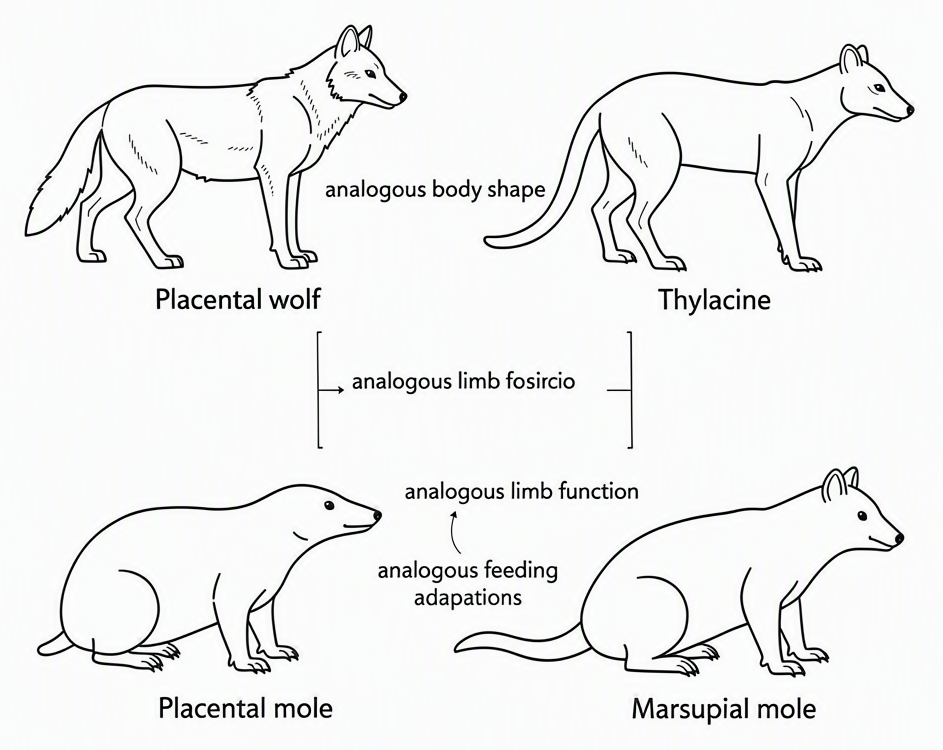
Convergent evolution. Placental mammals and Australian marsupials lived in different geographical areas yet ended up with strikingly similar body forms and functions. The process that produced these similarities between distantly related species after each group underwent its own adaptive radiation is convergent evolution. The four options were divergent evolution, convergent evolution, founder effect, genetic drift.
What does the official NEET solution say about this question?
Placental mammals and Australian marsupials evolved independently in different geographical regions. They developed similar adaptive features because they occupied similar ecological niches. Similarity between unrelated or distantly related groups is called convergent evolution.
Adaptive radiation within each group produced different forms. The resemblance between corresponding placental and marsupial mammals is a classic example of convergent evolution. The correct choice is therefore B.
What reasoning error leads to picking divergent evolution instead?
Treating the phrase "adaptive radiation" as automatically meaning the whole answer must be divergent evolution fails to separate the within-group diversification (adaptive radiation) from the between-group similarity of unrelated lineages (convergent evolution). The method mistake is not first checking whether the similar features are in unrelated species facing identical selection pressures versus related species moving into different niches. Adaptive radiation happened inside each lineage, yet the resemblance across lineages is convergent.
Which Genetics and Evolution questions test the same logic?
Darwin's finches on Galapagos islands show different beak shapes from a common ancestor; this is an example of: (A) convergent evolution (B) divergent evolution (C) genetic drift (D) founder effect.
The correct answer is B. The birds are related, moved into different niches, and developed homologous structures with modified functions. Check relatedness first.
The presence of wings in birds and bats but different bone patterns illustrates: (A) homologous organs and divergent evolution (B) analogous organs and convergent evolution (C) vestigial structures (D) atavism.
The correct answer is B. The wings serve the same flight function yet evolved independently in unrelated groups, producing analogous structures.
A small population of birds colonises an island and shows changed allele frequencies due to limited founders; this is known as founder effect. This is a mechanism of micro-evolution that changes allele frequencies, not an explanation for morphological similarity between distant taxa.
What key distinctions separate convergent evolution from divergent evolution for NEET 2026?
- Convergent evolution: unrelated species, similar niches, analogous structures, e.g., placental and marsupial moles
- Divergent evolution: related species, different niches, homologous structures, e.g., Darwin's finches
- Adaptive radiation is the process that produces diversity within a lineage; it can occur in both convergent and divergent scenarios
- Founder effect and genetic drift are mechanisms of micro-evolution that change allele frequencies, not explanations for morphological similarity between distant taxa
- Expected solving time for such conceptual MCQs is 45 seconds
How should you use this question in your NEET 2026 preparation?
Solve at least three evolution MCQs daily from the past-paper archive focusing on examples from Australian fauna. Search by chapter, mark the ones involving marsupials or isolated populations, and write the first-check (related or unrelated) before looking at options.
Revise the convergent and divergent pair alongside homologous and analogous organs every 15 days. Photograph any doubt on similar questions and get a step-by-step solution. Link this concept to the high-weightage Biology chapter weight in the 90-question paper (360 marks total for Biology).
Next step: the past-paper archive on NEET JEEnius AI and search past NEET papers by year, subject or chapter, each with a worked solution (100 free searches a month).
For a worked example of the same idea, see Chemical Kinetics NEET 2025: First-Order Isomerization Numerical.
Frequently asked questions
Why is similarity between placental mammals and Australian marsupials an example of convergent evolution?
Placental mammals and Australian marsupials lived in different geographical areas but developed similar body forms and functions due to similar ecological niches. They are distantly related, so the similarities are analogous structures produced by convergent evolution after each group underwent adaptive radiation.
What is the difference between convergent evolution and divergent evolution for NEET?
Convergent evolution occurs in unrelated species facing similar selection pressures, producing analogous structures. Divergent evolution occurs in related species moving into different niches, producing homologous structures with modified functions. Check relatedness first before selecting the answer.
Why do students pick divergent evolution for the placental mammals and marsupials NEET question?
Students see the phrase "adaptive radiation" and assume the answer must be divergent evolution. This misses that adaptive radiation happened separately within each lineage while the cross-lineage resemblance in unrelated groups is due to convergent evolution under identical selection pressures.
Are Darwin's finches an example of convergent or divergent evolution?
Darwin's finches are an example of divergent evolution. They share a common ancestor and developed different beak shapes after moving into different ecological niches on the Galapagos, producing homologous structures with modified functions.