What is the correct order in the Plasmodium NEET 2026 question?
Option A is correct for the life cycle of Plasmodium NEET 2026 question: inoculation, transport to liver, liver multiplication, RBC multiplication, then gametocyte formation. This single-correct Biology item belongs to Biology and Human Welfare. Its medium difficulty and 45-second target are question-bank metadata, not official NTA classifications.
Starting with transmission to a human, arrange these five labelled events:
- Stage A: Parasites multiply asexually inside red blood cells (RBCs), followed by cell rupture.
- Stage B: Parasites multiply inside liver cells, which rupture and release parasites into circulation.
- Stage C: Gametocytes form within RBCs.
- Stage D: Sporozoites travel through circulation to the liver.
- Stage E: An infected female mosquito delivers sporozoites during its bite.
The answer choices are:
Stage A is one event; option A is an entire sequence.
Why do the mosquito bite and liver stages come first?
The first three events are stages E, D and B: sporozoites enter the human, travel to the liver and multiply inside liver cells. Blood is the transport route in stage D; RBCs are the intracellular multiplication site in stage A. Track both the parasite’s stage and its location, not just its presence in blood.
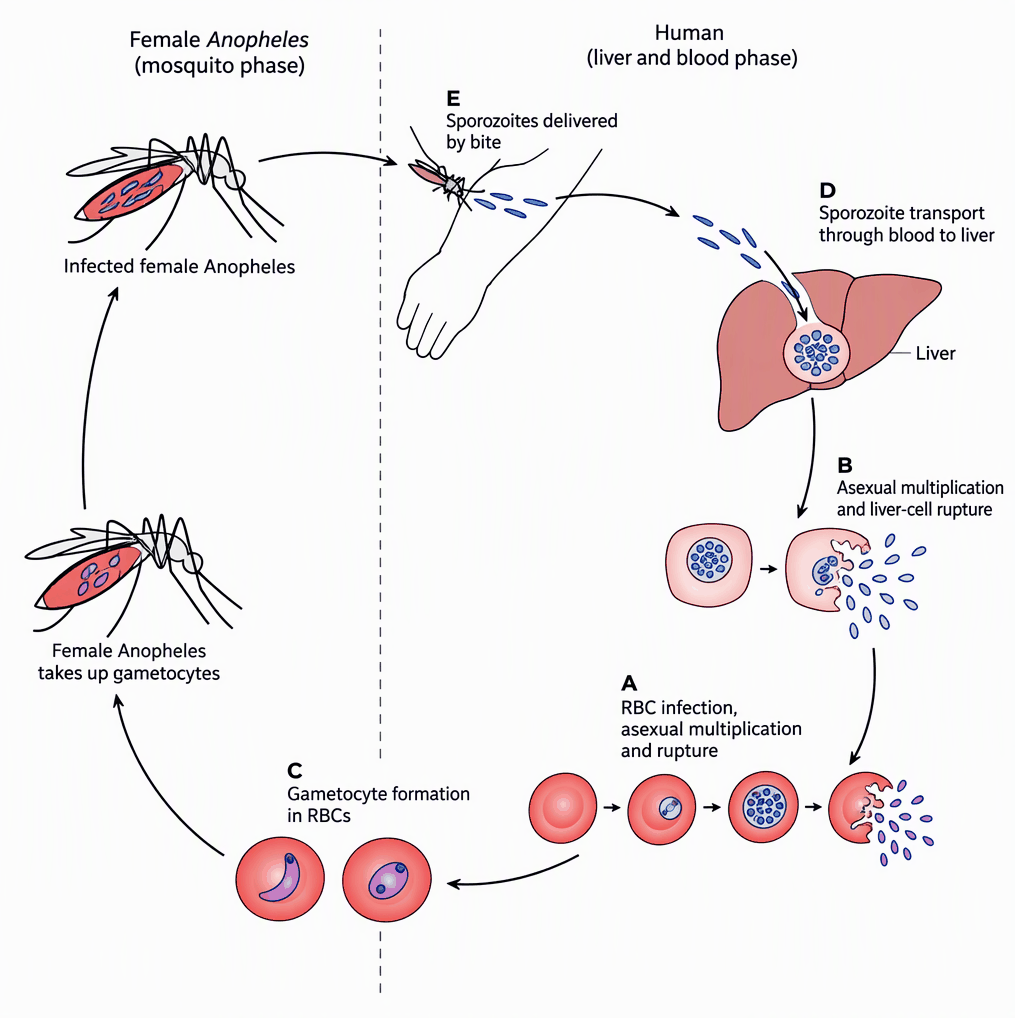
- Step 1, choose stage E. An infected female Anopheles introduces sporozoites into the human host during feeding. This begins the human infection, so it must precede multiplication inside human cells.
- Step 2, place stage D next. Those sporozoites travel through the blood to reach the liver. Being in circulation does not mean they have entered RBCs or begun multiplying there.
- Step 3, append stage B. Parasites must reach and enter liver cells before multiplying asexually there. Liver-cell rupture then releases parasites into circulation, enabling the subsequent RBC phase.
The partial sequence is:
Starting with RBC multiplication or gametocyte formation would omit the initial human infection events. That rules out options B and C without memorising the full letter string.
How do RBC multiplication and gametocytes complete the sequence?
Append stage A, then stage C: option A is correct. This is the developmental ordering of the listed events, not a claim that all parasites finish RBC multiplication together before any gametocytes appear.
- Step 4, append stage A. Parasites released after the liver phase infect RBCs, multiply asexually and cause RBC rupture.
- Step 5, append stage C. Some parasites within RBCs develop into gametocytes rather than continuing through asexual multiplication.
The complete sequence is:
Match each event to its location:
- E: Inoculation into the human.
- D: Transport through blood to the liver.
- B: Multiplication inside liver cells.
- A: Multiplication inside RBCs.
- C: Gametocyte formation inside RBCs.
Gametocytes are sexual stages, but their presence in human RBCs does not mean fertilisation occurs there. Another female Anopheles can ingest them while feeding, after which further sexual development occurs in the mosquito.
If the marking scheme awards four marks for correct option A and deducts one mark for incorrect option D, the score difference is:
That is a five-mark difference between responses, not a five-mark award for the question.
Why is option D wrong if sporozoites already enter the blood?
Option D fails at its first transition: it places gametocyte formation immediately after sporozoite inoculation, before the liver phase. Entering circulation does not turn a sporozoite into a gametocyte. The liver phase must precede the listed RBC events.
The incorrect option D is:
The method error is grouping events by their association with blood instead of checking developmental stage and cellular destination:
- Valid E to D: Inoculated sporozoites travel to the liver.
- Valid B to A: Parasites released after liver multiplication infect RBCs.
- Invalid E to C: Newly inoculated sporozoites cannot skip directly to gametocyte formation in RBCs.
For each arrow, ask: Where is the parasite now, and which listed event must happen before it reaches the next stage? Choose this location-and-stage check over a letter mnemonic because it works even when the stage labels are rearranged.
Can you answer three related questions using stage, site and host?
Use the sequence to check the transmitted stage, the multiplication site and the host that takes up gametocytes. These are original related practice questions, not additional verified NEET PYQs.
Which Plasmodium stage enters humans through an infected female Anopheles?
Sporozoites enter the human host. This is stage E, the starting point of the supplied sequence.
Choose from:
- Sporozoites
- Gametocytes
- Merozoites
- Zygote
Worked explanation: Check the direction of transmission. The infected mosquito delivers sporozoites to a human; a mosquito feeding on an infected human takes up gametocytes.
Where do initial asexual multiplication and gametocyte formation occur in humans?
Liver cells and RBCs, respectively, are the correct pair. “Initial” fixes the first site as liver cells.
Choose from:
- Liver cells/RBCs
- RBCs/liver cells
- Mosquito gut/RBCs
- Liver cells/mosquito gut
Worked explanation: Stage B precedes stages A and C, so liver multiplication comes before the RBC events. Gametocytes form in RBCs; blood transport in stage D is not multiplication.
Which statement correctly describes transmission back to the mosquito?
Gametocytes are taken up by a mosquito feeding on an infected human. This extends the sequence beyond stage C.
Choose from:
- Fertilisation occurs in human RBCs.
- Gametocytes are taken up by a mosquito feeding on an infected human.
- Sporozoites first multiply in human RBCs.
- Liver multiplication follows RBC multiplication.
Worked explanation: Gametocyte formation in human RBCs and subsequent sexual development in the mosquito are distinct events. Formation of a sexual stage is not fertilisation.
Cover the answer choices and reconstruct the five events aloud. Name the parasite’s location at every step.
Next step: the past-paper archive on NEET JEEnius AI and search past NEET papers by year, subject or chapter, each with a worked solution (100 free searches a month).
Read next: Chemical Thermodynamics NEET 2026: Protein Entropy.
Frequently asked questions
What is the correct order of the Plasmodium life cycle in humans?
The listed events occur in this order: sporozoite inoculation, transport to the liver, liver multiplication, RBC multiplication and gametocyte formation. In the supplied question, this is E → D → B → A → C, making option A correct. This developmental order does not mean all parasites complete RBC multiplication together before any gametocytes appear.
Which stage of Plasmodium enters humans through a mosquito bite?
An infected female Anopheles introduces sporozoites into the human host during feeding. These sporozoites travel through circulation to the liver before the listed RBC events occur.
Where does Plasmodium first multiply asexually in humans?
Initial asexual multiplication occurs inside liver cells. Liver-cell rupture releases parasites into circulation, enabling the subsequent RBC phase. Transport through blood is not the same as multiplication inside RBCs.
Where are Plasmodium gametocytes formed?
Gametocytes form within human RBCs when some parasites develop into sexual stages rather than continuing asexual multiplication. A female Anopheles can ingest these gametocytes while feeding on an infected human. Further sexual development occurs in the mosquito; gametocyte formation is not fertilisation.