What is the answer to optical isomerism in alkanes NEET 2001?
A, 2,3-dimethylpentane, is correct because carbon-3 has four different attached groups. The optical isomerism in alkanes NEET 2001 question requires both the correct molecular formula and a structure that can exhibit optical isomerism.
The stem asks which listed compound can exhibit optical isomerism and has this formula:
This belongs to Some Basic Principles of Organic Chemistry. The question bank labels it hard on its difficulty scale and gives 60 seconds as its expected solving time, not a measured student average.
Why is carbon-3 in 2,3-dimethylpentane chiral?
Carbon-3 has four different attached groups. The parent chain has five carbons, with methyl branches at C2 and C3; for these simple alkanes, test whether a tetrahedral carbon carries four different groups. Compare the groups attached to each candidate carbon, not just the number of branches.
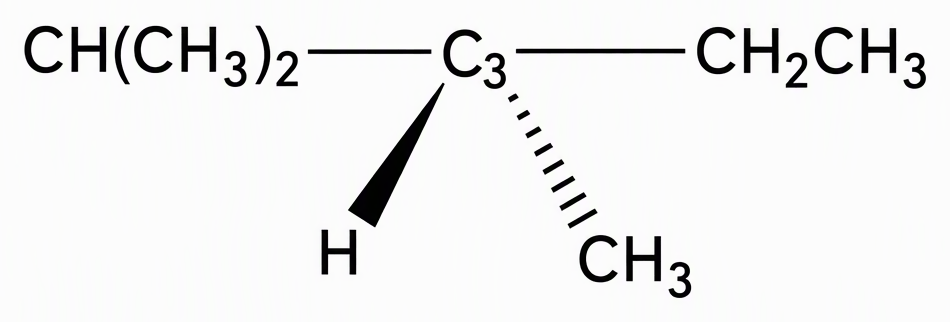
The condensed structure, with parent-chain carbons numbered from left to right, is:
First, verify the formula. Five parent-chain carbons plus two methyl carbons give:
Count the hydrogens on the five parent-chain carbons, then on the two branches:
The formula therefore matches:
Now inspect C3. Its four directly attached groups are hydrogen, methyl, ethyl and isopropyl:
The three carbon-containing groups begin with the same element, but they are not the same group. Exclude the bond back to C3 and inspect what each first carbon carries:
- Methyl: hydrogen, hydrogen, hydrogen.
- Ethyl: carbon, hydrogen, hydrogen.
- Isopropyl: carbon, carbon, hydrogen.
That first outward comparison distinguishes all three carbon-containing groups. Along with hydrogen, they give four different groups, so C3 is a chiral centre and the compound can exhibit optical isomerism.
This does not mean every sample rotates plane-polarised light. An equal mixture of the two enantiomers has no net optical rotation.
Why are the other three options incorrect?
B fails both the molecular-formula check and the chiral-carbon check. C has the required formula but lacks a chiral centre, while D fails because A satisfies both conditions.
B) 2,2-dimethylbutane has the structure:
Four parent-chain carbons plus two methyl carbons give six carbons. Counting hydrogens confirms:
C2 also carries three identical methyl groups. Every other carbon is a methylene or methyl carbon, with repeated hydrogens, so none can carry four different groups.
C) 2-methylhexane has the structure:
Its carbon and hydrogen counts give the required formula:
At C2, the four groups are:
The two methyl groups are identical. All remaining carbons are methylene or methyl carbons, so there is no alternative chiral centre.
A satisfies both requirements; B fails both; C lacks a chiral centre. Therefore, D is incorrect.
How can an incomplete group comparison lead to “none of the above”?
A student can falsely reject A by seeing hydrogen and three carbon atoms at C3, then treating all three carbon-containing substituents as identical. After correctly eliminating B and C, that incomplete comparison can lead to D. The error is comparing only the directly bonded elements, not the complete attached groups.
Move outward until the groups first differ. Excluding the bond back to C3, the first carbon in each group carries:
These groups differ at the atoms attached to their first carbon. No ranking or configuration assignment is needed.
Within A, C2 is not chiral because it has two methyl groups, but C3 is chiral. Finding one non-chiral branch point does not settle the whole molecule; inspect the next candidate.
How do you apply the four-group test to three more alkanes?
Expand each name, identify candidate carbons and compare their complete attached groups. These are original related practice questions, not verified past-paper questions. Check the group lists before reading each conclusion.
1. Can 3-methylhexane exhibit optical isomerism?
C3 carries hydrogen, methyl, ethyl and n-propyl groups. All four differ, so yes, C3 is chiral and the compound can exhibit optical isomerism.
The four groups at C3 are:
Ethyl and n-propyl initially look alike because both begin with a methylene carbon. Trace outward: the n-propyl chain continues one carbon farther.
2. Does 3-ethylpentane have a chiral centre?
The candidate C3 carries hydrogen and three identical ethyl groups, so no, it is not chiral. Every other carbon has repeated hydrogens, leaving no alternative candidate.
The four groups at C3 are:
One ethyl group is written as a branch; the other two lie along the parent chain. That naming choice does not make the groups different.
3. Does 2,3-dimethylbutane become chiral because it has two branched methine carbons?
C2 and C3 each carry hydrogen, two methyl groups and an isopropyl group. Each candidate therefore has two identical groups, so no, neither is a chiral centre and the compound is achiral.
Each candidate has this attached-group set:
Two branch points do not fix a repeated-group failure. Use this routine: expand the name, check the required formula, inspect candidate carbons, and compare all four groups.
Next step: the past-paper archive on NEET JEEnius AI and search past NEET papers by year, subject or chapter, each with a worked solution (100 free searches a month).
If that step was the hard part, work through Mean Free Path NEET 2026: Number Density Ratio Explained.
Frequently asked questions
What is the answer to the optical isomerism in alkanes NEET 2001 question?
Option A, 2,3-dimethylpentane, is correct. It has the required molecular formula, C7H16, and carbon-3 carries four different groups, allowing the compound to exhibit optical isomerism.
Why is carbon-3 chiral in 2,3-dimethylpentane?
Carbon-3 is attached to hydrogen, methyl, ethyl and isopropyl groups. These are four different groups, so it is a chiral centre. Carbon-2 is not chiral because it carries two identical methyl groups.
Why does 2-methylhexane not show optical isomerism?
Although 2-methylhexane has the required formula C7H16, carbon-2 carries two identical methyl groups. Every other carbon has repeated hydrogens, so the molecule has no chiral centre.
Does every sample of 2,3-dimethylpentane rotate plane-polarised light?
No, having a chiral centre does not mean every sample shows net optical rotation. An equal mixture of the two enantiomers has no net optical rotation because their rotations cancel.