Which butyl chloride fits both clues in the 2001 question?
Option A, t-butyl chloride, is correct because its coupled hydrocarbon has only one hydrogen environment. The organic compounds containing halogens NEET 2001 question tests monochlorination of the Wurtz product, not the starting chloride.
A chloride with the following molecular formula reacts with sodium in dry diethyl ether:
The resulting hydrocarbon gives just one derivative when one hydrogen is replaced by chlorine. Choose the starting chloride:
This 2001 question belongs to Organic Compounds Containing Halogens. “Hard” is the question bank’s difficulty classification, not an official exam rating.
How do you construct the Wurtz product of t-butyl chloride?
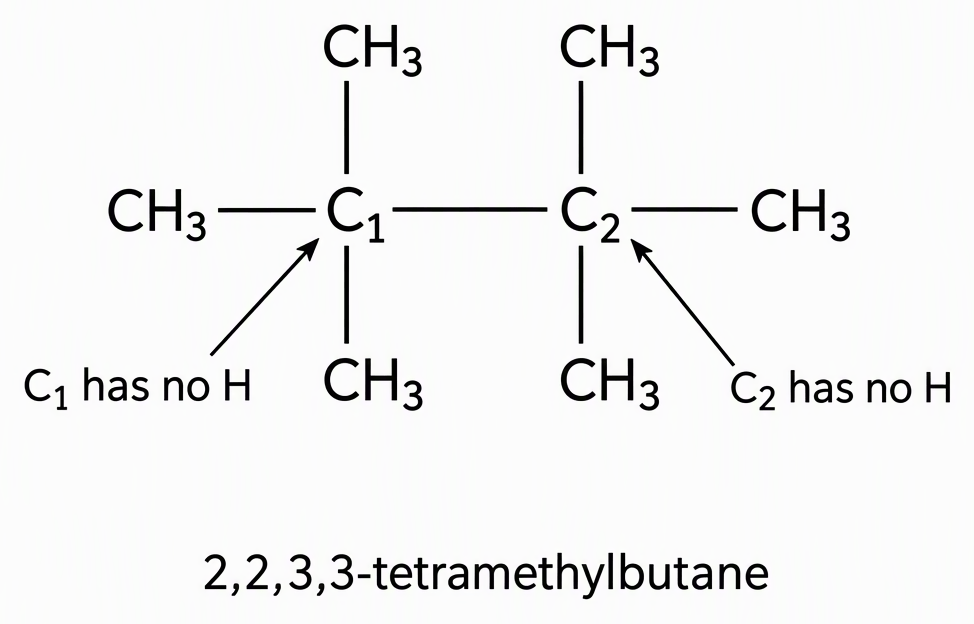
In t-butyl chloride, chlorine is attached to a carbon bonded to three methyl groups. Formal Wurtz coupling joins two such central carbons, producing 2,2,3,3-tetramethylbutane. Keep all three methyl groups attached to each central carbon; replace the two carbon–chlorine bonds with one carbon–carbon bond.
The general Wurtz equation uses sodium in dry diethyl ether:
Here, the alkyl fragment is:
Substitution gives the balanced equation used in the supplied solution:
Check the skeleton before counting products. There are two central carbons and six methyl carbons:
The hydrocarbon formula is therefore:
Do not join two methyl ends instead: the new bond must connect the carbons that originally carried chlorine. That attachment rule determines the skeleton.
Practical chemistry caveat: tertiary halides can undergo competing elimination. This question uses formal Wurtz coupling; its solution does not establish that preparative coupling of tertiary halides is universally clean.
Why does this hydrocarbon give only one monochloro derivative?
All 18 hydrogens belong to one equivalent environment, so replacing any one of them with chlorine gives the same constitutional product. Each central carbon already has four carbon–carbon bonds, so neither carries hydrogen.
All six methyl groups are symmetry-equivalent. The three hydrogens within each methyl group are also equivalent for this product count.
The hydrogen count is:
But the number of hydrogen environments is:
Replacing one hydrogen gives:
Verify the new hydrogen count and formula:
Monochlorination means one substitution per molecule, not chlorination of every methyl group. Choosing a different equivalent methyl group does not create a different constitutional product.
The other options fail after coupling:
Each alternative has more than one hydrogen environment; no stereoisomer count is needed to reject them. Only t-butyl chloride satisfies the stated condition, so option A is correct.
Why is choosing iso-butyl chloride from its branching a mistake?
Option C fails because branching does not prove hydrogen equivalence. Its formal coupling product has symmetry, but that symmetry does not make a methyl hydrogen equivalent to a methylene or methine hydrogen.
For iso-butyl chloride, coupling gives:
This is 2,5-dimethylhexane. It contains three different kinds of hydrogen-bearing carbon:
- Methyl: a carbon carrying three hydrogens.
- Methylene: a carbon carrying two hydrogens.
- Methine: a carbon carrying one hydrogen.
Those distinct environments already rule out a single monochloro derivative. In contrast, the correct product has no central-carbon hydrogens; every hydrogen belongs to an equivalent methyl group.
Use this corrective sequence:
- Draw the coupled product.
- Mark every hydrogen-bearing carbon.
- Test which positions are equivalent, rather than judging the overall shape.
What does 1-chloropropane form, and how many monochloro products follow?
Wurtz coupling of 1-chloropropane forms n-hexane, which gives three constitutional monochloro derivatives. Reversing the numbering pairs equivalent positions, but it does not make every position along the chain equivalent.
Original practice question, not another verified PYQ: When 1-chloropropane undergoes Wurtz coupling, what hydrocarbon forms and how many constitutional monochloro derivatives can it produce?
The reaction in dry ether is:
Number the n-hexane chain from either end. Equivalent positions pair as:
Each pair gives one constitutional product:
- 1-chlorohexane
- 2-chlorohexane
- 3-chlorohexane
Thus, six carbon positions reduce to three substitution environments. Do not count stereoisomers separately, because the question asks for constitutional products.
Which products are possible when chloromethane and chloroethane react together?
Ethane, propane and butane are the three possible coupling hydrocarbons. A mixed Wurtz reaction allows both self-coupling and cross-coupling, so writing propane alone leaves out two possible products.
Original practice question from the same chapter: Which coupling hydrocarbons are possible when chloromethane and chloroethane react together with sodium in dry ether?
List every fragment pairing:
- Methyl–methyl: gives ethane by self-coupling.
- Methyl–ethyl: gives propane by cross-coupling.
- Ethyl–ethyl: gives butane by self-coupling.
The presence of two different chlorides does not force every methyl fragment to couple with an ethyl fragment. This list identifies possible products; it does not imply equal yields or assign percentages.
Revision rule: identify the alkyl fragments first, construct the coupling product or products second, and only then analyse hydrogen equivalence.
Next step: the past-paper archive on NEET JEEnius AI and search past NEET papers by year, subject or chapter, each with a worked solution (100 free searches a month).
Read next: Kinematics NEET 2026: Average Speed with Direction Reversal.
Frequently asked questions
Which butyl chloride is correct in the NEET 2001 Wurtz reaction question?
Option A, t-butyl chloride, is correct. Its formal Wurtz product is 2,2,3,3-tetramethylbutane, whose 18 hydrogens are equivalent, giving one constitutional monochloro derivative. The question assumes formal coupling; tertiary halides can undergo competing elimination in practice.
Why is iso-butyl chloride not the correct answer?
Formal Wurtz coupling of iso-butyl chloride gives 2,5-dimethylhexane. This product contains distinct methyl, methylene and methine hydrogen environments, so it cannot give just one constitutional monochloro derivative. Branching alone does not establish hydrogen equivalence.
How many monochloro products does the Wurtz product of 1-chloropropane give?
Wurtz coupling of 1-chloropropane forms n-hexane. Its equivalent carbon positions pair as C1/C6, C2/C5 and C3/C4, giving three constitutional monochloro derivatives: 1-chlorohexane, 2-chlorohexane and 3-chlorohexane. Stereoisomers are not counted separately in this constitutional product count.
What products form in a mixed Wurtz reaction of chloromethane and chloroethane?
The possible coupling hydrocarbons are ethane, propane and butane. Methyl–methyl and ethyl–ethyl self-coupling give ethane and butane, while methyl–ethyl cross-coupling gives propane. These possibilities do not imply equal yields.