What is the correct answer to the phases of plant growth NEET 2026 question?
D: Large conspicuous nuclei is correct because this feature characterises the meristematic phase, not elongation. This phases of plant growth NEET 2026 question is a Biology, Plant Physiology, single-correct item.
Identify the cell feature that does not characterise the elongation phase of plant growth.
The question bank classifies it as medium difficulty, not an official NEET difficulty rating. Its supplied target solving time is 30 seconds, not a measured student average. Focus on “does not”: select the exception, not a recognised elongation feature.
Which features belong to elongation and which belong to the meristematic phase?
The official solution assigns new cell wall deposition, increased vacuolation and cell enlargement to elongation. It assigns large, conspicuous nuclei to the meristematic phase. These feature-to-phase matches are the rule needed here; hormones and growth-rate explanations are not needed.
A characteristic identifies a phase. It is not simply something that a cell possesses: elongating cells still contain nuclei, but large, conspicuous nuclei are the identifying feature assigned to meristematic cells in this question.
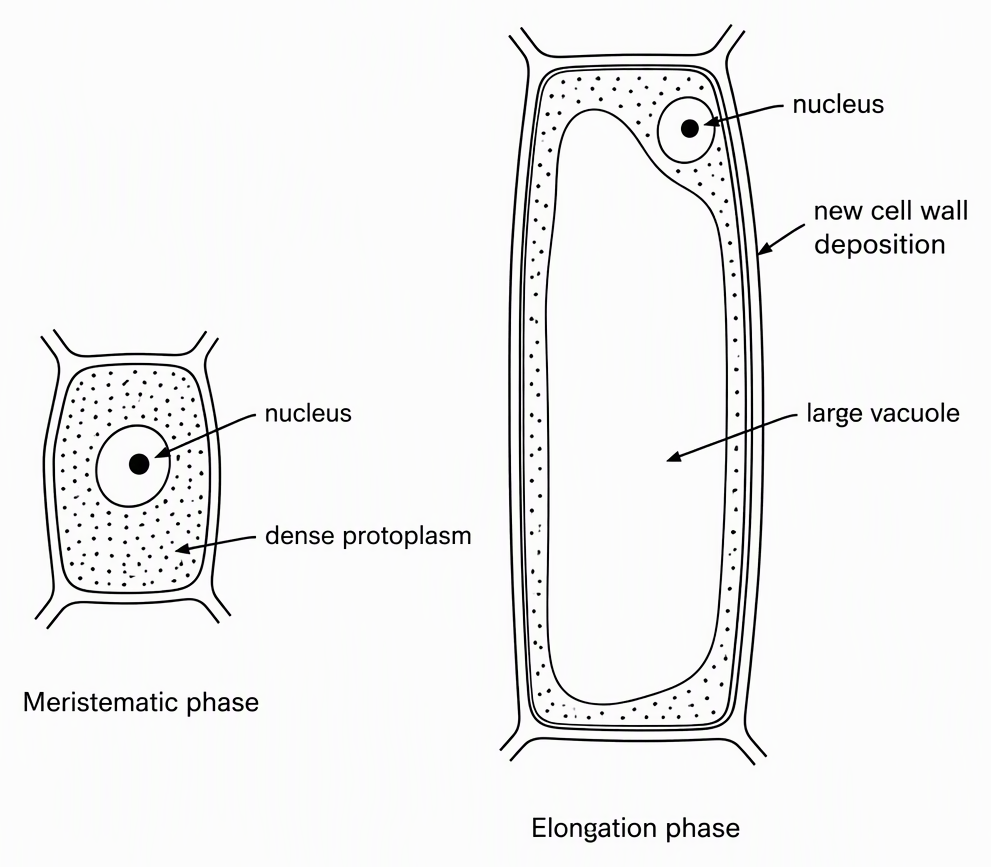
Use this checklist before selecting the exception:
- Elongation: new wall deposition, increased vacuolation, enlargement.
- Meristematic: large, conspicuous nuclei.
Match the whole feature, not just the word “nuclei.” This is conceptual classification: no algebra, numerical calculation or spatial arrangement is needed.
How do you check all four options against the negative stem?
A, B and C match elongation; D does not. Therefore, D is the requested exception. Keep two decisions separate: whether the feature belongs to elongation, and whether it answers a stem containing “not.”
Check each option in the same order: feature, official phase association, decision under the negative stem.
Correct answer: D: Large conspicuous nuclei. A, B and C are true elongation features but incorrect answers to this negatively worded question.
Elongation means enlargement, increased vacuolation and new wall deposition. Conspicuous nuclei point to the meristematic phase.
Why would choosing A be a method mistake?
Choosing A would replace the phase checklist with an unjustified “only” rule. A hypothetical faulty argument is: “New cell wall deposition happens only when cells divide, so it cannot belong to elongation.” That confuses wall formation associated with division with wall-material deposition during subsequent growth.
An association with division does not make wall deposition exclusive to division. The official solution explicitly lists new cell wall deposition as an elongation-phase characteristic.
The method error is making an exclusive phase assignment from a remembered association instead of checking the stated feature. Use this corrective routine:
- Notice the negative stem.
- Classify each feature.
- Choose the mismatch.
For marking only, if choosing D earns four marks and choosing A loses one mark, the difference is:
This calculation is conditional on that marking scheme. It is not part of the biological solution.
How can you apply the method to related Plant Physiology questions?
Match the full feature set to a phase, then check whether the question asks for a match or an exception. These are original related practice questions, not additional verified NEET PYQs. Test the reasoning rather than memorising option D.
Question 1: A cell has dense protoplasm and a large conspicuous nucleus. Which growth phase does this feature set indicate?
Answer: B, Meristematic. Dense protoplasm and a large, conspicuous nucleus identify meristematic cells. Match these stated features directly; the general fact that a cell is living or growing does not identify its growth phase.
Question 2: After elongation, cells reach their maximal size and develop structural features suited to their functions. Which phase is described?
Answer: C, Maturation. Maximal size and functional differentiation indicate maturation. The stem describes the state after elongation, not simply an increase in cell size.
Do not select B from the word “size” alone. Read it together with “maximal” and the development of function-specific structures.
Question 3: Which feature–phase pairing is incorrect?
Answer: C. Large, conspicuous nuclei belong with the meristematic phase in this classification. A and B correctly match elongation, while D correctly matches meristematic cells.
This is another negative stem: select the false pairing, not a familiar true one. The answer letter changes, but the biological rule does not.
Without looking back, name the three elongation-phase features, then check that your list contains all three.
Next step: photograph a doubt on NEET JEEnius AI and photograph any question you are stuck on and get a step-by-step solution across Physics, Chemistry and Biology (20 free a month).
Related on NEET JEEnius AI: Oxidation states NEET 2026: Decreasing order explained.
Frequently asked questions
Which feature does not characterise the elongation phase of plant growth?
Large, conspicuous nuclei do not characterise the elongation phase; they identify the meristematic phase. In the supplied question, D is correct because the stem asks for the exception.
What are the three features of the elongation phase?
The elongation phase is characterised by cell enlargement, increased vacuolation and new cell wall deposition. Large, conspicuous nuclei belong to the meristematic feature checklist instead.
Does new cell wall deposition occur during elongation?
Yes, new cell wall deposition is an elongation-phase characteristic in the supplied solution. Associating wall formation with cell division does not make wall-material deposition exclusive to division.
What is the difference between elongation and maturation in plant growth?
Elongation involves cell enlargement, increased vacuolation and new wall deposition. In maturation, cells reach their maximal size and develop structural features suited to their functions.