What is the correct option in the three-cell photoelectric effect NEET 2026 question?
The official intended answer to the photoelectric effect NEET 2026 question is A: cell 1 does not emit, while cell 3 has a greater stopping-potential magnitude than cell 2. Check emission first, then compare the emitted electrons’ maximum kinetic energies.
Three separate photoelectric cells, labelled 1, 2 and 3, receive light of the same wavelength. Each cell has its own threshold wavelength and stopping-potential magnitude, with matching subscripts identifying the cell; the incident wavelength has no subscript.
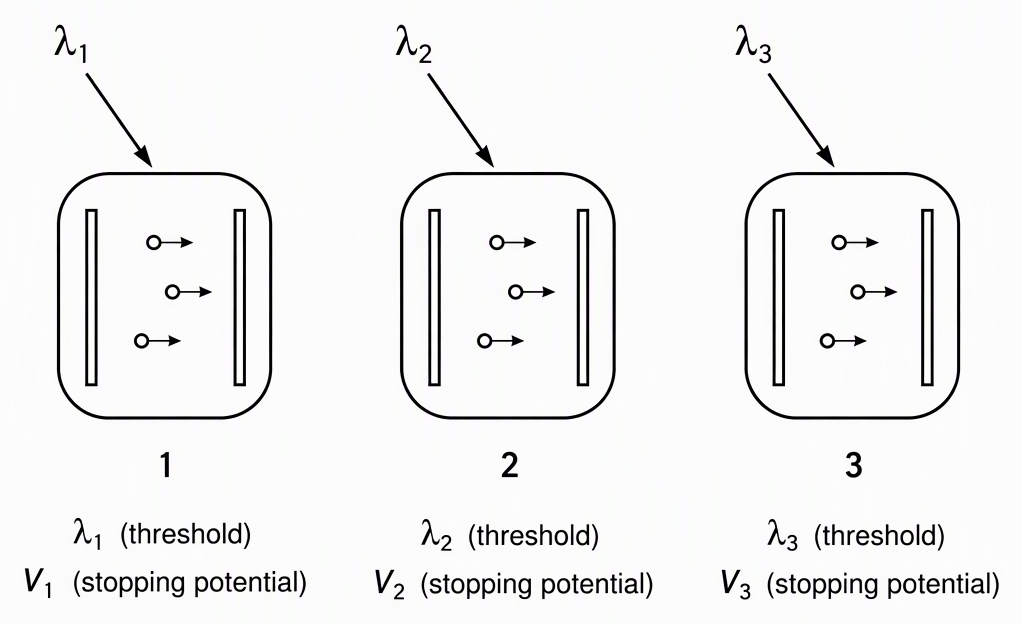
The supplied relations and options are:
- A
- B
- C
- D
The chapter is Dual Nature of Matter and Radiation, and the question-bank difficulty is medium. The expected solving time is 90 seconds, based on an emission check and a comparison without numerical calculation, not an official time allowance.
Why does cell 1 not emit photoelectrons?
Its incident wavelength is longer than its threshold wavelength, so each photon carries less energy than the work function. Check emission before substituting into the stopping-potential equation. Otherwise, a negative algebraic result may be mistaken for a physical stopping-potential magnitude.
Incident photon energy and work function are:
The subscript-zero wavelength is the threshold wavelength. Planck’s constant and the speed of light have their usual symbols; the charge symbol in Einstein’s equation denotes the positive elementary charge.
Emission requires photon energy at least equal to the work function:
The last step follows because wavelengths are positive. For emitted photoelectrons, Einstein’s equation gives:
For cell 1:
The photon cannot supply the work function, so no photoelectric emission occurs. In the question’s convention:
There is no photocurrent to stop. A negative result from substitution is not a stopping-potential magnitude.
Why does the official solution put cell 3 above cell 2?
The official solution treats cell 3 as having a larger threshold wavelength than cell 2. That gives cell 3 a smaller work function and leaves more of the identical incident photon energy as electron kinetic energy. Its stopping-potential magnitude is therefore greater.
For cell 2, the incident wavelength is shorter than its threshold wavelength, so emission occurs:
Cell 3 also emits because its threshold wavelength is much larger than the incident wavelength. Threshold frequency and work function both decrease as threshold wavelength increases:
Under the official solution’s intended comparison:
The incident photon energy is identical for both cells. Subtracting their respective work functions gives:
Therefore:
The algebraic check makes the required ordering explicit:
Precision note: the supplied relations say that one threshold exceeds the incident wavelength and another greatly exceeds it. They do not, by themselves, rigorously order the two thresholds against each other. The official solution uses the intended larger-threshold comparison for cell 3.
The official intended answer is A:
What mistaken method leads to option B?
Option B reverses the comparison between the two emitting cells. One route to it is treating a larger threshold wavelength as a larger work function, then subtracting more energy for cell 3. The subtraction method is right, but the assumed relationship is wrong.
The option being analysed is:
The correct proportionality is:
Under the intended ordering:
- Larger threshold wavelength means smaller work function.
- Smaller work function leaves greater maximum kinetic energy at fixed incident wavelength.
- Greater maximum kinetic energy requires greater stopping potential.
Write the reciprocal relationship before comparing the cells. This keeps the work-function ordering, and therefore the stopping-potential ordering, correct.
Can you apply the method to three related questions?
Check emission first in each case, then calculate or compare maximum kinetic energy. These are original practice questions from Dual Nature of Matter and Radiation, not verified past-paper questions. Try each before reading its answer check.
1. Light arrives exactly at the threshold wavelength. What are the maximum kinetic energy and stopping potential?
The photon just supplies the work function:
This is the ideal threshold-emission limit, with zero maximum kinetic energy. Cell 1 is different: its photons lack enough energy to release electrons.
2. Two cells have the following threshold and incident wavelengths. Which has the greater stopping potential?
Both emit because the incident wavelength is shorter than both threshold wavelengths. Subtracting their stopping potentials gives:
Cell b therefore has the greater stopping potential. For a worked numerical check, choose:
Then:
3. The incident wavelength stays fixed below the threshold wavelength, but intensity increases. Does stopping potential increase?
No. Photon energy and maximum kinetic energy remain unchanged, so stopping potential remains unchanged. Greater intensity supplies more photons per second, increasing photocurrent under otherwise fixed conditions.
Next, practise converting wavelength into momentum rather than energy: Dual Nature NEET 2026: Electron-to-Photon Momentum Ratio.
Frequently asked questions
What is the answer to the three-cell photoelectric effect NEET 2026 question?
The official intended answer is A: V₁ = 0 and V₂ < V₃. Cell 1 does not emit because its incident wavelength exceeds its threshold wavelength. The comparison V₃ > V₂ assumes that cell 3 has a larger threshold wavelength than cell 2; the supplied inequalities alone do not rigorously establish that ordering.
Can stopping potential be negative if no photoelectrons are emitted?
A negative result from Einstein’s equation is not a physical stopping-potential magnitude. If the incident wavelength exceeds the threshold wavelength, photon energy is below the work function and no photoelectrons are emitted. There is no photocurrent to stop, so this question uses V₁ = 0.
Why does a larger threshold wavelength give a greater stopping potential?
Work function is inversely proportional to threshold wavelength: φ = hc/λ₀. For two emitting cells receiving the same incident wavelength, the cell with the larger threshold wavelength has the smaller work function. Its electrons therefore have greater maximum kinetic energy and require a greater stopping-potential magnitude.
Does increasing light intensity increase stopping potential?
No, provided the incident wavelength stays fixed below the threshold wavelength. Photon energy and maximum photoelectron kinetic energy remain unchanged, so stopping potential stays unchanged. Greater intensity supplies more photons per second and increases photocurrent under otherwise fixed conditions.