Plant Growth Regulators NEET 2025: Hard PYQ Solved
The verified answer to the Plant Growth Regulators NEET 2025 question is option A, statements A, B and C only. This Plant Physiology question appeared in the NEET 2025 Biology paper held on 4 May 2025. It is tagged hard, and its listed expected solving time is 90 seconds.
The task is to check five claims involving:
- Auxin-induced seedless fruit formation
- Promotion and inhibition by plant growth regulators
- Dedifferentiation followed by redifferentiation
- ABA as a promoter or inhibitor
- Apical dominance and lateral-bud growth
The absent option entries should not be reconstructed or guessed.
How do you check each statement in the full worked solution?
Check each claim separately for its direction of effect. Statements A, B and C agree with the underlying NCERT concepts. Statements D and E reverse the recognised actions of ABA and apical dominance. This statement-by-statement audit is safer than choosing an option through hormone-name recall.
Why is statement A correct?
Statement A is correct. Auxins can induce parthenocarpy, which means fruit development without fertilisation. Use this fixed association:
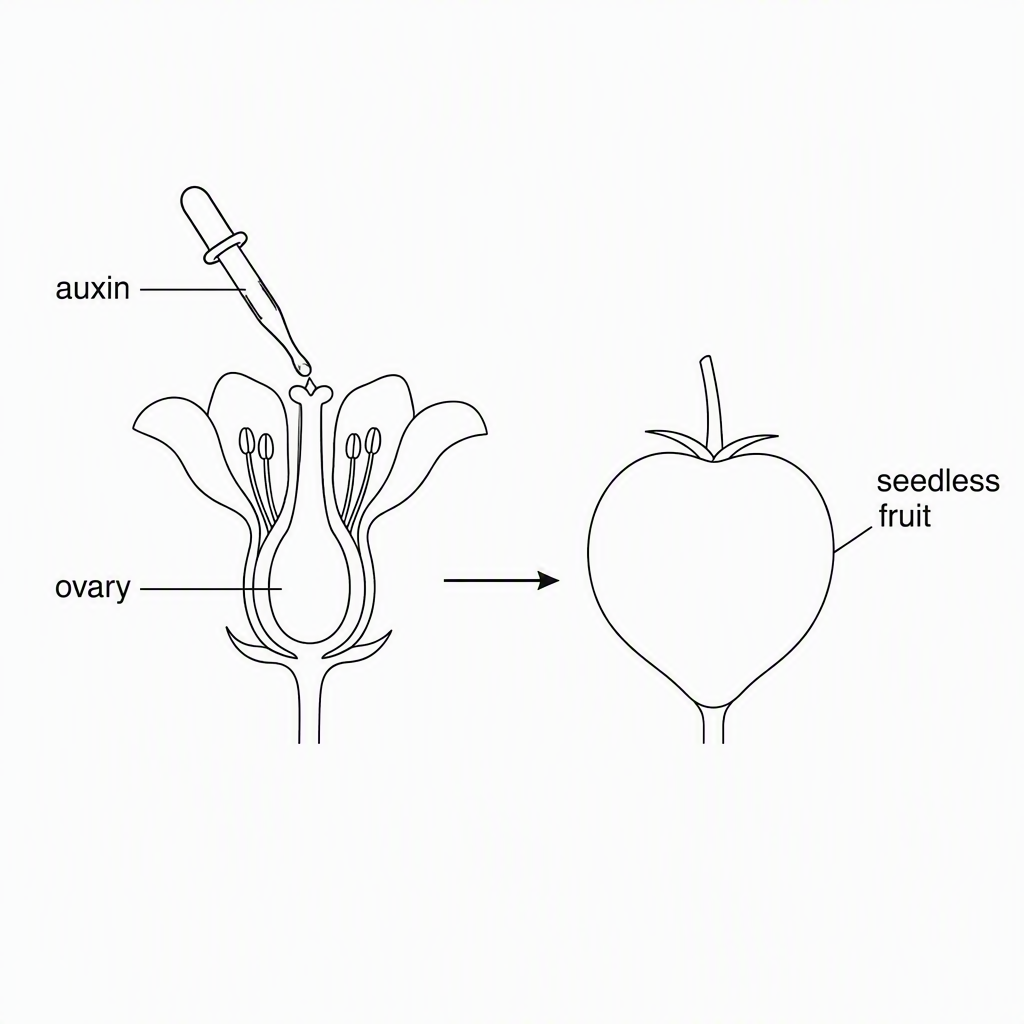
The statement concerns fruit formation without fertilisation, not seed germination or ordinary fertilised fruit development.
Why is statement B correct?
Statement B is correct. Plant growth regulators may promote or inhibit growth depending on the regulator and physiological context. The word regulator does not mean promoter.
A regulator controls a process. That control can increase growth, reduce growth or coordinate a response under specific conditions.
Why is statement C correct?
Statement C is correct. During dedifferentiation, mature differentiated cells regain the capacity to divide. This renewed division creates the basis for their later redifferentiation into specialised cells.
The required developmental sequence is:
Dedifferentiation does not mean immediate specialisation. It restores division capacity before later specialisation occurs.
Why is statement D incorrect?
Statement D is incorrect. Abscisic acid, or ABA, is primarily classified as a growth inhibitor and stress hormone. It is not a general plant growth promoter.
ABA has major physiological functions, especially in stress responses. An important physiological function is not the same as promotion of overall growth.
Why is statement E incorrect?
Statement E is incorrect. Apical dominance favours the apical bud while suppressing lateral or axillary bud growth. The statement reverses this direction.
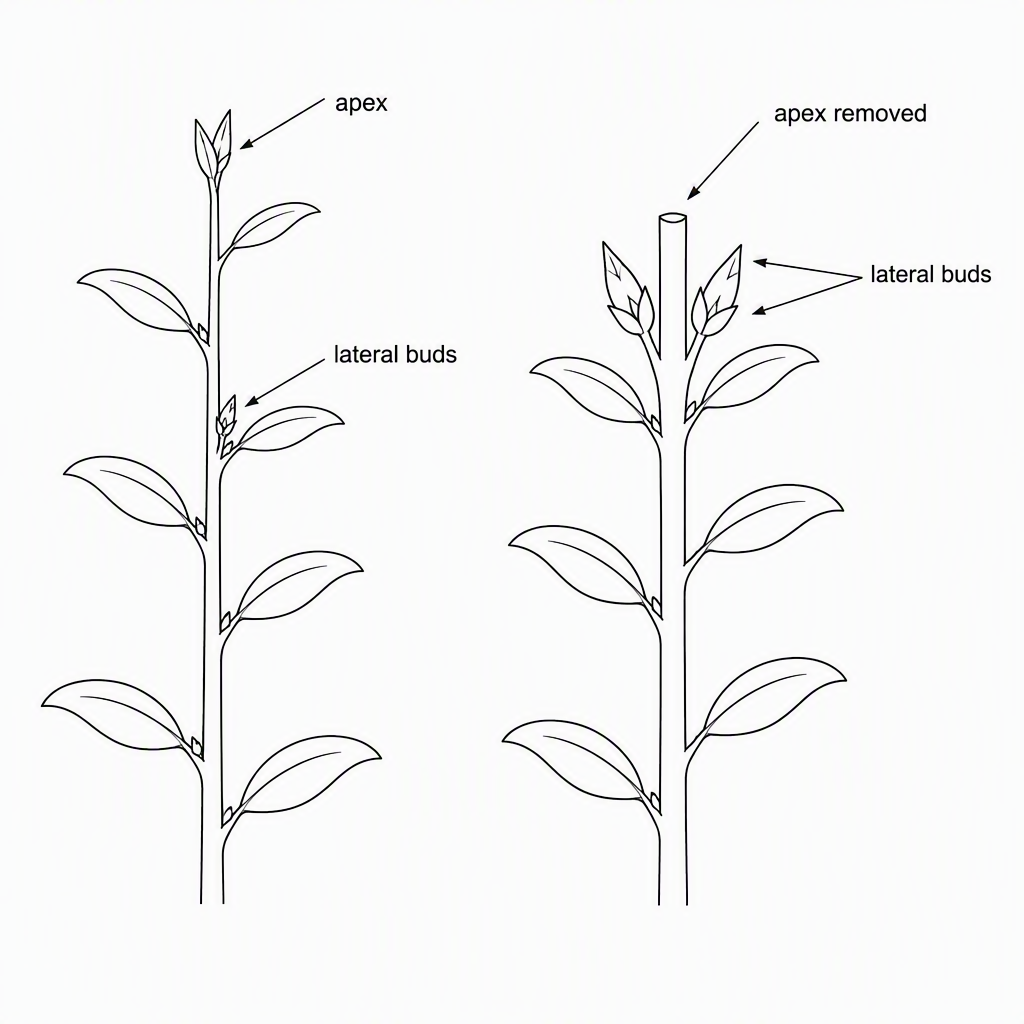
The correct relationship is:
The final truth pattern is:
- A ✓
- B ✓
- C ✓
- D ✗
- E ✗
The correct combination is A, B and C only, corresponding to option A.
What does the numerical statement audit show?
Five statements are checked independently. Giving a value of one to each correct statement and zero to each incorrect statement produces:
Thus, three of the five statements are correct:
The percentage cannot identify the option. The decisive result is the exact set of correct statements: A, B and C.
How can you reach the answer within 90 seconds?
For this Plant Growth Regulators NEET 2025 PYQ, eliminate the two reversed statements first, then confirm the remaining three. Statements D and E contain direct direction-of-action errors, so they provide the fastest elimination route while following the official statement-by-statement method.
- Eliminate statement D. Reject every combination treating ABA as a growth promoter. ABA is mainly a growth inhibitor and stress hormone.
- Eliminate statement E. Reject every combination claiming that apical dominance promotes lateral buds. Apical dominance suppresses lateral or axillary bud growth.
- Confirm statement A. Use the fixed association:
- Confirm statement B. Separate the broad category plant growth regulator from the narrower category growth promoter. Regulation includes both promotion and inhibition.
- Confirm statement C. Follow the developmental sequence:
An equal time ceiling would be:
You can expect D and E to take less than this because each reverses a standard relationship. The final result remains A ✓, B ✓, C ✓, D ✗, E ✗.
Why is the A, D and E combination wrong?
Option C contains statements A, D and E only, but only statement A survives biological checking. The method error is keyword recall without checking whether the named regulator or process promotes or suppresses the stated effect. Both D and E point in the wrong direction.
Calling ABA a promoter reverses its standard role as a growth inhibitor and stress hormone. Important physiological action is not the same as growth promotion.
Apical dominance does not mean that all buds are promoted. It means the apical bud dominates by suppressing lateral buds.
Rejecting statement B usually reflects the false equation:
Rejecting statement C ignores the required progression from dedifferentiation to redifferentiation. Mature cells must first regain division capacity before specialised cells can arise again.
Which three related Plant Growth Regulator questions should you practise?
Practise the auxin-parthenocarpy association, the sequence from differentiation to redifferentiation, and the effect of shoot-apex removal on lateral buds. Each question tests the same direction-of-effect method used in the solved PYQ. Answer each before reading the explanation.
Question 1: Which regulator can induce parthenocarpic fruit development?
Answer: Auxin. Parthenocarpy is fruit formation without fertilisation, and auxins can be used to induce it.
Question 2: How should differentiation, dedifferentiation and redifferentiation be arranged?
Answer:
A differentiated cell regains division capacity through dedifferentiation, then later specialises again through redifferentiation.
Question 3: What happens to lateral buds after the shoot apex is removed?
Answer: Suppression is reduced, so lateral buds generally grow because apical dominance is weakened. Removing the dominant apex releases axillary buds from its inhibitory influence.
For another NEET 2025 Biology PYQ, solve Genetics and Evolution NEET 2025: RNA World MCQ Answer.
What are the Plant Growth Regulators NEET 2025 FAQs?
The key doubts concern the difference between a regulator and a promoter, the classification of ABA, and the effect of apical dominance on lateral buds. For the Plant Growth Regulators NEET 2025 MCQ, check the direction of each effect rather than relying only on hormone-name recall.
Is a plant growth regulator always a growth promoter?
No. A plant growth regulator controls growth or development and may promote or inhibit a process depending on the regulator and physiological context. A growth promoter is only one type of regulator.
Why is ABA classified mainly as an inhibitor?
ABA mainly inhibits growth and coordinates plant responses to stress. Its important physiological functions do not make it a general growth promoter.
What does apical dominance do to lateral buds?
Apical dominance favours growth of the shoot apex and suppresses lateral or axillary buds. When the shoot apex is removed, that suppression weakens and lateral buds generally begin growing.
What is the final answer to this NEET 2025 question?
The correct statements are A, B and C only. The verified answer is option A, with the pattern A ✓, B ✓, C ✓, D ✗, E ✗.
Frequently asked questions
What is the answer to the Plant Growth Regulators NEET 2025 question?
The correct answer is option A: statements A, B and C only. The final pattern is A correct, B correct, C correct, D incorrect and E incorrect.
Is a plant growth regulator always a growth promoter?
No. A plant growth regulator may promote or inhibit growth and development, depending on the regulator and physiological context. The term regulator is broader than promoter.
Why is ABA called a growth inhibitor?
Abscisic acid primarily inhibits growth and coordinates plant responses to stress. Its major physiological importance does not make it a general growth promoter.
What does apical dominance do to lateral buds?
Apical dominance suppresses the growth of lateral or axillary buds while favouring the shoot apex. Removing the shoot apex weakens this suppression, so lateral buds generally begin growing.
Can auxin induce parthenocarpy?
Yes. Auxin can induce parthenocarpy, which is fruit development without fertilisation. This is why the auxin statement in the NEET 2025 question is correct.