What is the correct answer to the pollination NEET 2026 question?
B) Xenogamy is correct for the supplied pollination NEET 2026 Biology question from Reproduction. Pollen comes from a different plant of the same species, not merely a different flower.
The question asks: Which pollination category delivers pollen from a genetically different plant to the receiving stigma? Decide by identifying the pollen-donor plant.
The question bank classifies this as medium difficulty and sets an expected solving time of 30 seconds. These are the bank’s classification and expectation, not an official NEET difficulty rating or measured student performance.
How do you solve it by tracing pollen back to its plant?
Compare the pollen-donor plant with the plant bearing the receiving stigma. Only transfer between different plants of the same species meets the stem’s condition; moving between flowers on one plant does not.
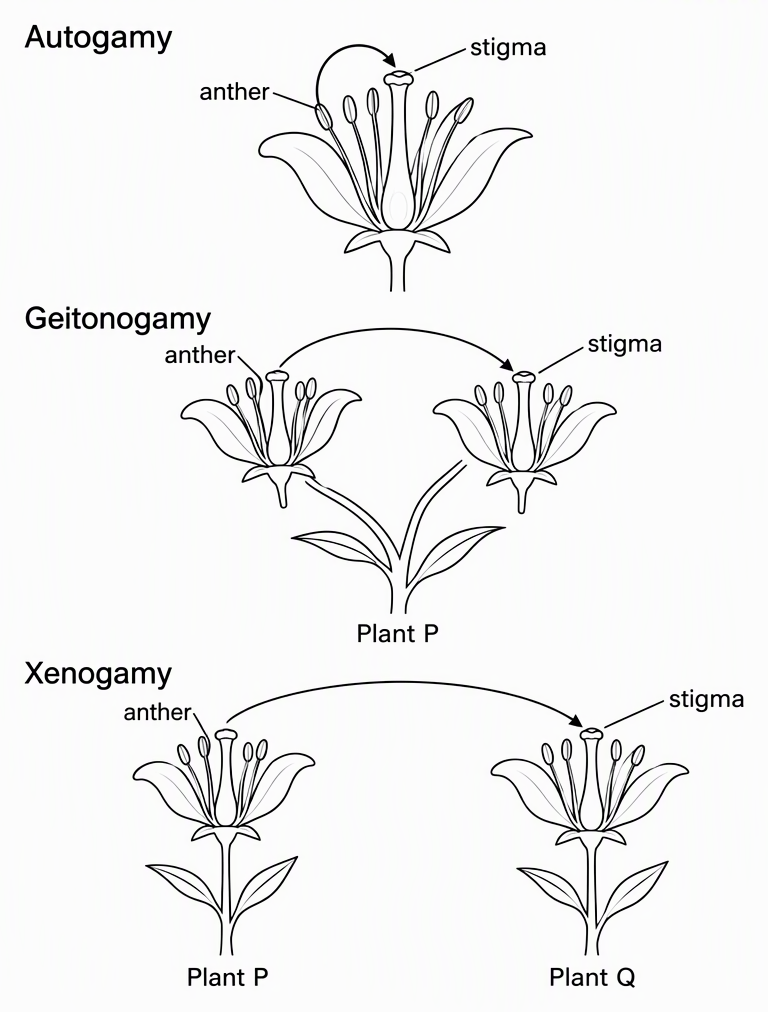
- Identify the tested condition. The stem asks for genetically different pollen reaching the stigma. Movement between flowers alone is insufficient.
- Apply the defining relationship. The supplied official solution defines xenogamy as pollen transfer from the anther of one plant to the stigma of another plant of the same species.
- Match the definition to the stem. Xenogamy therefore brings genetically different pollen to the receiving stigma.
- Eliminate autogamy. Pollen transfer occurs within the same flower, so there is no different donor plant.
- Eliminate geitonogamy. Transfer occurs between different flowers on the same plant. The flower changes; the donor-plant relationship does not.
- Eliminate cleistogamy. These flowers remain closed and are invariably autogamous. Cleistogamy describes the closed-flower condition associated with assured autogamy, not a separate genetically cross-pollinating route.
Compare each term by its transfer relationship and whether it meets the criterion:
- Autogamy: same flower; no.
- Xenogamy: different plants of the same species; yes.
- Geitonogamy: different flowers, same plant; no.
- Cleistogamy: within a closed, self-pollinating flower; no.
Final answer: B) Xenogamy.
Why is geitonogamy wrong even though the pollen reaches another flower?
A different flower is not necessarily a different plant. The faulty reasoning is: “Pollen reaches another flower, so the transfer must be genetically cross-pollinating.” The missing check is whether the donor and recipient flowers belong to the same plant.
Geitonogamy is functionally cross-pollination because it requires a pollinating agent. Genetically, it resembles autogamy because the pollen comes from the same plant.
- Same flower: autogamy.
- Different flower on the same plant: geitonogamy.
- Flower on a different plant of the same species: xenogamy.
Check the plant boundary, not just the flower boundary. This classification concerns the donor-plant relationship; it does not claim that every pollen grain produced by one plant is genetically identical.
Choosing B earns four marks; choosing C loses one mark. The difference between those outcomes is:
That is a five-mark difference between responses, not a five-mark award for the question.
What if a bee carries pollen between two flowers on the same plant?
The answer is B) Geitonogamy. The flowers differ, but the plant does not. This and the next two questions are original related practice from Reproduction, not additional verified NEET PYQs.
Question: A bee carries pollen from one flower to another flower belonging to the same plant. Identify the pollination category.
Worked explanation: Apply the donor-plant test used in the main question: both flowers belong to one plant. The bee acts as the pollinating agent; its involvement does not turn geitonogamy into xenogamy. Identify the plant relationship before considering the carrier.
What pollination occurs when a bisexual flower stays closed?
The answer is C) Autogamy. The closed-flower condition is cleistogamy, while the pollen-transfer category is autogamy because pollen reaches the stigma within that same flower.
Original related practice: A bisexual flower remains closed, and its own pollen reaches its stigma. Identify the assured pollination category.
Worked explanation: No pollinating agent is needed because pollen transfer occurs inside the closed flower. The donor and recipient belong to that flower, so neither geitonogamy nor xenogamy applies. Assured self-pollination does not mean that fertilisation and every later reproductive stage are guaranteed to succeed.
Which pollination routes are prevented when male and female flowers occur on separate plants?
The answer is C) Both autogamy and geitonogamy. Neither a single flower nor a single plant has both male and female reproductive structures.
Original related practice: In a dioecious species, male and female flowers occur on separate plants. Which routes are prevented?
- Check the flower. Unisexual flowers prevent anther-to-stigma transfer within a single flower.
- Check the plant. Separate male and female plants prevent transfer between male and female flowers on the same plant.
- Identify the permitted route. Pollen reaching a female flower must come from a different plant of the same species, permitting xenogamy.
Use this rule before selecting an option: same flower → autogamy; different flower, same plant → geitonogamy; different plant of the same species → xenogamy.
Next step: photograph a doubt on NEET JEEnius AI and photograph any question you are stuck on and get a step-by-step solution across Physics, Chemistry and Biology (20 free a month).
Read next: D- and f-block elements NEET 2026: Ho³⁺ Unpaired Electrons.
Frequently asked questions
What is the correct answer to the pollination NEET 2026 question?
B) Xenogamy is correct for the supplied question asking which category brings pollen from a genetically different plant to the stigma. Xenogamy transfers pollen between different plants of the same species, not merely between flowers on one plant.
Why is geitonogamy genetically similar to autogamy?
In geitonogamy, pollen moves between different flowers on the same plant, so the donor plant does not change. It is functionally cross-pollination because it requires a pollinating agent, but genetically it resembles autogamy.
What is the difference between cleistogamy and autogamy?
Cleistogamy describes the condition in which flowers remain closed. Autogamy is pollen transfer within the same flower, and cleistogamous flowers are invariably autogamous. Assured self-pollination does not guarantee successful fertilisation or every later reproductive stage.
Which pollination types are prevented in dioecious plants?
Dioecious plants prevent both autogamy and geitonogamy because male and female flowers occur on separate plants. Pollen reaching a female flower must come from another plant of the same species, permitting xenogamy.