What is the answer to the NEET 2026 Solanaceae question?
Option A is correct in this Structural Organisation NEET 2026 question: statements (a), (b) and (c) are true, while (d) is false. The source is NEET 2026, Code-50, Biology, Families of Flowering Plants, Solanaceae. This question bank rates it medium and gives an expected solving time of 45 seconds. That is the bank’s practice target, not an observed student average.
Select the combination that correctly describes Solanaceae flowers. The four claims are: (a) each flower has male and female reproductive organs and radial symmetry; (b) the calyx consists of five fused sepals; (c) five stamens are attached to the petals; (d) the ovary occupies an inferior position.
Why is option A correct when each statement is checked?
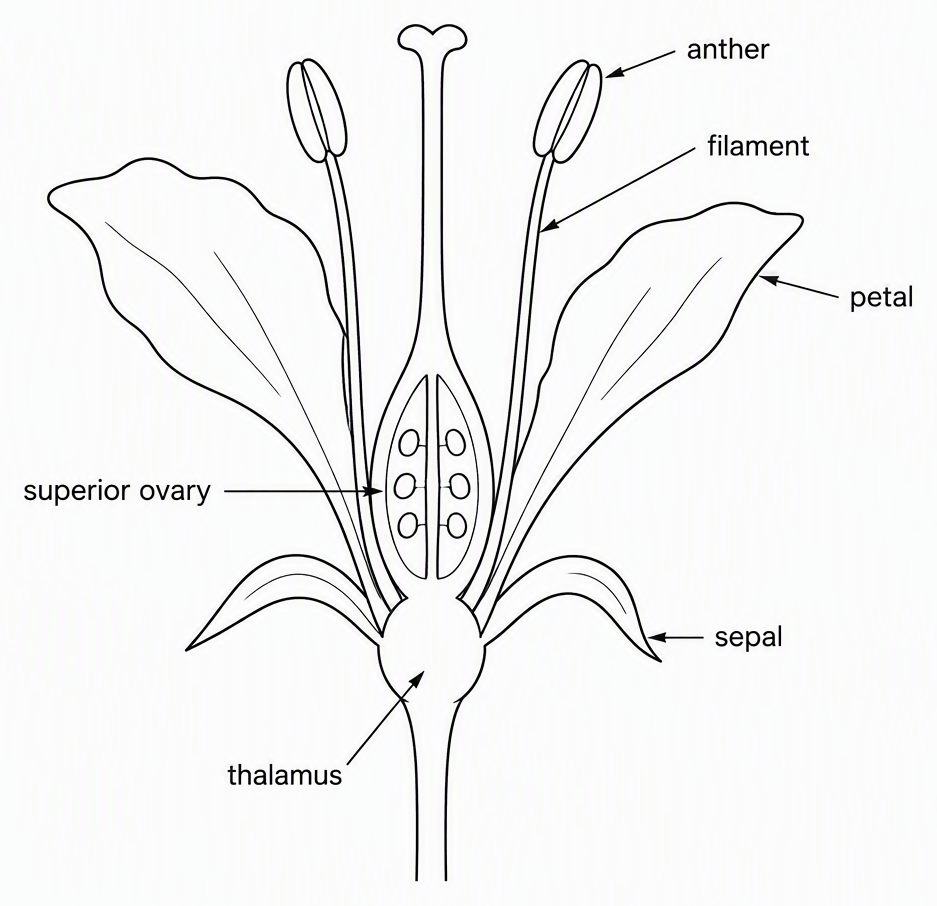
Solanaceae flowers are bisexual and actinomorphic, with five united sepals, five epipetalous stamens and a superior ovary. These characters make A correct. Check each statement in the official solution’s order, separating the features within it.
- Statement (a): true. Bisexual means that the same flower contains both the androecium, its male reproductive whorl, and the gynoecium, its female reproductive whorl. Actinomorphic means radial symmetry: several vertical planes through the centre can divide the flower into matching halves. Solanaceae flowers typically satisfy both conditions.
- Statement (b): true. Check sepal number first, then fusion. The calyx contains five sepals, and those sepals are united rather than separate. Gamosepalous means united sepals; fusion does not change the stated count from five to one.
- Statement (c): true. Check stamen number first, then attachment. The androecium contains five stamens, and they are attached to the petals. Epipetalous means stamens attached to petals, so both parts of this statement match the Solanaceae description.
- Statement (d): false. Solanaceae has a superior ovary, not an inferior ovary. Superior position means that the other floral whorls arise below the ovary. The attachment of a stamen to a petal does not make the ovary inferior; attachment and ovary position describe different relationships.
The resulting truth pattern is true, true, true, false. Match that complete pattern to A: (a), (b), (c) only.
Rejecting (d) eliminates B and D, but leaves A and C. You must still verify (c): option C excludes a true statement, so eliminating the inferior-ovary options alone cannot finish the solution.
How can a definition error lead to option C?
Option C accepts (a) and (b) but excludes (c), so choosing it treats the stamen statement as false. One possible error is reading epipetalous as stamens fused to one another, rather than stamens attached to petals.
Keep three checks separate:
- Number: how many organs are present?
- Fusion: are like organs united?
- Attachment: which different organ is the structure attached to?
Here, five gives the stamen count; epipetalous gives attachment to petals. Both parts of (c) are correct.
Under the marking rule used here, choosing C earns minus one mark instead of the four marks earned by A. The score difference is:
What does epipetalous actually mean?
It means stamens are attached to petals, so the answer is B. The next three questions are original practice questions from the same chapter, not additional verified PYQs.
Question: In a flower described as epipetalous, the stamens are attached to which structure?
The defining feature is attachment to petals, not fusion between stamens. The term alone does not specify stamen number; the five-stamen count comes from the Solanaceae family description.
What is the ovary position when the other whorls arise below it?
The ovary is superior, and the flower is hypogynous. These terms describe the ovary’s relationship to the attachment of the other floral whorls.
Question: A flower has its sepals, petals and stamens arising below the ovary; is its ovary superior or inferior, and what is this floral condition called?
Judge the attachment points, not the apparent height or size of an ovary in a drawing. This arrangement explains why statement (d) in the source question is false: it incorrectly calls the Solanaceae ovary inferior.
How do you repair an incorrect Solanaceae description?
Use five united sepals, five stamens attached to petals and a superior ovary. Cover the corrections below and repair this deliberately inaccurate description:
Solanaceae has five separate sepals, five stamens attached to sepals, and an inferior ovary.
- Five united sepals: gamosepalous means the sepals are fused, not separate.
- Five stamens attached to petals: epipetalous identifies petal attachment, not sepal attachment.
- Superior ovary: the other floral whorls arise below the ovary.
Reproduce the three corrected characters without looking. Then use them to reconstruct the source question’s truth pattern:
(a), (b), (c) true; (d) false; option A.
Next step: the past-paper archive on NEET JEEnius AI and search past NEET papers by year, subject or chapter, each with a worked solution (100 free searches a month).
Keep going with D- and f-block elements NEET 2025: Cr²⁺ vs Nd³⁺.
Frequently asked questions
What is the correct answer to the NEET 2026 Solanaceae question?
Option A is correct: statements (a), (b) and (c) are true, while (d) is false. Solanaceae flowers are bisexual and actinomorphic, with five fused sepals and five stamens attached to petals. The ovary is superior, not inferior.
What does epipetalous mean in Solanaceae?
Epipetalous means that stamens are attached to petals, not fused to one another. Solanaceae has five epipetalous stamens. The term describes attachment; the count of five comes from the family description.
Does Solanaceae have a superior or inferior ovary?
Solanaceae has a superior ovary. The sepals, petals and stamens arise below the ovary, a condition called hypogynous. Judge the attachment points rather than the apparent height or size of the ovary in a diagram.
Why is option C wrong in the NEET 2026 Solanaceae question?
Option C includes statements (a) and (b) but leaves out statement (c), which is also true. Solanaceae has five stamens attached to petals, exactly as statement (c) describes. Rejecting the inferior-ovary statement eliminates B and D, but checking stamen attachment is necessary to choose A over C.