What is the correct answer to the NEET 2026 p-nitrotoluene question?
Option A is correct: both statements are true. Indexed under acidic strength of phenols for NEET 2026, this question directly tests substituted benzoic acid and aniline, not phenol products. Phenols supply the related principle: substituents change acid strength by changing conjugate-base stability.
The source is NEET UG 2026, held on 21 June 2026, Code-50. Its medium difficulty is the question bank’s classification, not an official exam-wide rating.
The two claims are:
- Statement I: Acidic potassium permanganate oxidises p-nitrotoluene into an acid stronger than benzoic acid.
- Statement II: Tin and hydrochloric acid, followed by neutralisation, convert p-nitrotoluene into an amine more basic than aniline.
The answer mapping is:
Here, p- means para: the two substituents occupy the benzene ring’s 1,4 positions.
Why is the oxidation product more acidic than benzoic acid?
Acidic potassium permanganate oxidises the methyl side chain to a carboxyl group, producing p-nitrobenzoic acid. The nitro group remains present. Identify this product before applying a substituent-effect rule.
The first experiment changes the methyl group. The second changes the nitro group, so keep the transformations separate.
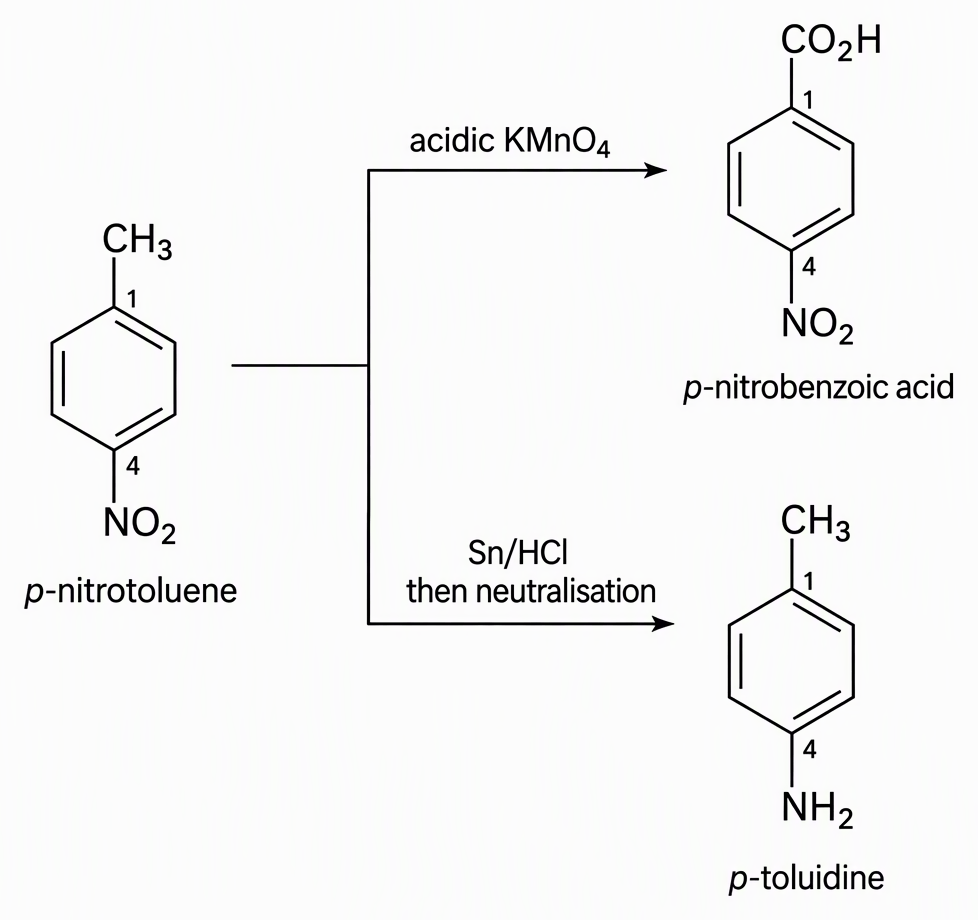
Starting from p-nitrotoluene, this is a transformation scheme, not a balanced redox equation:
The carboxyl group loses a proton to form p-nitrobenzoate:
The para nitro group withdraws electron density through inductive and resonance effects. This stabilises the carboxylate conjugate base relative to benzoate. Greater conjugate-base stability favours proton loss, so the parent acid is stronger.
The supplied approximate acid-dissociation values confirm that comparison:
A lower value means a stronger acid, so Statement I is true. Treat these values as confirmation, not numbers you must memorise. Product identification and conjugate-base stability establish the answer without them.
Why is the reduction product more basic than aniline?
Reduction gives p-toluidine, also called 4-methylaniline, which is more basic than aniline. Return to the original p-nitrotoluene here. Statement II is a separate experiment, not reduction of the p-nitrobenzoic acid from Statement I.
Tin and hydrochloric acid reduce the nitro group to the amino functionality. The para methyl group remains unchanged. The transformation scheme, including the work-up, is:
In the acidic reaction mixture, the amine is protonated. Neutralisation releases the free amine, the species used for the basicity comparison.
Following the supplied solution, methyl donates electron density through the positive inductive effect and hyperconjugation. This makes the nitrogen lone pair more available for protonation relative to aniline.
The supplied base-dissociation constants are:
A larger base-dissociation constant means a stronger base. The numerical check is:
Thus, p-toluidine’s base-dissociation constant is approximately 2.6 times that of aniline. This confirms the direction predicted by methyl donation, so Statement II is true.
Which option matches the two property comparisons?
The final answer is option A. For this NEET 2026 question, keep the comparisons separately labelled, even though its index refers to acidic strength of phenols:
- Acidic strength:
- Basic strength:
Both statements are true. Use this sequence: identify the product, identify the property being compared, apply the substituent effect, then map the truth values to the option. A correct substituent rule applied to the wrong process still gives a wrong answer.
How can reversing the methyl effect lead to option C?
A possible route to C is transferring an acidity conclusion directly to basicity. The faulty reasoning is: “Methyl decreases phenol acidity, so methyl must also decrease aniline basicity.” That inference ignores what each property measures.
Phenol acidity concerns proton loss and phenoxide stability. Methyl donation destabilises the negatively charged phenoxide relative to phenoxide without that substituent. This makes proton loss less favourable and decreases acidity.
Amine basicity concerns proton acceptance at nitrogen. In the comparison given, methyl donation makes the nitrogen lone pair more available, increasing basicity. The donating effect produces different conclusions because the chemical processes differ.
Accepting Statement I but wrongly rejecting Statement II maps precisely to option C. The correction is: never transfer an acidity conclusion to basicity without checking the species and process involved.
How do you solve three related oxygen-compound questions?
Compare conjugate bases first, then rank the parent acids. These are original related practice questions, not additional verified NEET PYQs. They apply the reasoning from the NEET 2026 acidic strength of phenols entry within Organic Compounds Containing Oxygen.
- Arrange p-nitrophenol, phenol and p-cresol in decreasing acidic strength.
Compare their corresponding phenoxide ions. Nitro withdrawal stabilises p-nitrophenoxide relative to phenoxide, while methyl donation destabilises p-cresoxide relative to phenoxide. The acid with the more stable conjugate base is stronger:
- Which is more acidic, phenol or ethanol, and why?
Phenol is more acidic. Compare phenoxide with ethoxide, rather than judging only the neutral molecules. Phenoxide has resonance stabilisation, allowing negative charge to be delocalised; ethoxide lacks comparable resonance delocalisation. Phenol therefore loses a proton more readily.
- Arrange p-nitrobenzoic acid, benzoic acid and p-methylbenzoic acid in decreasing acidic strength.
Compare the carboxylate conjugate bases. Nitro withdrawal stabilises p-nitrobenzoate relative to benzoate. Methyl donation destabilises p-methylbenzoate relative to benzoate, making its parent acid weaker:
Cover the answers and repeat all three comparisons. For each, name the conjugate base and explain what stabilises or destabilises it before writing the acid-strength order. If the order is correct but the explanation is missing, repeat the reasoning rather than memorising the sequence.
Next step: photograph a doubt on NEET JEEnius AI and photograph any question you are stuck on and get a step-by-step solution across Physics, Chemistry and Biology (20 free a month).
Keep going with Self Inductance of Solenoid NEET 2026: Formula and Solution.
Frequently asked questions
What is the answer to the NEET 2026 p-nitrotoluene question?
Option A is correct because both statements are true. Acidic potassium permanganate produces p-nitrobenzoic acid, which is stronger than benzoic acid. Tin and hydrochloric acid, followed by neutralisation, produce p-toluidine, which is more basic than aniline.
Why is p-nitrobenzoic acid stronger than benzoic acid?
The para nitro group withdraws electron density through inductive and resonance effects, stabilising the carboxylate conjugate base relative to benzoate. Greater conjugate-base stability favours proton loss, making p-nitrobenzoic acid stronger than benzoic acid.
Why is p-toluidine more basic than aniline?
The para methyl group donates electron density through the positive inductive effect and hyperconjugation. This makes the nitrogen lone pair more available for protonation than in aniline. The supplied Kb values confirm that p-toluidine has a base-dissociation constant approximately 2.6 times that of aniline.
What is the acidic strength order of p-nitrophenol, phenol and p-cresol?
The decreasing acidic strength order is p-nitrophenol > phenol > p-cresol. Nitro withdrawal stabilises the phenoxide conjugate base, whereas methyl donation destabilises it relative to unsubstituted phenoxide. The acid with the more stable conjugate base is stronger.
Does methyl decrease both phenol acidity and aniline basicity?
No: in these para-substituted comparisons, methyl decreases phenol acidity but increases aniline basicity. Methyl donation destabilises the negatively charged phenoxide, making proton loss less favourable. In p-toluidine, it makes the nitrogen lone pair more available for proton acceptance.