What is the correct answer to the self inductance of solenoid NEET 2026 question?
Option A is correct for the self inductance of solenoid NEET 2026 question: circular area supplies pi, while field strength and the number of linked turns each supply one factor of turn density. This verified question is from NEET UG 2026, held on 21 June 2026, Code-50. Its medium difficulty is the question bank’s classification, not an NTA rating.
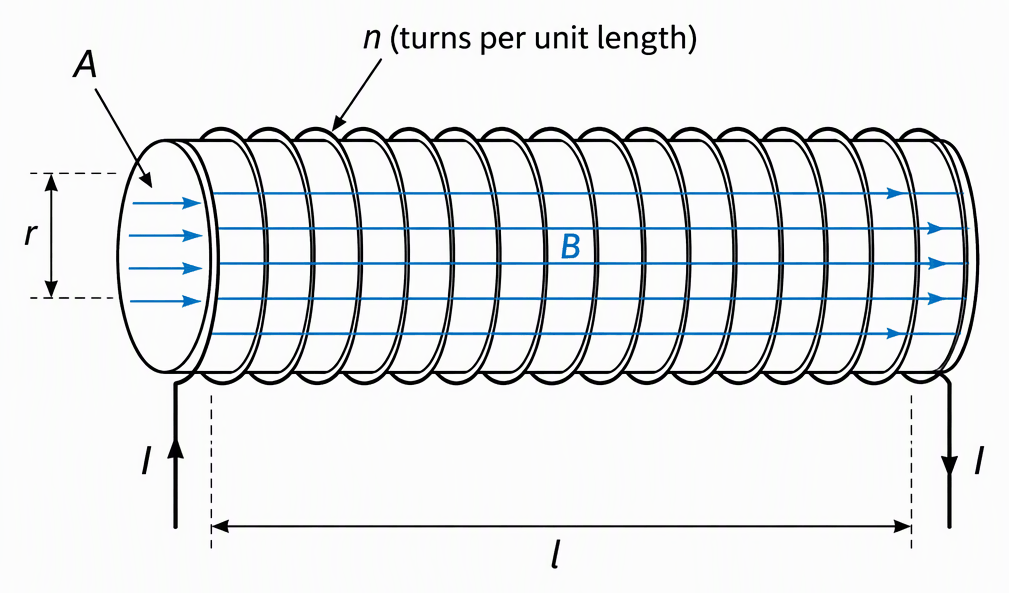
A long solenoid in free space has axial length denoted by lowercase l, circular radius r, and n turns per unit length. Find its self-inductance using the permeability of free space, denoted by μ₀. Keep lowercase l, the length, separate from uppercase L, the inductance.
The four supplied options are:
- A)
- B)
- C)
- D)
How do you calculate the magnetic flux through one turn?
Multiply the solenoid’s internal magnetic field by the area of one circular turn. This gives single-turn flux, not the whole coil’s flux linkage. Following the supplied NCERT-based solution, introduce an arbitrary current, denoted by I, to calculate the field produced by the solenoid itself.
For a long solenoid, the interior field is approximately uniform and end effects are neglected. Its field is:
Here, lowercase n means turns per unit length, not total turns. The circular cross-sectional area is:
The field is perpendicular to the plane of each turn, so it is parallel to the area normal. The single-turn flux is therefore:
This is not yet the coil’s total flux linkage; we must still count the linked turns. The magnetic field is independent of radius in this approximation, but the flux is not: a larger radius encloses more area, so single-turn flux increases with the square of radius.
How does total flux linkage give option A?
Multiply the single-turn flux by the total number of turns, then divide by current. Follow the official method in order: field, single-turn flux, total flux linkage, inductance.
Turn density multiplied by axial length gives total turns. Denote this count by uppercase N:
Define uppercase Phi here as total flux linkage. Since each turn links approximately the same flux:
Substitute both the turn count and the single-turn flux:
By the definition of self-inductance:
The answer is option A. The equivalent NCERT form is:
The two factors of turn density have separate origins:
- Field strength: more turns per unit length produce a stronger internal field at the same current.
- Linked turns: at a fixed length, more turns per unit length also mean more turns linking that field.
Current cancels because flux linkage is proportional to current for this ideal free-space solenoid. Its inductance depends on geometry and permeability, not on the arbitrary current chosen for the derivation.
How does missing the circular area factor produce option B?
Replacing circular area with radius squared removes pi and produces option B exactly. The remaining flux-linkage steps can be correct while this substitution makes the answer wrong.
Start with the erroneous area:
Then the incorrect single-turn flux becomes:
Carrying it through the remaining steps gives:
Radius squared has the dimensions of area, but it is not the area of a circle. The missing pi is a geometry error, not a different inductance convention.
All four options have identical dimensions because they differ only by dimensionless numerical factors. A units check cannot decide this MCQ. To prevent the error, write the circular area on its own line before substituting into flux:
How do you solve related solenoid-inductance practice questions?
Identify what stays fixed before using proportionality. These three original related practice questions from Electromagnetic Induction, not additional verified NEET PYQs, test that distinction and the induced-emf law. Assume every change preserves the long-solenoid approximation and the free-space core.
What happens if the radius doubles at fixed turn density and length?
Question 1 answer: inductance becomes four times its original value. Only circular area changes:
For an original inductance of 2 millihenries:
The field stays unchanged at the same current. Flux linkage increases because the area increases.
What happens if length doubles at fixed total turns and radius?
Question 2 answer: inductance halves, because spreading the same turns over twice the length reduces turn density. First substitute total turns divided by length:
Thus:
In contrast, doubling length at fixed turn density and area doubles the total turns:
These are different constraints. Identify which turn quantity stays fixed before using a length proportionality.
What emf is induced when current rises uniformly from zero?
Question 3 answer: multiply inductance by the current rise per unit time. For the original solenoid, specify the final current and rise time as:
The magnitude of the self-induced emf is:
The signed law is:
The minus sign expresses opposition to the change in current, not a negative emf magnitude. For magnitude, calculate the positive value; for direction, apply that opposition separately.
Next step: the past-paper archive on NEET JEEnius AI and search past NEET papers by year, subject or chapter, each with a worked solution (100 free searches a month).
For a worked example of the same idea, see How to Study Wave Optics NEET: Order, Formulas and Practice.
Frequently asked questions
What is the self-inductance formula for a long solenoid?
For a long solenoid in free space, L = μ₀n²Al = μ₀πn²r²l, where n is turns per unit length and l is axial length. With N total turns, the equivalent formula is L = μ₀N²A/l. This gives option A in the supplied NEET 2026 question.
Why does solenoid self-inductance depend on n squared?
One factor of turn density n comes from the magnetic field B = μ₀nI. The second comes from the total linked turns N = nl. Multiplying the single-turn flux by N and dividing by current gives L = μ₀n²Al.
Why is option B wrong in the solenoid inductance question?
Option B omits π because it effectively uses A = r² instead of the circular area A = πr². All four options have identical dimensions, so a units check cannot identify this error.
Does doubling a solenoid's length double its inductance?
It depends on which turn quantity stays fixed. At fixed total turns and radius, doubling the length halves the inductance. At fixed turn density and radius, doubling the length doubles the inductance, assuming the long-solenoid approximation remains valid.
How do you calculate self-induced emf in a solenoid?
For a uniform current change, the emf magnitude is |ε| = L|ΔI/Δt|. If current rises from zero to I₀ in time Δt, the magnitude is LI₀/Δt. The signed law ε = −L dI/dt expresses opposition to the change in current.