
Which AI doubt solver is best for NEET?
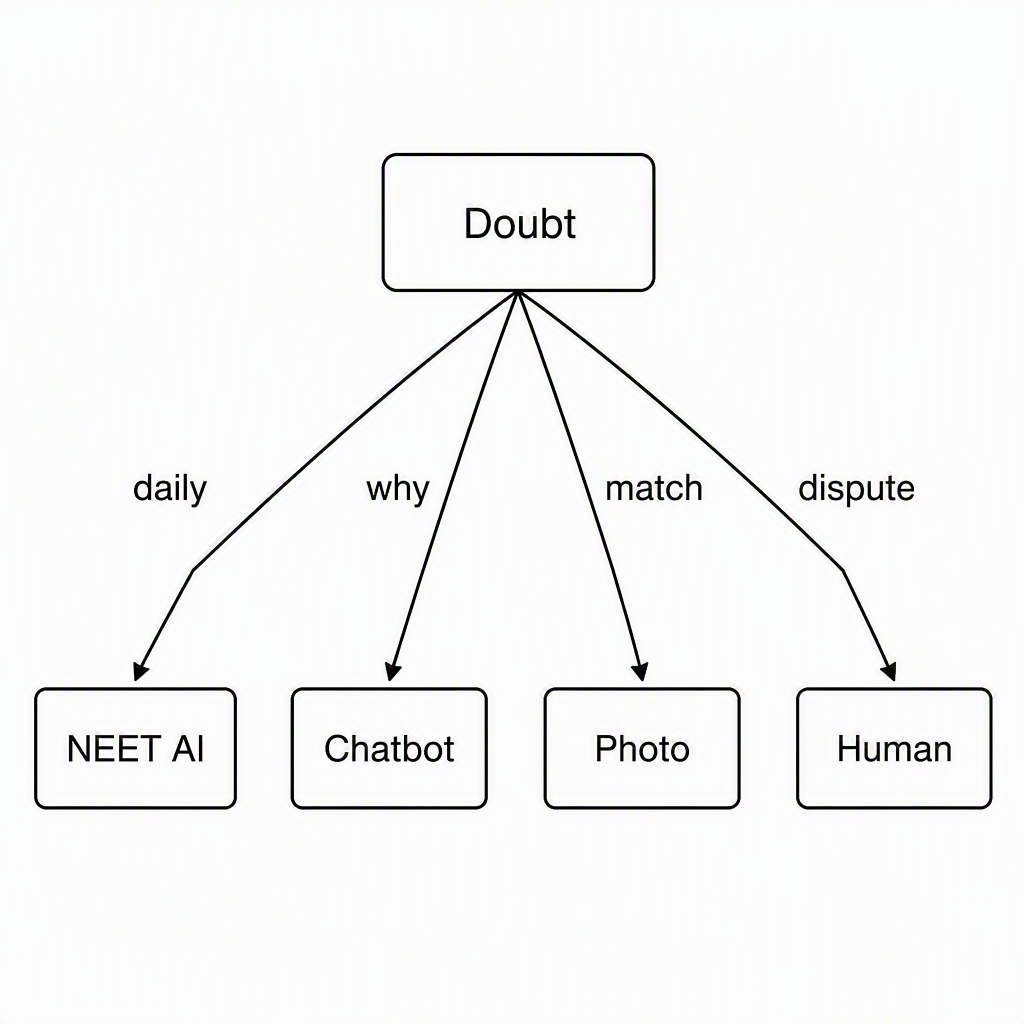
The best AI doubt solver for NEET is an NEET-specific, NCERT-grounded conversational tutor that shows every step, accepts follow-up questions and admits uncertainty. No single tool is best for every doubt. Use a general chatbot for alternate explanations, a photo solver for locating familiar questions, and a qualified teacher when the question may be ambiguous or disputed.
Verdict: Make an NEET-specific AI tutor your primary solver. Keep a general chatbot as a secondary explanation tool. Use photo/search solvers for quick question identification, not final verification. Escalate doubtful diagrams, disputed answer keys, Biology exceptions and Organic Chemistry exceptions to a teacher.
A general AI chatbot can discuss a concept at length and explain it in several ways. Use it when the first explanation does not click, but not as the final authority for exact NCERT wording, official answer keys or syllabus-specific exceptions.
Photo and search-based solvers work well when a coaching-sheet question already exists in their database. They may retrieve a visually similar solved question without finding the precise misconception that caused your error.
Ambiguous circuit diagrams, unclear optical paths and poorly printed graphs need human inspection. Teacher escalation is also the correct choice when two sources disagree, an answer key appears defective, or an exception in Biology or Organic Chemistry changes the answer.
How do NEET AI tutors, general chatbots, photo solvers and human-backed platforms compare?
An NEET-specific tutor is the best regular option because it can combine syllabus context, worked reasoning and follow-up discussion. A human-backed platform is safer for disputed problems, while a general chatbot is better for extended exploration. A photo solver is mainly a retrieval tool, even when its interface makes the result look like a freshly reasoned solution.
The comparison uses four fixed options: NEET-specific AI tutor, general AI chatbot, photo/search-based solver, and human-backed doubt platform. The labels are qualitative because unsupported accuracy percentages and star ratings reveal little about the risk of learning a wrong method.
- NCERT alignment: NEET-specific AI tutor, usually strong if it identifies the relevant chapter and separates NCERT content from extra detail. General chatbot, variable and may mix school, college and web knowledge. Photo solver, depends on the retrieved source. Human-backed platform, strong when the teacher explicitly checks NCERT.
- Physics derivation quality: NEET-specific AI tutor, strong when it states the law, substitutions and units. General chatbot, often detailed but may assume missing information. Photo solver, useful only when the retrieved question is an exact match. Human-backed platform, best placed to spot a student's specific wrong step.
- Chemistry reaction and exception handling: NEET-specific AI tutor, useful if it checks reagent, conditions and syllabus exceptions. General chatbot, broad knowledge but may introduce reactions beyond NEET scope. Photo solver, vulnerable to matching by reagent name alone. Human-backed platform, preferable when competing reactions are possible.
- Biology wording: NEET-specific AI tutor, generally the best AI option when grounded in NCERT. General chatbot, may paraphrase away a decisive word. Photo solver, inherits the wording and quality of its source. Human-backed platform, safest when a statement depends on exact textbook language.
- Image or diagram input: NEET-specific AI tutor, useful if it first reports what it has read. General chatbot, capable but may silently misread labels. Photo solver, convenient for clean printed questions. Human-backed platform, best for faint symbols, unusual diagrams and handwritten work.
- Multi-turn follow-ups: NEET-specific AI tutor, strong for moving from prerequisites to the answer. General chatbot, usually strong for extended discussion. Photo solver, commonly centred on one question and one retrieved solution. Human-backed platform, effective if the service supports continued discussion.
- Uncertainty disclosure: NEET-specific AI tutor, acceptable only if it identifies missing data and uncertainty. General chatbot, inconsistent and may sound confident while guessing. Photo solver, weak when similarity is mistaken for identity. Human-backed platform, better because a teacher can flag ambiguity directly.
- Source traceability: NEET-specific AI tutor, useful when it names the NCERT chapter or governing concept. General chatbot, generated citations and quotations require checking. Photo solver, may show the source solution but not prove its quality. Human-backed platform, good when the teacher cites NCERT or an accepted key.
- Response speed: NEET-specific AI tutor, suited to routine study. General chatbot, suited to immediate discussion. Photo solver, usually the quickest route to a familiar question. Human-backed platform, speed varies because a person must inspect the doubt.
- Human escalation: NEET-specific AI tutor, valuable only if escalation is available or the student can take the doubt elsewhere. General chatbot, cannot replace expert review. Photo solver, generally weak for disputes. Human-backed platform, designed for cases where AI output is insufficient.
- Best used for: NEET-specific AI tutor, daily doubts and test analysis. General chatbot, alternate explanations and deeper “why” discussions. Photo solver, finding an existing solution to a coaching-sheet question. Human-backed platform, disputed keys, unclear diagrams, exceptions and repeated contradictions.
- Main failure risk: NEET-specific AI tutor, appearing syllabus-aware while producing an unsupported step. General chatbot, confident non-NCERT claims. Photo solver, retrieving a question with different values, options or diagram labels. Human-backed platform, assuming every response is correct without checking its stated basis.
Generating a fresh solution means interpreting the given data and deriving an answer. Retrieval means finding a visually or textually similar solved question. A retrieved solution can be perfectly written and still be irrelevant because one condition, sign or option differs.
Product features, usage limits and pricing change frequently. Check the provider’s current page before paying, especially for image input, follow-up questions, NCERT references and access to human teachers.
Who should choose each type of NEET doubt solver?
Choose according to your preparation stage and error pattern, not app popularity. Students with weak foundations need guided conversation. Students balancing boards and NEET need concise NCERT-linked answers. Droppers need efficient test analysis, while high scorers need a solver that can handle exceptions and survive challenges to its assumptions.
What should Class 11 students with weak fundamentals choose?
Use a NEET-specific conversational tutor that can step backwards from the question. It should explain prerequisite ideas, check what you already understand and then return to the final solution. If a friction problem exposes confusion about free-body diagrams, the tool must address that gap rather than merely substitute numbers into a formula.
What should Class 12 students balancing boards and NEET choose?
Prioritise NCERT-linked explanations and short stepwise solutions over long generic lectures. Board preparation needs proper presentation, while NEET needs fast identification of the decisive concept and option. For Biology and Inorganic Chemistry, the solver should identify the relevant NCERT idea. For numericals, it should show enough calculation to expose a sign, unit or substitution error.
What should NEET droppers use during test analysis?
Use an NEET-specific solver as the primary tool. Use a general chatbot only for an alternate explanation or a deeper “why” question. The primary solver should help classify the error as conceptual, factual, calculation-based or caused by misreading. Asking several chatbots and choosing the majority answer is not verification.
When is a photo solver the right choice?
Students who mainly solve coaching sheets may benefit from photo or search-based tools. Before trusting a retrieved solution, compare every value, option, condition and diagram label with the original question. Small changes can reverse the result, especially in “incorrect statement” questions, circuit polarity, graph axes and Organic Chemistry reaction conditions.
What should consistently high-scoring students prioritise?
Prioritise exception handling, assertion-reason analysis and the ability to challenge the AI’s assumptions. Ask why the other options fail and what change in wording would alter the answer. If you repeatedly receive contradictory answers, stop regenerating until the AI agrees with you. Move the doubt to a human-backed platform or a qualified teacher.
What must a good NEET AI doubt solver do in Physics, Chemistry and Biology?
A reliable solver must meet a different standard in each subject. Strong performance in formula-based Physics does not prove that the same system can handle NCERT Biology wording or competing Organic Chemistry reactions. Judge the reasoning process subject by subject, not the fluency of the final paragraph.
How should it solve a NEET Physics question?
It should identify known quantities, interpret or construct the physical setup, state the applicable law, retain units, show substitutions and test whether the final magnitude is physically sensible. If a diagram is supplied, it must first state how it interpreted forces, directions, connections or axes. A correct option without this chain may hide an invalid formula or cancelling errors.
How should it handle Physical Chemistry calculations?
It must preserve units, signs, logarithms and significant assumptions through every step. It should state approximations rather than quietly applying them. Check whether concentration units are compatible, temperature is on the correct scale and powers of ten survive the calculation. A polished final number does not repair an invalid assumption.
How should it solve Organic Chemistry doubts?
It should identify the substrate, reagent, reaction conditions, likely mechanism and competing reactions. Matching only the reagent name is unsafe because temperature, solvent, substrate structure and work-up can change the product. When an exception applies, the solver should explain why the standard rule fails. If plausible pathways remain, teacher review is better than forced certainty.
How should it answer Inorganic Chemistry and Biology questions?
It should stay close to NCERT terminology and clearly separate direct NCERT statements from added information. Extra knowledge can be irrelevant or conflict with the expected NEET framing. For diagrams and graphs, the solver must describe what it interpreted before solving. This exposes OCR errors such as reading a plus sign as a minus sign or confusing two labelled structures.
How can you test an AI doubt solver in three minutes?
Test reasoning, correction and uncertainty instead of speed. Give every candidate tool the same set: one NCERT-based Biology statement question, one multi-step Physics numerical and one Chemistry question involving an exception or reaction condition. Reject a tool that repeatedly changes its final answer without explaining which premise or step changed.
- Ask for the NCERT chapter or concept supporting the Biology answer. Check any generated chapter reference, quotation or claimed textbook line in your own NCERT book.
- Inspect whether the Physics solution states the law, preserves units and shows substitutions. Change one value or condition and see whether the reasoning changes appropriately.
- In the Chemistry question, alter a reaction condition or replace the substrate. The tool should reconsider the mechanism, not repeat the first product.
- Ask: What assumption could make this answer wrong? A trustworthy system should identify missing information or ambiguity rather than defend its first response automatically.
- Upload a slightly unclear image. The tool should report uncertain symbols, options or labels and ask for clarification instead of silently guessing.
- Challenge one step with a plausible objection. Keep the tool only if it explains whether the objection changes the result and why.
The best AI doubt solver for NEET is not the one that answers fastest. It is the one that makes its reasoning, evidence and uncertainty easy to inspect.
How should you use an AI doubt solver without learning wrong answers?
Use a fixed evidence chain: attempt the question, mark the exact stuck step, ask the doubt, inspect the reasoning, verify the decisive fact, then solve one similar question independently. NCERT, accepted official keys and qualified teachers must remain above AI in the evidence hierarchy.
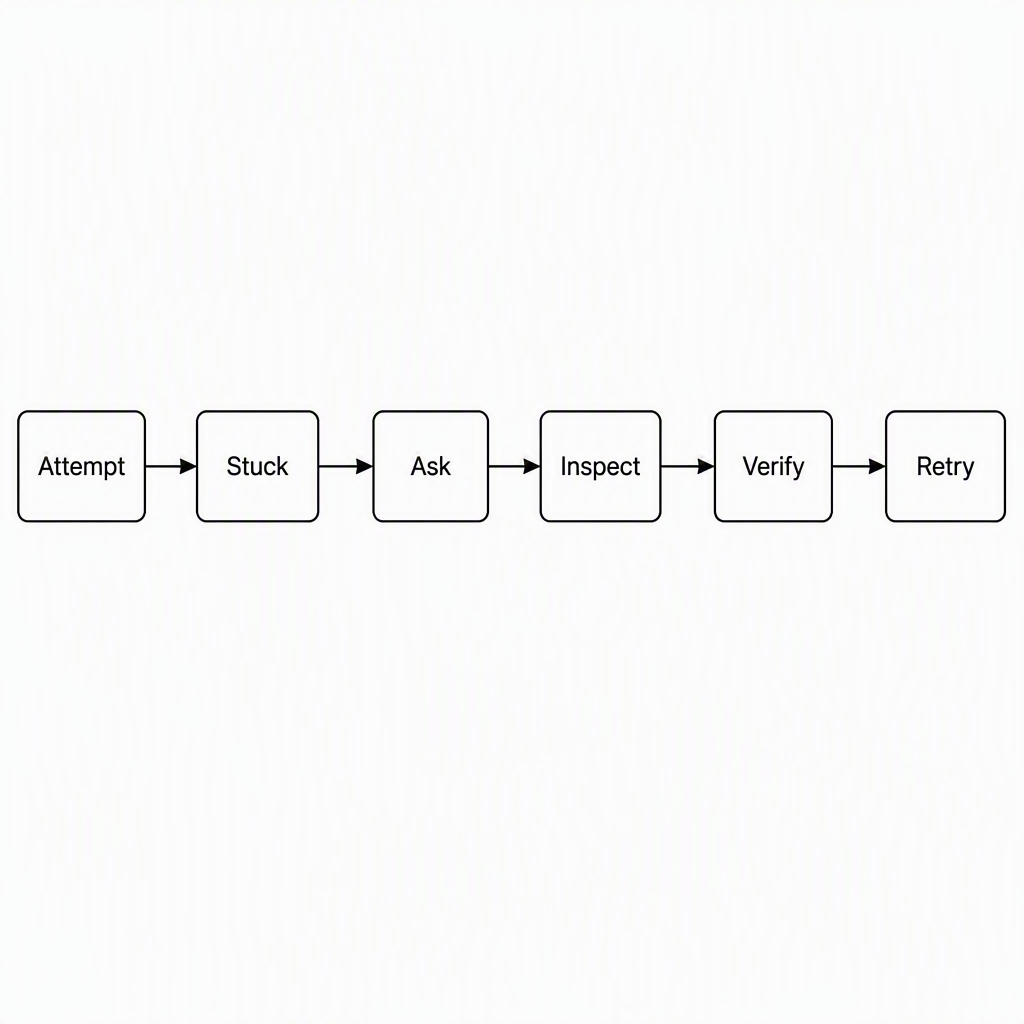
- Attempt first. Write the formula, fact, mechanism or option elimination you considered.
- Mark the exact block. State whether you cannot select a law, interpret the diagram, recall an NCERT line or complete a calculation.
- Send the complete question. Include all options, the full diagram, the source and your own attempt. A cropped fragment may remove the condition that decides the answer.
- Inspect the reasoning. Do not accept an option alone. Check whether each step follows from the question and whether the AI introduced an unstated assumption.
- Verify the decisive claim. For Biology and Inorganic Chemistry, compare factual claims with the relevant NCERT passage. A generated quotation is not evidence until you locate it in the book.
- Audit every numerical. Independently check dimensions, signs, powers of ten and whether the selected option matches the calculated result.
- Solve one similar question without help. This distinguishes understanding from recognition.
Treat AI as a tutor, not an answer-key generator. Copying solutions creates familiarity, but familiarity often disappears when values, wording or diagrams change in the exam.
Escalate conflicting textbook statements, ambiguous questions, suspected answer-key errors and repeated AI contradictions to a qualified teacher. Record the corrected principle beside the original mistake, then solve a fresh question using that principle without AI assistance.
Next step: the past-paper archive on NEET JEEnius AI and search past NEET papers by year, subject or chapter, each with a worked solution (100 free searches a month).
Frequently asked questions
Which AI doubt solver is best for NEET?
An NEET-specific, NCERT-grounded conversational tutor is the best primary option for routine doubts. It should show each step, support follow-up questions and clearly state uncertainty. Use a qualified teacher for disputed keys, ambiguous diagrams and syllabus exceptions.
Can I trust an AI doubt solver for Biology NCERT questions?
Trust the reasoning only after checking the decisive claim in your NCERT textbook. A reliable solver should identify the relevant chapter, stay close to NCERT terminology and separate textbook statements from added information.
When should I use a photo solver for NEET doubts?
Use a photo solver to locate an existing solution to a familiar coaching-sheet or printed question. Before accepting it, compare every value, option, condition and diagram label because a visually similar question may require a different answer.
How do I test an AI doubt solver before paying?
Test it with one NCERT-based Biology question, one multi-step Physics numerical and one Chemistry exception. Check whether it cites the governing concept, preserves units, responds correctly to changed conditions and admits missing information.
What should I do if AI and the NEET answer key disagree?
Do not choose the answer supported by the largest number of chatbots. Verify the decisive fact using NCERT or an accepted official key, then escalate repeated contradictions, suspected key errors or ambiguous questions to a qualified teacher.