What is the answer to the capacitor networks NEET 2026 question?
In the capacitor networks NEET 2026 question, P stores one-sixth of the total capacitor energy, so option D is correct. It is from NEET UG 2026, held on 2026-06-21, Code-50, Physics, Electrostatics. The question bank classifies it as medium difficulty, using tag 2.
Three capacitors, P, Q and S, each have capacitance C. P and Q connect in parallel between nodes X and B; this parallel block connects in series with S across a battery of voltage V. Find the energy stored in P divided by the total energy stored in all three capacitors.
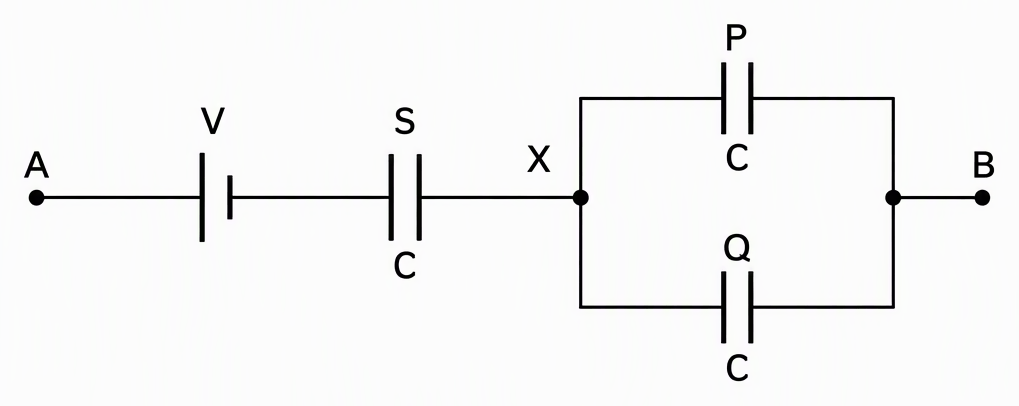
The answer choices are:
The denominator is energy stored in the capacitors, not energy supplied by the battery:
How do you find the equivalent capacitance and total stored energy?
Combine P and Q first, then combine that block with S in series. The official reduction method uses the equivalent capacitance and full battery voltage to calculate total stored energy. Do not treat all three capacitors as individual series elements.
Step 1: Reduce the network. P and Q are parallel because both connect between the same two nodes, X and B. They have the same potential difference, and their capacitances add:
The reduced circuit has two series elements: the parallel block and capacitor S. Substituting their capacitances gives:
Step 2: Calculate the total stored energy. The equivalent capacitor is across the full battery voltage:
Keep this denominator for the final division. P’s energy requires P’s own voltage, not the full battery voltage.
How do you find P’s voltage and prove its energy fraction is one-sixth?
P has one-third of the battery voltage across it. Find this by calculating the series charge, then S’s voltage, then the voltage left across the parallel block. P shares the block’s voltage, but not its entire charge.
Step 3: Find the charge and voltage division. Use lowercase charge notation to avoid confusion with the capacitor labelled Q:
This is the charge magnitude on S and on the parallel block as a whole. The voltage across S is:
Subtract this from the battery voltage:
Both parallel branches connect across that same potential difference:
P does not carry the entire block charge. The branch charges are:
Step 4: Calculate P’s energy using P’s voltage.
Step 5: Divide by the total stored energy.
This gives option D. Verify it by adding the individual energies:
Identical capacitance does not guarantee identical energy. Energy also depends on the square of the voltage.
Why does swapping P and S produce option A?
Option A comes from assigning S’s voltage to P while keeping the correct total energy. This swaps the roles of the individual series capacitor S and the parallel-branch capacitor P. The energy formula is applied to the wrong capacitor’s voltage.
The incorrect assignment is:
That voltage actually belongs to S. Using it for P produces the wrong numerator:
Dividing by the correctly calculated total gives:
Two-thirds is the actual fraction stored in S, not P. Before assigning any voltage, identify the two nodes across the named capacitor: P spans X and B; S spans A and X.
How do you solve three related questions using the same circuit?
Use the established voltage division: charge depends on voltage, while energy depends on voltage squared when capacitance is fixed. These are original related practice questions, not additional verified NEET PYQs. Keep the same circuit and labels throughout.
What is the ratio of charge on P to charge on S?
P carries half the charge magnitude on S. The series-block charge splits equally between P and Q because their capacitances and voltages are equal.
S matches the charge of the whole parallel block, not either branch alone.
What is the ratio of energy in Q to energy in S?
Q stores one-quarter as much energy as S. Their capacitances are equal, but Q has half of S’s voltage.
Equivalently, the energy ratio is the square of their voltage ratio:
What happens to P’s energy and total energy if the battery voltage doubles?
Both energies quadruple, while their ratio stays one-sixth, because stored energy depends on voltage squared. All capacitances remain unchanged, so each capacitor still receives the same fraction of the battery voltage.
Cover the working and reproduce the solution. Identify each capacitor’s node pair before assigning its voltage.
Next step: photograph a doubt on NEET JEEnius AI and photograph any question you are stuck on and get a step-by-step solution across Physics, Chemistry and Biology (20 free a month).
For a worked example of the same idea, see How to Study Rotational Motion NEET: A Six-Step Plan.
Frequently asked questions
What is the answer to the capacitor networks NEET 2026 question?
Capacitor P stores one-sixth of the total energy stored in the three capacitors, so option D is correct. Its energy is CV²/18, while the total stored energy is CV²/3.
How do you find the equivalent capacitance of this network?
P and Q, each of capacitance C, connect in parallel, giving a combined capacitance of 2C. This block connects in series with S, whose capacitance is C. The equivalent capacitance is therefore (2C × C)/(2C + C) = 2C/3.
Why is the voltage across P equal to V/3?
The parallel block containing P and Q has capacitance 2C and connects in series with S of capacitance C. These two series elements carry equal charge, so their voltages are inversely proportional to their capacitances. The block receives V/3, and P shares that voltage because it connects across the same two nodes.
Why is 2/3 the wrong energy fraction for P?
The fraction 2/3 belongs to S, the individual series capacitor, not P in the parallel block. S has voltage 2V/3, whereas P has voltage V/3. Assigning S's voltage to P gives the wrong numerator when calculating P's fraction of the total stored energy.