What is the correct answer to the Cell Membrane NEET 2026 question?
The supplied answer to the Cell Membrane NEET 2026 question is option C, numbered option (3): A, B and D only. This Biology question belongs to Cell Structure and Function and is tagged medium by the question bank. Given that difficulty tag, treat 60 seconds as an expected solving target, not a guaranteed completion time.
The task is to select all correct statements about a eukaryotic cell membrane. Water-based extracellular fluid and cytoplasm lie on opposite sides of the bilayer.
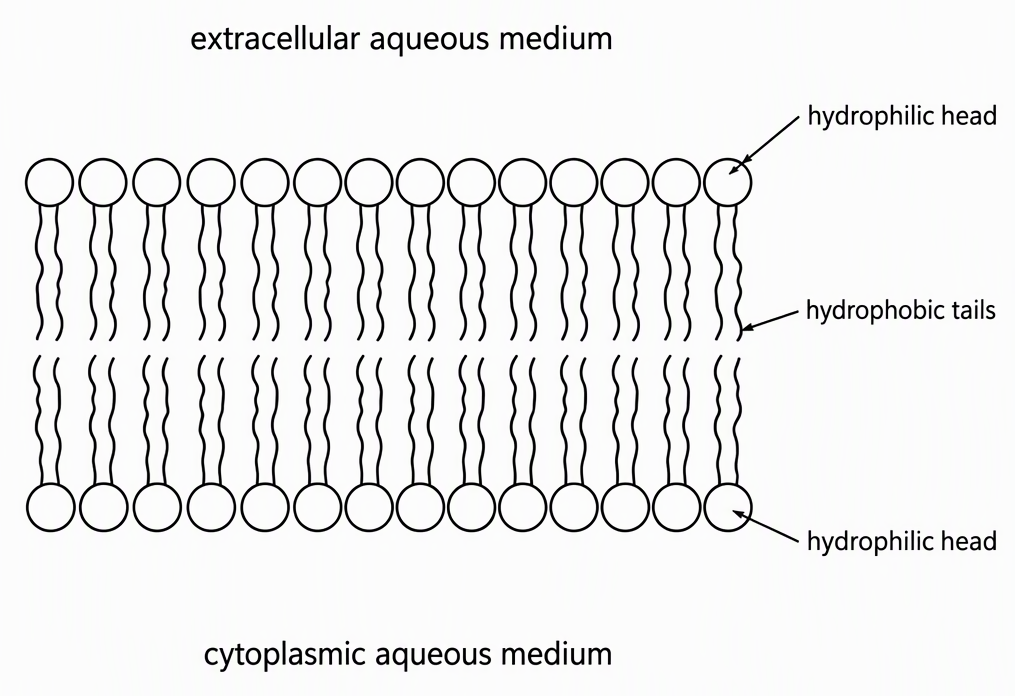
The five statements, paraphrased, are:
- A: Proteins account for about 52% of the human RBC membrane.
- B: The principal phospholipids form two layers.
- C: Inward plasma-membrane folds produce mesosomes.
- D: Water-repelling lipid tails face the membrane interior.
- E: A glycocalyx coats the membrane’s external surface.
The answer combinations are:
- Option A/(1): C, D and E only.
- Option B/(2): B, C and E only.
- Option C/(3): A, B and D only.
- Option D/(4): A, C and E only.
Statement C and answer option C are different labels: one names a claim; the other names a combination.
Why does the supplied solution reject mesosomes and glycocalyx?
The supplied solution excludes statement C because it assigns mesosomes to prokaryotes, not eukaryotes. It excludes statement E because it also treats glycocalyx as a prokaryotic feature. The second rejection needs a qualification: it does not establish that animal cells lack glycocalyx.
For statement C, the textbook account used by this question describes mesosomes as infoldings of the plasma membrane in prokaryotes. They are not a general property of all cells. Under that account, assigning mesosomes to a eukaryotic cell fails the question’s cell-type requirement.
For statement E, rejection follows the supplied key’s treatment of glycocalyx, not a reliable universal distinction between cell types. Keep that distinction visible when reproducing the supplied solution.
Accuracy note: The blanket claim that eukaryotes lack glycocalyx is biologically incorrect. Animal cells can bear a carbohydrate-rich glycocalyx on their outer surface.
The question therefore has a wording/key limitation. Retain the supplied answer for this solution set, but do not memorise “eukaryotes lack glycocalyx” as a membrane rule. Keep statement E as written rather than changing its meaning to justify the key.
Why are statements A, B and D accepted?
The human RBC protein proportion supports A; the phospholipid bilayer supports B; and its inward-facing hydrophobic tails support D. Check each fact rather than relying only on option elimination. The composition claim applies to a particular membrane, while B and D explain its lipid arrangement.
- A is accepted: The human RBC membrane contains approximately 52% protein. Keep “approximately” and the membrane’s identity together. This value does not establish the protein proportion of every cellular membrane.
- B is accepted: The major phospholipids are organised into a bilayer, meaning two layers.
- D is accepted: Phospholipid tails are hydrophobic. They face the bilayer interior, away from the surrounding aqueous regions.
B and D are connected: the two-layer arrangement places hydrophilic heads towards extracellular fluid and cytoplasm while shielding hydrophobic tails between them. “Membrane interior” means within the bilayer, not inside the cell’s aqueous cytoplasm.
How do A, B and D map to option C?
The supplied classification is A accepted, B accepted, C rejected, D accepted and E rejected under the key’s stated interpretation. The qualification belongs beside E: animal cells can have glycocalyx, so E is not universally false.
The surviving combination is:
Final answer: option C, equivalent to numbered option (3), “A, B and D only”. Every other listed option contains statement C, so rejecting mesosomes in the stated eukaryotic scope also provides an option-level cross-check.
How can a scope error lead to wrong option B?
Choosing option B/(2), containing B, C and E, can result from recognising membrane-related terms before checking the cell type. Familiar terms do not make the whole combination correct.
B is true, but mesosomes do not fit the eukaryotic scope under this question’s textbook account, so option B fails. It also leaves out accepted statements A and D; E alone is not the reason to reject it.
Under the supplied marking scheme, a correct response earns 4 marks and a wrong response loses 1. Choosing wrong option B instead of correct option C gives this score difference:
Repair the method in this order:
- Underline the cell type.
- Judge each statement independently.
- Match the complete accepted combination.
Can you apply the membrane facts to two original practice questions?
Test lipid orientation and the limits of a membrane-specific percentage with these two original chapter practice questions, not additional verified NEET PYQs. Neither depends on the disputed glycocalyx rejection. Answer each before reading its explanation.
Question 1, original chapter practice: Which phospholipid arrangement is consistent with aqueous fluid on both sides of a membrane?
Answer: A. Hydrophilic heads face the aqueous regions on both sides. Hydrophobic tails point towards one another within the bilayer, away from those fluids.
Question 2, original chapter practice: A student uses the approximate 52% protein value for human RBC membranes to claim that all cellular membranes have the same protein proportion. Is the claim justified?
Answer: No. The cited value concerns a particular membrane. It cannot establish a universal composition, so retain both the membrane’s identity and “approximately” when learning the fact.
For another chapter-specific question, use NEET JEEnius AI’s past-paper archive: search by year, subject or chapter, with worked solutions and 100 free searches a month. Classify the statements before opening the solution.
Next step: photograph a doubt on NEET JEEnius AI and photograph any question you are stuck on and get a step-by-step solution across Physics, Chemistry and Biology (20 free a month).
Keep going with Organic Compounds Containing Oxygen NEET 2003: Option D Explained.
Frequently asked questions
What is the answer to the Cell Membrane NEET 2026 question?
The supplied answer is option C, numbered option (3): A, B and D only. These statements concern human RBC membrane protein content, the phospholipid bilayer and inward-facing hydrophobic tails. The key’s rejection of statement E needs qualification because animal cells can have glycocalyx.
What percentage of the human RBC membrane is protein?
The human RBC membrane contains approximately 52% protein. This value applies to that particular membrane and should not be treated as the protein proportion of every cellular membrane.
Which way do phospholipid heads and tails face in the cell membrane?
Hydrophilic heads face the aqueous extracellular fluid and cytoplasm on opposite sides of the membrane. Hydrophobic tails point towards one another within the bilayer. The bilayer interior is not the cell’s aqueous cytoplasm.
Is glycocalyx absent in eukaryotic cells?
No. Animal cells can bear a carbohydrate-rich glycocalyx on their outer surface. The supplied solution rejects statement E by treating glycocalyx as a prokaryotic feature, but that is a limitation of the wording or key, not a universal membrane rule.