What is the final product in Organic Compounds Containing Oxygen NEET 2003?
Option D is correct: the final product is a tertiary alcohol, not reduced acetophenone. In this organic compounds containing oxygen NEET 2003 question, ethanoic acid becomes intermediate A with phosphorus pentachloride. Benzene and anhydrous aluminium chloride then produce B, which reacts with ethylmagnesium bromide in ether.
Hydrolysis is implicit in the official solution, although the question’s reagent sequence does not show it. Intermediate labels A, B and C name reaction stages, not answer options.
- Option A
- Option B
- Option C
- Option D
The question bank rates this question hard, with an expected solving time of 90 seconds. These are bank settings, not measured student performance.
How does phosphorus pentachloride convert acetic acid into intermediate A?
Intermediate A is acetyl chloride, also called ethanoyl chloride. Phosphorus pentachloride replaces the carboxylic acid’s hydroxyl group with chlorine. It does not remove the carbonyl oxygen or change the methyl group attached to the carbonyl carbon.
The balanced equation shows this replacement. The carbon framework remains intact:
Track the carbonyl carbon, the carbon double-bonded to oxygen in acetic acid. It remains the carbonyl carbon in acetyl chloride and becomes the hydroxyl-bearing carbon in the final alcohol. Follow this atom and its attached groups rather than matching the overall appearance of an answer option.
Why does Friedel–Crafts acylation give acetophenone as intermediate B?
Intermediate B is acetophenone, a ketone. Acetyl chloride reacts with benzene in the presence of anhydrous aluminium chloride. The acetyl group attaches to the benzene ring, so the product retains the carbonyl group rather than becoming methylbenzene.
Friedel–Crafts acylation introduces the whole acetyl group, not only a methyl group. The group attached to benzene is:
Rewrite acetophenone around the carbon we are tracking. This makes both carbon groups attached to it visible:
The carbonyl carbon now has phenyl on one side and methyl on the other. Methyl is retained from acetyl chloride; phenyl is introduced through the reaction with benzene. Both remain attached during the next reaction.
Answer option B is acetophenone, but it is only the intermediate. Selecting it stops the solution before the Grignard reaction and hydrolysis.
How does ethylmagnesium bromide give the final tertiary alcohol?
Ethyl adds to the carbonyl carbon first; hydrolysis then converts the magnesium alkoxide into an alcohol. These are separate operations. The carbon–magnesium bond is polarised towards carbon, making the ethyl carbon bonded to magnesium the nucleophilic end of the reagent.
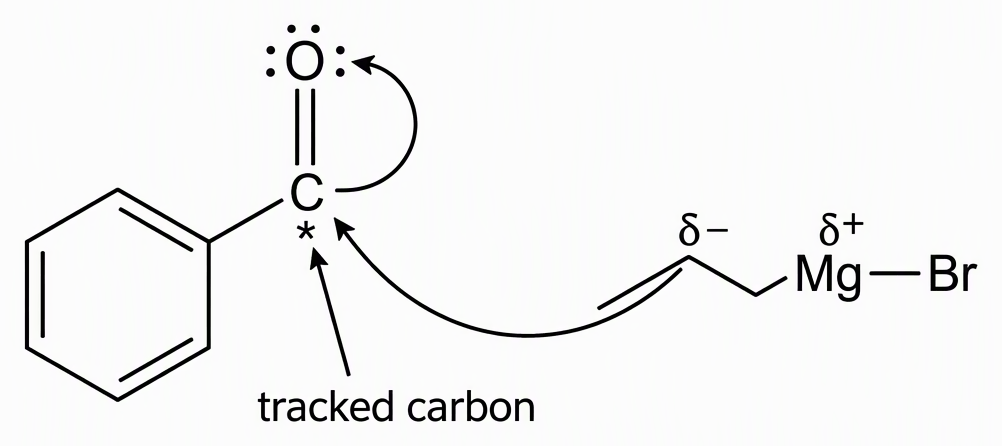
The Grignard reagent is not a free, isolated ethyl carbanion. Its polarised bond explains why ethyl attacks the electron-poor carbonyl carbon.
As ethyl forms a new carbon–carbon bond, the carbonyl pi electrons move onto oxygen. The immediate product is a magnesium alkoxide, not the neutral alcohol. A separate aqueous work-up gives the alcohol:
Dry ether is needed during addition because water would consume the Grignard reagent by protonating its ethyl group. Water enters only during work-up, after addition has occurred.
The hydroxyl-bearing carbon carries three carbon groups, making the alcohol tertiary, as shown in option D:
- Phenyl, introduced through Friedel–Crafts acylation.
- Methyl, retained from the original acetic acid.
- Ethyl, added by the Grignard reagent.
Check the carbon count: acetophenone contains six ring carbons, one carbonyl carbon and one methyl carbon. Ethyl supplies two more, with no original carbon group lost or replaced.
Why does treating the last step as reduction give option C?
Option C results from adding hydrogen instead of ethyl to acetophenone’s carbonyl carbon. That produces a secondary alcohol. It is a valid reduction product, but not the product of the stated Grignard addition followed by hydrolysis.
Option C can be written as follows. Its hydroxyl-bearing carbon has a hydrogen where the required product has ethyl:
Reduction retains the 8-carbon skeleton here. Ethylmagnesium bromide instead creates a new carbon–carbon bond and produces a 10-carbon alcohol.
Hydrolysis supplies the proton on oxygen. It does not replace the newly attached ethyl group with hydrogen on carbon.
Use this checking rule:
- Retain both original ketone substituents.
- Add the Grignard alkyl group to the carbonyl carbon.
- Convert the oxygen–magnesium group into a hydroxyl group during work-up.
What happens when the same reagent reacts with propanone and ethanal?
Propanone gives a tertiary alcohol, while ethanal gives a secondary alcohol. In both cases, ethyl is added and the original carbonyl substituents remain. These are original related practice questions, not verified past-paper questions.
What forms when propanone reacts with ethylmagnesium bromide in dry ether followed by hydrolysis?
The product is 2-methylbutan-2-ol. Retain propanone’s two methyl groups, attach ethyl, then hydrolyse the magnesium alkoxide.
Its hydroxyl-bearing carbon carries two methyl groups and one ethyl group. Three carbon attachments make this a tertiary alcohol.
What forms when ethanal reacts with ethylmagnesium bromide in dry ether followed by hydrolysis?
The product is butan-2-ol. Ethanal starts with methyl and hydrogen attached to its carbonyl carbon; both remain when ethyl adds.
One hydrogen remains on the hydroxyl-bearing carbon, so this alcohol is secondary. It matches original option A, which fits an ethanal starting carbonyl, not acetophenone.
Before classifying the alcohol, count what remains attached to the tracked carbon. The ketone propanone retains two carbon groups and gains a third; the aldehyde ethanal retains one carbon group and one hydrogen, then gains a second carbon group.
Next step: the past-paper archive on NEET JEEnius AI and search past NEET papers by year, subject or chapter, each with a worked solution (100 free searches a month).
For a worked example of the same idea, see Floating Body and SHM NEET 2026: Density Ratio of 1/4.
Frequently asked questions
What is the final product in the organic compounds containing oxygen NEET 2003 question?
Option D is correct: C6H5C(OH)(CH3)(C2H5), a tertiary alcohol. Ethylmagnesium bromide adds ethyl to acetophenone’s carbonyl carbon, and subsequent hydrolysis gives the alcohol. The hydroxyl-bearing carbon is attached to phenyl, methyl and ethyl groups.
What are intermediates A and B in the NEET 2003 reaction sequence?
Intermediate A is acetyl chloride, formed when ethanoic acid reacts with phosphorus pentachloride. Intermediate B is acetophenone, formed by Friedel–Crafts acylation of benzene with acetyl chloride in the presence of anhydrous aluminium chloride.
Why is option C wrong in the acetophenone Grignard reaction?
Option C is the secondary alcohol formed by reducing acetophenone, which adds hydrogen rather than ethyl to the carbonyl carbon. Ethylmagnesium bromide instead forms a new carbon–carbon bond, increasing the carbon count from eight to ten. Hydrolysis protonates oxygen without removing the newly attached ethyl group.
Why is dry ether used before hydrolysis in a Grignard reaction?
Water would consume ethylmagnesium bromide by protonating its ethyl group, so the addition is carried out in dry ether. The immediate addition product is a magnesium alkoxide. Water is introduced only during the subsequent work-up to produce the alcohol.