What is the correct answer to the floating body and SHM NEET 2026 question?
Option D, one-fourth, is correct for the floating body and SHM NEET 2026 question: doubling the period requires one-fourth the liquid density. The question belongs to Properties of Solids and Liquids. The question bank rates it medium and gives an expected solving time of 90 seconds, not a measured student average.
The same uniform cylindrical cork floats with its axis vertical in two different liquids. In each liquid, it is pushed a small distance downward and released, producing small vertical oscillations about equilibrium.
The given periods and required ratio are:
The supplied choices are:
How does extra immersion produce a restoring force?
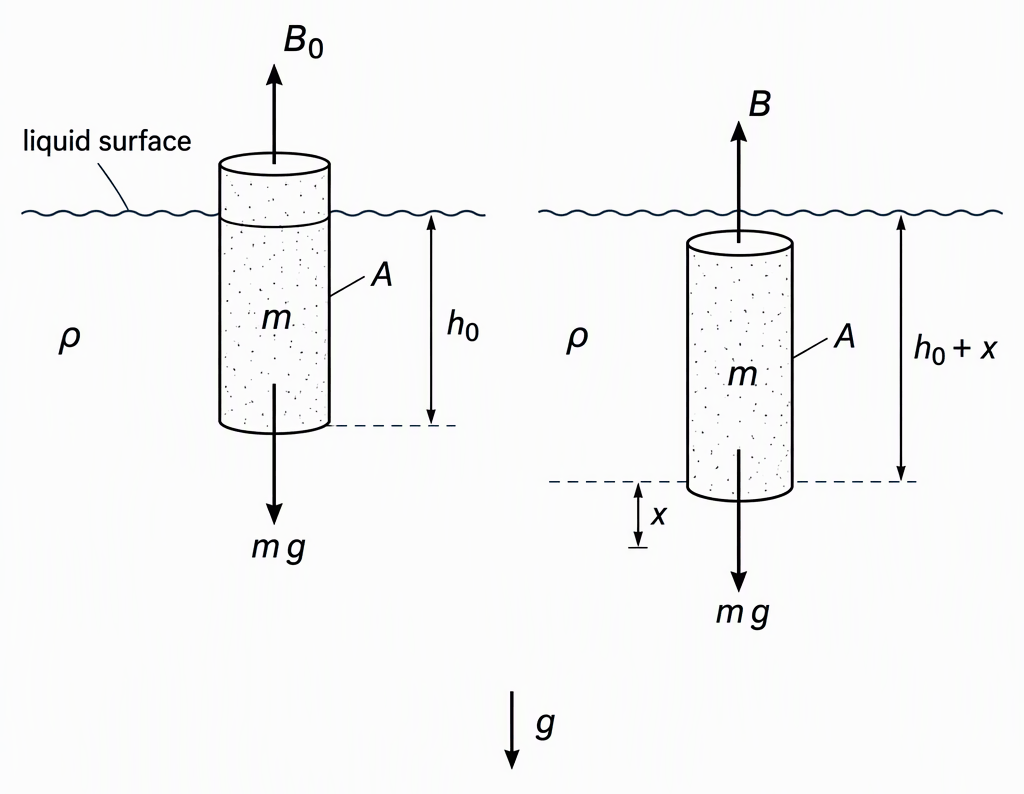
The restoring force is the change in buoyancy, not total buoyancy. At equilibrium, the original buoyancy balances the cork’s weight. A downward push submerges extra volume, increasing the upward force while leaving the weight unchanged.
Use these symbols:
Archimedes’ principle gives the equilibrium balance:
Because the cork is cylindrical, the extra submerged volume is its cross-sectional area multiplied by the downward displacement:
The increase in upward buoyancy is:
Choose downward as positive. Weight is positive, while buoyancy acts in the negative direction:
The equilibrium buoyancy and weight cancel, leaving only the change in buoyancy. The minus sign shows that a downward displacement produces an upward net force. For a small upward displacement, buoyancy decreases and the net force points downward.
Comparing this result with the spring force law identifies the effective spring constant:
How do we derive the period of the floating cork?
Use the effective spring constant in Newton’s second law to obtain the SHM equation. For the same cork, a denser liquid gives a larger restoring force per unit displacement. The cork therefore oscillates faster, so its period decreases.
Newton’s second law gives:
Rearranging into the standard SHM form:
The coefficient of displacement is the square of angular frequency:
Substitute this into the period relation:
This matches the official worked solution. The cork’s mass, cross-sectional area and gravitational acceleration remain unchanged between the liquids, giving:
Here, density means liquid density, not cork density. This model assumes small vertical motion, constant cross-sectional area at the liquid surface, continued partial immersion, and negligible damping or other fluid-dynamic corrections.
Why does doubling the period give option D?
The period varies inversely with the square root of liquid density, so doubling it requires one-fourth the density. Write the full period ratio before cancelling constants. This keeps the density order correct without relying on memory.
For the same cork:
Substitute the given period ratio:
Square both sides:
Now invert explicitly to obtain the ratio asked:
Check the direction independently: lower liquid density gives a smaller increase in buoyancy for the same displacement. That means a weaker restoring force and a longer period, exactly as required.
For the same cork, under the stated model, the reusable relation is:
Why does reversing the density dependence give option A?
Putting the densities in the wrong order gives a density ratio of four instead of one-fourth. The incorrect route is:
The error confuses spring stiffness with period:
A lighter liquid makes the cork sit deeper at equilibrium. But equilibrium depth is not the restoring-force gradient, the change in buoyancy per unit displacement:
Prefer the full-expression method over a memorised ratio. Write each period before cancelling constants, then check that the longer period belongs to the less-dense liquid.
How can you apply this method to three related practice questions?
Use the period relation for oscillations and the equilibrium balance for immersion. These are original related practice questions from Properties of Solids and Liquids, not additional verified NEET PYQs.
Question 1: What is the period ratio if the second liquid has one-ninth the original density?
The period triples, provided the same cork still floats partially immersed. Substitute the new liquid density:
Question 2: How do the equilibrium immersed depths compare in the original setup?
The cork sits four times deeper in the less-dense liquid, provided it remains partially immersed. Use force balance: the same weight must be supported in both liquids.
Therefore:
Question 3: What cork density allows partial immersion in both original liquids?
The cork density must be less than one-fourth the first liquid’s density. The less-dense liquid sets the stricter condition, because the submerged fraction must be less than one.
From Archimedes’ principle:
Hence:
Equality would require full immersion. That lies outside the surface-crossing model used to obtain the extra submerged volume.
Next, practise connecting restoring force with energy using Simple Harmonic Motion NEET 2026: Energy Graph Solution.
Frequently asked questions
What is the answer to the floating body and SHM NEET 2026 question?
Option D, one-fourth, is correct. For the same cylindrical cork, the period varies inversely with the square root of liquid density, so doubling the period requires one-fourth the original liquid density.
What is the time period formula for a floating cylindrical cork?
The period is T = 2π√(m/(ρAg)), where m is cork mass, ρ is liquid density, A is the constant horizontal cross-sectional area, and g is gravitational acceleration. This model assumes small vertical oscillations, continued partial immersion, and negligible damping or other fluid-dynamic corrections.
Why is the restoring force on a floating cork equal to −ρAgx?
At equilibrium, buoyancy balances the cork's weight. A downward displacement x adds submerged volume Ax, increasing upward buoyancy by ρAgx. Taking downward as positive, the net restoring force is therefore −ρAgx.
What cork density allows it to float in both liquids?
When the second liquid has one-fourth the first liquid's density, the cork density must be less than ρ₁/4 to remain partially immersed in both. Equality would require full immersion in the second liquid, outside the surface-crossing model used for this SHM derivation.