What is the correct match in the cellular respiration NEET 2026 question?
Option C, numbered option 3, is correct: ETS lies in the inner mitochondrial membrane, but pumped protons accumulate in the intermembrane space. This supplied cellular respiration NEET 2026 Biology question belongs to Plant Physiology. The question bank tags it medium and gives an expected solving time of 60 seconds, not an official time limit.
Assign each List-I respiration event to its List-II cellular site. Use the mitochondrial context to distinguish the membrane, the compartments beside it and the cytoplasm outside.
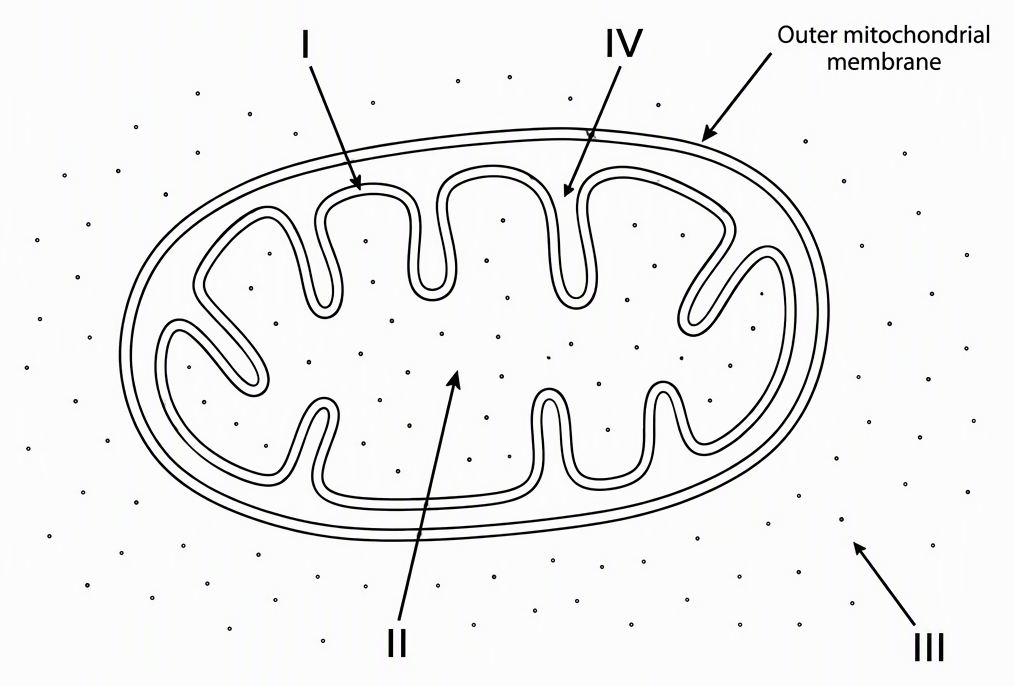
List-I: processes
List-II: locations
- I: Inner mitochondrial membrane
- II: Mitochondrial matrix
- III: Cytoplasm
- IV: Intermembrane space
Answer choices
- Option A (1): A-IV/B-II/C-I/D-III
- Option B (2): A-II/B-III/C-IV/D-I
- Option C (3): A-III/B-I/C-IV/D-II
- Option D (4): A-I/B-IV/C-III/D-II
Option letters name complete answers; List-I letters name individual processes.
Where does each respiration process occur?
Glycolysis occurs in the cytoplasm; the other three matches concern mitochondrial sites. Establish all four locations independently, in the supplied solution’s order, rather than selecting an option from one familiar pair.
Step 1: Place glycolysis in the cytoplasm.
Glycolysis does not require entry into a mitochondrion. Its reactions occur in the cytoplasm, even though it forms part of cellular respiration. Therefore, List-I item A matches location III: A-III.
Step 2: Place ETS in the inner mitochondrial membrane.
In the mitochondrial setting of this question, the electron transport system is located in the inner mitochondrial membrane. This identifies the site of the transport machinery, not the compartment where pumped protons collect. Thus, List-I item B matches location I: B-I.
Step 3: Place proton accumulation in the intermembrane space.
During mitochondrial electron transport, protons are pumped from the matrix towards the intermembrane space. That receiving compartment is the site of accumulation, so List-I item C matches location IV: C-IV.
The membrane contains the transport machinery; the neighbouring space receives the pumped protons. Match the process to its stated site, not merely to a nearby structure involved in it.
Step 4: Place Krebs’ cycle in the mitochondrial matrix.
At the process-location level used in this question, Krebs’ cycle is assigned to the mitochondrial matrix. Therefore, List-I item D matches location II: D-II.
Why is option C, numbered option 3, correct?
Option C reproduces all four independently established pairs. The complete result is:
A-III, B-I, C-IV, D-II.
Option C (3) lists A-III/B-I/C-IV/D-II, agreeing with every pair in order. The correct answer is option C, corresponding to numbered option 3.
This is a location-matching problem, so no calculation is needed. Separately, if a marking scheme awards four marks for a correct response and deducts one for an incorrect response, the score difference is:
Recall: glycolysis: cytoplasm; ETS: inner membrane; proton accumulation: intermembrane space; Krebs’ cycle: matrix.
Why is C-I in option A wrong?
Option A, numbered option 1, incorrectly assigns List-I item C, proton accumulation, to location I, the inner mitochondrial membrane. The error is using the site of the proton-pumping machinery as the destination of the pumped protons. The membrane houses the machinery; the space beside it receives the protons.
Keep these questions separate:
- Where is ETS located? Inner mitochondrial membrane.
- Where do the pumped protons accumulate? Intermembrane space.
Check the direction of proton pumping during mitochondrial electron transport:
The arrow ends at the accumulation site, not at the membrane containing the machinery. This explains one incorrect component of option A; that option also contains other incorrect matches.
How do you solve related respiration-location questions?
Identify the reaction site, transport direction and cell type before choosing a location. These are original practice questions from cellular respiration within Plant Physiology, not additional verified NEET past-paper questions. Answer each before reading its explanation.
Where is pyruvate converted to acetyl-CoA during aerobic respiration in a eukaryotic cell?
Answer: the mitochondrial matrix. Glycolysis produces pyruvate in the cytoplasm, but its conversion to acetyl-CoA during aerobic respiration takes place in the matrix. Connected stages need not occur in the same compartment.
In which direction do protons move through mitochondrial ATP synthase during ATP formation?
Answer: from the intermembrane space to the matrix. This return flow is opposite to proton pumping during mitochondrial electron transport, which sends protons from the matrix towards the intermembrane space.
Can a prokaryotic cell perform glycolysis without mitochondria?
Answer: yes, because glycolysis occurs in the cytoplasm. A mitochondrion is not required for this pathway. Do not extend the main question’s mitochondrial ETS location to prokaryotes: that match applies specifically to the mitochondrial setting.
Next, practise identifying the location before reading the options: Plant Physiology Practice Questions NEET: 6 Explained MCQs.
Frequently asked questions
What is the correct match in the cellular respiration NEET 2026 question?
Option C, numbered option 3, is correct: A-III, B-I, C-IV, D-II. Glycolysis occurs in the cytoplasm, ETS lies in the inner mitochondrial membrane, pumped protons accumulate in the intermembrane space, and Krebs’ cycle is assigned to the mitochondrial matrix.
Where do protons accumulate during mitochondrial electron transport?
Pumped protons accumulate in the intermembrane space. ETS is located in the inner mitochondrial membrane, but protons are pumped from the matrix towards the intermembrane space. The location of the machinery is not the destination of the pumped protons.
Which way do protons move through mitochondrial ATP synthase?
During ATP formation, protons move through mitochondrial ATP synthase from the intermembrane space to the matrix. This return flow is opposite to proton pumping during mitochondrial electron transport.
Can prokaryotes perform glycolysis without mitochondria?
Yes, prokaryotic cells can perform glycolysis because the pathway occurs in the cytoplasm and does not require mitochondria. The inner mitochondrial membrane location given for ETS in this question applies specifically to the mitochondrial setting, not to prokaryotes.