
Which Plant Physiology practice format should I start with for NEET?
Choose chapterwise MCQs first, PYQs next, and full mocks for exam execution. For plant physiology practice questions NEET students can attempt immediately, use NCERT-aligned questions to identify and repair gaps. Use previous-year questions to study how concepts have been tested, and full mocks to test complete-paper performance.
A full mock is not an efficient substitute for revising two concepts you repeatedly confuse. The free original diagnostic below includes answers and explanations; these are not questions claimed to have appeared in NEET.
How do free chapterwise MCQs, verified PYQs and full-length mocks compare?
Chapterwise questions expose specific gaps; verified PYQs show how concepts were tested; mocks test complete-paper performance. Choose by the feedback you need, not by the number of questions available.
- Best use
- This page’s original MCQs: Identify and repair Plant Physiology misunderstandings.
- Verified Plant Physiology PYQs: Study how concepts were tested.
- NEET JEEnius AI full-length mocks: Practise complete-paper execution.
- Topic focus
- This page: Photosynthesis, respiration, and plant growth and development.
- PYQs: Plant Physiology questions selected from official papers.
- Mocks: Physics, Chemistry and Biology across a full paper.
- Answer provenance
- This page: Original NCERT-aligned practice with explanations, neither official PYQs nor next-paper predictions.
- PYQs: Wording checked against the corresponding official paper; answers checked against its final key.
- Mocks: No official-paper or final-key provenance is specified in the verified offer.
- Feedback available
- This page: Mechanism-based explanations and a repair task for each mistake.
- PYQs: A verified correct option; the official final key alone does not explain the mechanism.
- Mocks: A scored per-subject breakdown, not a Plant Physiology topic-level diagnosis.
- Principal limitation
- This page: Six questions cannot cover every concept.
- PYQs: Remembering familiar answers can conceal weak understanding.
- Mocks: A subject score cannot by itself explain a recurring concept error.
- Free access
- This page: All six questions and explanations are readable below.
- PYQs: Use official NTA papers and final keys when available through neet.nta.nic.in.
- Mocks: 30 free full-length mocks a month, each with 180 questions, 720 marks and 180 minutes: 45 Physics, 45 Chemistry and 90 Biology questions.
A year label alone does not establish authenticity. Check both the wording and answer against the corresponding official paper and final key.
Which format should Class 11 students, Class 12 students and droppers choose?
Choose by your recurring error, not merely by your class. Separate difficulty understanding a mechanism from difficulty applying it in a complete paper. Those problems need different practice.
- Class 11, just studied photosynthesis: Start chapterwise. Explain each answer before mixing photosynthesis with respiration or growth regulators.
- Class 12, revisiting C3 and C4 pathways: Use targeted comparison questions first. Correct the enzyme, cell location and carbon-acceptor distinctions, then attempt relevant PYQs.
- Dropper, remembers PYQ answers: Choose fresh questions with altered distractors. Justify rejected options, because recognising a familiar answer is not mastery.
- Accurate in isolated questions, weaker in complete papers: Choose full mocks. Review time allocation, omissions and guesses rather than adding another chapterwise set.
- Unable to explain a basic mechanism: Return to the relevant NCERT passage before attempting another large set. Identify the step you cannot explain and revise it first.
For parents, the useful signal is whether the same conceptual mistake returns, not how many questions the student has clicked through. Ask the student to explain one corrected distinction without notes rather than relying on a completion counter.
Can I try free Plant Physiology practice questions for NEET now?
Attempt these six questions without notes and mark every uncertain answer. This original diagnostic sample covers selected distinctions in photosynthesis, respiration, and plant growth and development. It is not complete chapter coverage, official PYQs or a difficulty-calibrated predictor of NEET performance.
Choose one answer per question before checking the explanations in the next section. For wider practice, check the applicable official syllabus at neet.nta.nic.in rather than relying on an old chapter list.
1. Two illuminated leaf preparations receive different oxygen-labelled substances: one receives labelled water, the other labelled carbon dioxide. Which result identifies the direct source of oxygen gas evolved during photosynthesis?
- A. Evolved oxygen carries the label from carbon dioxide.
- B. Evolved oxygen carries the label from water.
- C. Evolved oxygen comes directly from chlorophyll breakdown.
- D. Evolved oxygen comes from splitting ATP.
2. In an illuminated chloroplast, electrons excited from photosystem I circulate back through electron carriers rather than reducing NADP. Which output describes this cyclic electron flow?
- A. ATP, NADPH and oxygen.
- B. NADPH only, without ATP.
- C. ATP only, without NADPH formation or oxygen evolution.
- D. Oxygen only, without ATP.
3. An inhibitor specifically blocks PEP carboxylase in the mesophyll cells of a C4 leaf. Which process depends directly on this enzyme, rather than RuBisCO in bundle-sheath cells?
- A. Initial fixation of inorganic carbon into a four-carbon product.
- B. RuBisCO-mediated carboxylation of RuBP in bundle-sheath cells.
- C. Splitting of water at photosystem II.
- D. Transfer of electrons through the mitochondrial respiratory chain.
4. A student places glycolysis inside the mitochondrion because it contributes to respiration. Which correction identifies where glucose undergoes glycolysis in a typical plant cell?
- A. Mitochondrial matrix.
- B. Inner mitochondrial membrane.
- C. Mitochondrial intermembrane space.
- D. Cytoplasm.
5. Mature, unripe bananas are exposed to a gaseous plant growth regulator to promote ripening. Which regulator explains this response, rather than water-stress-associated stomatal closure?
- A. Abscisic acid.
- B. Ethylene.
- C. Cytokinin.
- D. Gibberellin.
6. A well-watered plant experiences declining soil moisture. Which regulator-response pair describes a protective response that reduces further water loss, rather than promoting growth?
- A. Gibberellin promotes stem elongation.
- B. Cytokinin promotes cell division.
- C. Abscisic acid promotes stomatal closure.
- D. Auxin promotes cell elongation.
What are the answers, and what should I revise after each mistake?
The answer key is 1 B, 2 C, 3 A, 4 D, 5 B, 6 C. Identify the distinction you missed, not just the correct letter. A correct guess remains an unresolved learning gap, although it still earns the normal marks in an exam-style score.
1. B: Photosynthetic oxygen comes from water.
Water splitting associated with photosystem II supplies electrons and releases protons and oxygen. Carbon dioxide supplies carbon for carbon fixation, but it is not the direct source of the oxygen gas evolved.
Option A wrongly treats carbon dioxide as the source of every photosynthetic product. Repair task: Write separate statements identifying the source of evolved oxygen and the source of carbon incorporated into carbohydrates.
2. C: Cyclic photophosphorylation produces ATP only.
Electrons excited from photosystem I return through an electron-transport pathway, supporting the proton gradient used for ATP synthesis. This cyclic pathway neither reduces NADP to NADPH nor involves water splitting that evolves oxygen.
Option A gives the outputs of non-cyclic electron flow, not cyclic flow. Repair task: Make separate cyclic and non-cyclic output lists, checking ATP, NADPH and oxygen against NCERT.
3. A: PEP carboxylase carries out initial C4 fixation.
In C4 mesophyll cells, PEP is the primary carbon acceptor, and PEP carboxylase enables initial fixation into oxaloacetate, a four-carbon compound. C4 acids carry carbon to bundle-sheath cells, where released carbon dioxide enters the Calvin cycle through RuBisCO-mediated carboxylation.
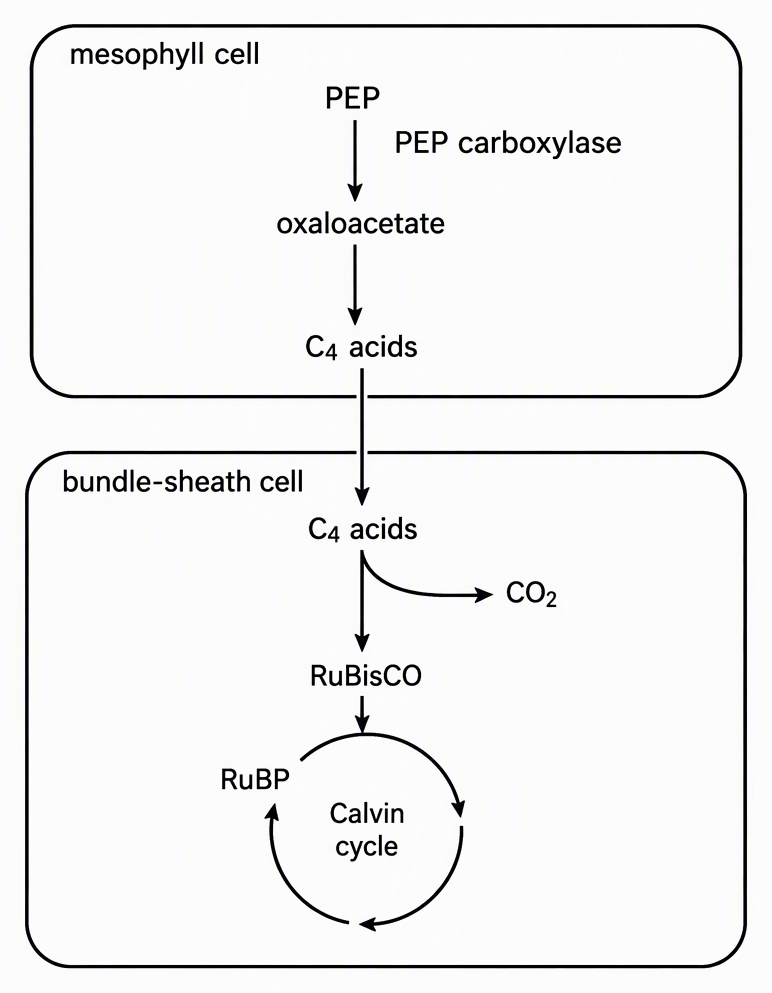
Option B confuses initial fixation with the later Calvin-cycle step, which the inhibited enzyme does not directly catalyse. Repair task: Make an enzyme-and-location map separating PEP carboxylase in mesophyll cells from RuBisCO in bundle-sheath cells.
4. D: Glycolysis occurs in the cytoplasm.
Glycolysis converts glucose to pyruvate outside the mitochondrion and does not directly require oxygen. Later stages of aerobic respiration include pyruvate oxidation and the Krebs cycle in the mitochondrial matrix, with electron transport at the inner mitochondrial membrane.
Option A assigns the location of later respiratory stages to glycolysis. Repair task: Label a cell sketch with cytoplasm, mitochondrial matrix and inner membrane, then place the relevant respiratory stages in each.
5. B: Ethylene promotes fruit ripening.
Ethylene is a gaseous plant growth regulator associated with ripening in fruits such as bananas. ABA also regulates plant responses, but its role in stress-associated stomatal closure does not explain this ripening treatment.
Repair task: Write two regulator-response pairs: ethylene with fruit ripening, and ABA with water-stress-associated stomatal closure. Keep the responses separate rather than treating growth regulators as interchangeable.
6. C: ABA promotes stomatal closure during water stress.
ABA-associated changes in guard-cell turgor promote closure, reducing water loss through transpiration. Gibberellin-driven stem elongation is a genuine growth response, but it does not answer a question asking for water conservation.
Repair task: Underline the response requested before selecting the regulator. Here, “reduces further water loss” rules out the growth-promoting responses.
What should I practise next, and when should I take a full mock?
Repair the missed distinction, then test it with a fresh question. Move to PYQs when you can explain both the answer and its tempting distractor. Choose full mocks when the objective becomes complete-paper execution, not because this short diagnostic establishes readiness.
Use this practice loop:
- Attempt without notes.
- Mark uncertain answers, including guesses.
- Check the explanation, not only the letter.
- Revisit the relevant NCERT passage.
- Attempt a fresh question testing the same distinction.
Keep your error log specific:
- Knowledge gap: “I did not know where glycolysis occurs.”
- Confused comparison: “I mixed up initial C4 fixation and Calvin-cycle fixation.”
- Stem-reading error: “I answered for non-cyclic flow although the question said cyclic.”
Apply the official marking rule:
Unattempted questions score zero. Mark correct guesses for revision without subtracting their earned marks; this short set predicts neither NEET score nor rank.
The current full paper has 180 compulsory single-correct questions in 180 minutes, with no optional Section B. That is an overall average of one minute per question, not a fixed allowance for each Biology question.
For separate Botany practice, use Plant Kingdom Practice Questions NEET: 6 Explained MCQs. It is not Plant Physiology revision.
When execution is the next target, use NEET JEEnius AI’s 30 free full-length mocks a month and scored per-subject breakdown. After the paper, inspect Biology omissions and guesses yourself, then return recurring Plant Physiology errors to the repair loop.
Frequently asked questions
Should I start Plant Physiology practice with MCQs, PYQs or mocks?
Start with chapterwise NCERT-aligned MCQs to identify specific concept gaps. Move to verified PYQs when you can explain the correct answer and reject the tempting distractor. Use full mocks to practise complete-paper execution, not to replace targeted revision.
Are these free Plant Physiology questions official NEET PYQs?
No. These six questions are original NCERT-aligned practice covering selected concepts in photosynthesis, respiration, and plant growth and development. To verify a claimed PYQ, check its wording against the corresponding official paper and its answer against the final key.
How should I revise after getting a Plant Physiology MCQ wrong?
Identify the exact distinction you missed, read the explanation, and revisit the relevant NCERT passage. Complete the repair task, then attempt a fresh question testing the same distinction. Mark correct guesses for revision too, without subtracting their earned marks.
Can six Plant Physiology questions predict my NEET score?
No, this short diagnostic predicts neither your NEET score nor rank and does not provide complete chapter coverage. Use it to identify selected conceptual gaps. Full mocks serve a different purpose: reviewing complete-paper execution, including time allocation, omissions and guesses.