
Should I start Plant Kingdom practice with chapter MCQs or a full mock?
Start with explained chapter MCQs after your first reading, not a full mock. Plant Kingdom practice questions for NEET should explain the distinction you missed, not just supply an answer letter. Six original, free questions with answers and explanations appear below, ready to attempt on this page.
If basic features and examples are still unfamiliar, begin with NCERT self-quizzing. Use full-length mocks to test recall under whole-paper pressure, not as your main tool for repairing one weak chapter.
This article compares practice formats, not unverified rankings of free websites. Choose the format that addresses the errors you make.
Which free Plant Kingdom practice format actually helps?
Explained chapter questions suit students who recognise the terms but confuse their meaning. NCERT self-quizzing tests basic recall; full-length mocks test recall during subject switching. The comparison below separates chapter repair from whole-paper practice.
Each comparison follows the same order: NCERT self-quizzing; this article’s explained MCQs; NEET JEEnius AI full-length mocks.
- Chapter focus: You select Plant Kingdom material from your textbook; all six questions here target Plant Kingdom; mocks cover the whole paper, with no guaranteed number of Plant Kingdom questions.
- Skill tested: Recall of features and examples; distinction between closely related botanical statements; recall, pacing and subject switching across a complete paper.
- Feedback available: Check your response against your textbook; use the answer key and editorial explanations below; receive a scored per-subject breakdown.
- Whole-paper relevance: Indirect preparation; focused repair before mixed practice; direct practice with a full-paper structure.
- Free-access scope: Make prompts from your own textbook; attempt this complete in-page set; use 30 free full-length mocks a month, each with 180 questions, 720 marks and 180 minutes.
- Main limitation: You must identify and explain your own errors; six questions cannot cover the chapter; a per-subject breakdown is not a Plant Kingdom diagnostic.
NCERT self-quizzing means turning textbook material into recall prompts. NCERT did not supply these original MCQs, and this in-page set does not imply an accompanying platform chapter bank.
Which format should Class 11, Class 12 and dropper students choose?
Choose by demonstrated weakness, not by your class or dropper status. A Class 11 student with sound chapter recall may need mixed practice, while a dropper may still need textbook recall work. Match your errors to these situations.
- Class 11, examples still unfamiliar: If you cannot reliably match Chlamydomonas, Marchantia or Selaginella with their groups, begin with NCERT self-quizzing. Close the book, name the group and give its diagnostic feature, then attempt the explained set.
- Class 12, generations getting confused: If you remember headings but swap gametophyte and sporophyte statements, prioritise chapter MCQs. Identify which generation each distractor actually describes.
- Dropper, familiar answers feel automatic: Attempt fresh chapter questions and justify your choice before checking it. Explain why the alternatives fail before treating full-paper performance as reassurance.
- Any student, recall fails during subject switching: If you can explain chapter answers but lose recall when moving between Physics, Chemistry and Biology, use full-length mocks to practise that switch.
Free access and useful feedback are different things. An answer letter alone cannot explain why you repeatedly assign the same feature to the wrong plant group.
Can I try free Plant Kingdom practice questions for NEET now?
Attempt these six original, NCERT-aligned, single-correct MCQs before reading the explanations. They are practice questions, not official NEET questions or PYQs. Each has four options; the answer key appears in the next section.
Keep your textbook closed. Beside each response, write confident, guessed or unattempted.
1. Which pairing correctly distinguishes the reserve food of green and red algae?
- A. Green algae: floridean starch; red algae: starch.
- B. Green algae: starch; red algae: floridean starch.
- C. Green algae: laminarin and mannitol; red algae: floridean starch.
- D. Green algae: starch; red algae: laminarin and mannitol.
2. Which statement correctly describes the bryophyte sporophyte?
- A. It is the dominant, free-living generation that produces gametes.
- B. It becomes nutritionally independent after fertilisation.
- C. It remains attached to the gametophyte and draws nourishment from it.
- D. It produces gametes within antheridia and archegonia.
3. A student identifies a familiar leafy fern and its small prothallus. Which assignment is correct?
- A. Leafy fern: sporophyte; prothallus: gametophyte.
- B. Leafy fern: gametophyte; prothallus: sporophyte.
- C. Both are sporophytes, differing only in age.
- D. Both are gametophytes, differing only in size.
4. Why are Selaginella and Salvinia described as heterosporous?
- A. They produce male and female seeds.
- B. They produce one spore type that always forms bisexual gametophytes.
- C. They bear ovules containing enclosed megaspores.
- D. They produce microspores and megaspores.
5. What does “naked” mean when describing gymnosperm ovules?
- A. Their ovules lack an integument.
- B. Their ovules are not enclosed by an ovary.
- C. Their reproductive structures cannot occur in cones.
- D. Their ovules develop inside fruits without a fruit wall.
6. Which comparison correctly describes the need for external water during fertilisation?
- A. Bryophytes need it for sperm movement, but pteridophytes do not.
- B. Seed plants need a surface film of water for sperm to reach the egg.
- C. Bryophytes and pteridophytes need it for sperm movement; seed plants do not require it for that transfer.
- D. Seed plants need no water for either fertilisation or ordinary growth.
What are the answers, and which confusion does each question reveal?
The answer key is 1-B, 2-C, 3-A, 4-D, 5-B, 6-C. Check the reasoning even for answers you guessed correctly. Use the error labels to identify what needs repair, rather than counting correct letters alone.
- 1. B, reserve-food mix-up. Green algae store starch, while red algae store floridean starch. Option A reverses these associations. Laminarin and mannitol belong with brown algae, so options C and D also misassign reserve food. Rebuild the group-to-food link instead of memorising “B”.
- 2. C, sporophyte-dependence error. The bryophyte sporophyte remains attached to the gametophyte and obtains nourishment from it. Option B wrongly applies the independence seen in dominant sporophytes of other plant groups. Some bryophyte sporophytes can photosynthesise, but that does not make them nutritionally independent. Antheridia and archegonia are gametophyte structures, so option D assigns gamete production to the wrong generation.
- 3. A, generation mix-up. The familiar fern plant is the sporophyte; the prothallus is the gametophyte. Option B swaps their identities. A prothallus is not simply a young leafy fern, so option C also fails. Distinguish them by reproductive role: the sporophyte produces spores, while the gametophyte bears the structures that produce gametes.
- 4. D, heterospory misconception. Selaginella and Salvinia produce two spore types: microspores and megaspores, which develop into male and female gametophytes, respectively. Option A confuses spores with seeds, and option C incorrectly introduces ovules. Heterospory is relevant to the evolutionary development of seed habit, but producing two spore types does not mean possessing seeds. Neither of these plants produces seeds.
- 5. B, ovule-versus-ovary confusion. Gymnosperm ovules are not enclosed within an ovary. “Naked” does not mean that the ovule lacks an integument, so option A is wrong. It also does not mean every reproductive structure lacks protection or cannot occur in a cone. The tested distinction is the absence of an enclosing ovary, not the absence of all surrounding structures.
- 6. C, external-water confusion. Bryophytes and pteridophytes require external water for their motile male gametes to reach the egg. Seed plants use pollen and pollen tubes, so fertilisation does not depend on that external water film. Option A wrongly exempts pteridophytes. Option D confuses a reproductive mechanism with ordinary water needs: seed plants still need water for growth and metabolism.
What should I do with my Plant Kingdom practice result?
Match each error to a repair task instead of treating the total as a readiness label. Review wrong answers, unattempted questions and guessed correct answers. Optional scoring follows the official rule: award 4 marks for a correct answer, deduct 1 for a wrong answer and award 0 for an unattempted question. This short chapter score does not predict a NEET total.
For feature and example errors, make a short NCERT comparison using four fields: group, diagnostic feature, reproductive feature and example. Use a bullet for each group, fill it from memory, then check your textbook.
For generation errors, reconstruct the labelled gametophyte, gamete, fertilisation, sporophyte and spore sequence. Compare which generation is dominant and whether the sporophyte depends on the gametophyte across groups.
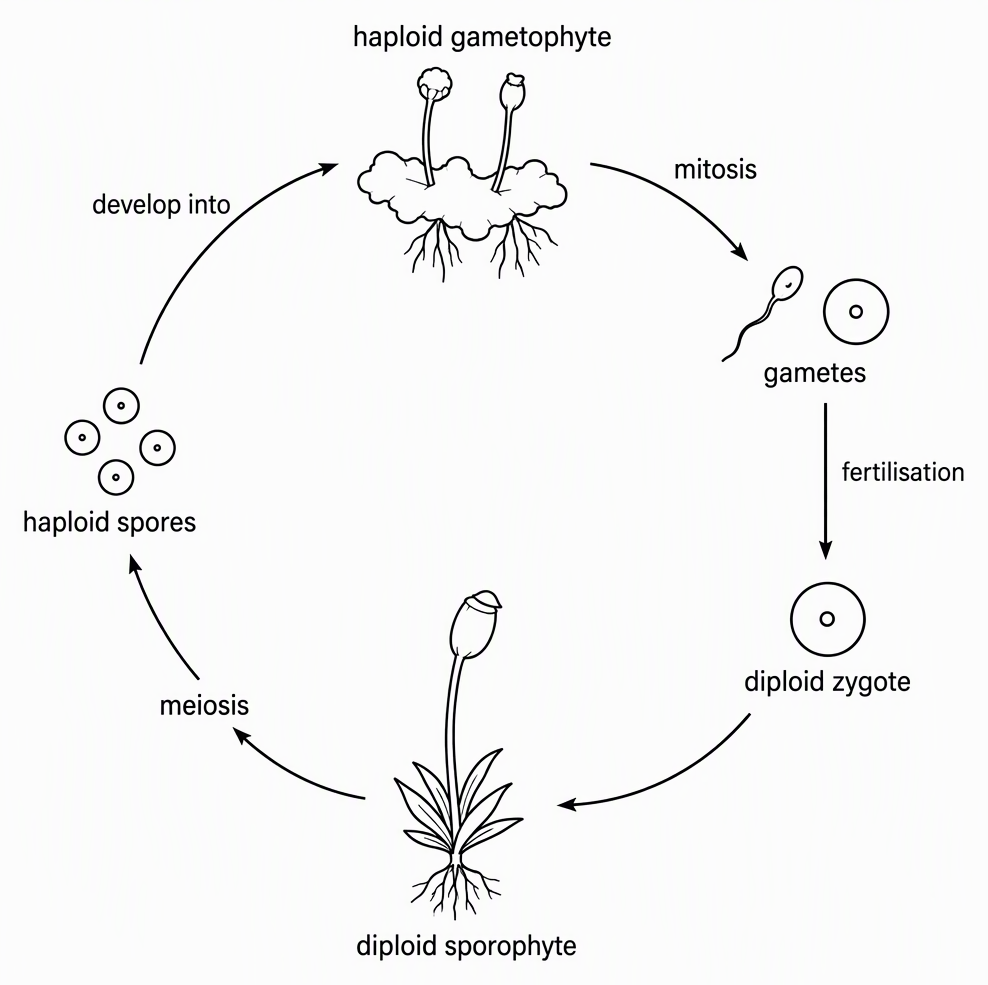
If you confuse Plant Kingdom with the broader classification framework, use Five Kingdom Classification: Criteria and Answer. Before attempting a fresh question, explain the corrected distinction without looking.
When does a free full-length NEET mock become the better choice?
Move beyond chapter-only practice when you can explain the distinctions without relying on this set’s answer sequence. If you still confuse a fern’s prothallus with its sporophyte, another full paper is an inefficient repair tool. If your explanations hold but recall breaks during subject switching, choose whole-paper practice.
The current paper has 180 compulsory questions in 180 minutes: 45 Physics, 45 Chemistry and 90 Biology. There is no optional Section B. Full-paper practice tests pacing and subject switching; chapter explanations repair specific knowledge gaps.
For that next step, NEET JEEnius AI offers 30 free full-length mocks a month, with a scored per-subject breakdown. Use that breakdown to inspect subject-level performance, not as a Plant Kingdom diagnosis. Online practice is not evidence of a confirmed computer-based NEET exam.
Repair the identified Plant Kingdom confusion first. Take a full mock when the remaining problem is whole-paper execution.
Next step: full-length mock tests on NEET JEEnius AI and sit a full 180-question, 720-mark, 180-minute paper, 45 Physics, 45 Chemistry and 90 Biology, and get a scored per-subject breakdown (30 free a month).
Frequently asked questions
Where can I practise free Plant Kingdom questions for NEET?
This article contains six free, original, NCERT-aligned Plant Kingdom MCQs with an answer key and explanations. They are single-correct practice questions, not official NEET questions or PYQs. Attempt them with your textbook closed and mark each response as confident, guessed or unattempted.
Should I start Plant Kingdom practice with chapter MCQs or full mocks?
Start with explained chapter MCQs after your first reading if you recognise the terms but confuse their meaning. If basic features and examples are still unfamiliar, begin with NCERT self-quizzing. Full-length mocks test whole-paper recall and pacing rather than repair specific chapter gaps.
How should I revise after getting Plant Kingdom MCQs wrong?
Review wrong answers, unattempted questions and guessed correct answers, then identify the distinction behind each error. For feature and example errors, build an NCERT comparison of plant groups, diagnostic features, reproductive features and examples. For generation errors, reconstruct the gametophyte-to-sporophyte sequence and compare dominance and dependence across groups.
When should I move from Plant Kingdom MCQs to full NEET mocks?
Move to full-length mocks when you can explain the chapter distinctions without relying on a memorised answer sequence. If your chapter explanations are sound but recall fails during subject switching, whole-paper practice is the better tool. A per-subject mock breakdown measures subject-level performance, not Plant Kingdom mastery.