Which animal matches the features in the Cyclostomata NEET 2026 question?
The correct answer to the Cyclostomata NEET 2026 question is B, Petromyzon sp., the lamprey. It matches the complete character set, not just the cartilaginous skeleton.
Researchers examine fish-like specimens with a cartilaginous internal skeleton. They are external parasites attached to fish skin by a round sucking mouth. Scales and paired fins are absent, while seven pairs of gill slits are present. Identify the animal:
This is a single-correct Biology question from Diversity in Living World. The question bank tags it medium and gives an expected solving time of 45 seconds. That is the bank’s practice target, not an official per-question time limit.
How does Petromyzon match every character in the question?
Petromyzon has a cartilaginous endoskeleton, so it passes the first check. Cartilage alone does not settle the identification because Scoliodon also has a cartilaginous skeleton. Keep Petromyzon as a candidate, then test every remaining character.
The circular sucking mouth provides the next match. Petromyzon uses this mouth to attach to a host fish, matching the attachment to fish skin described in the question.
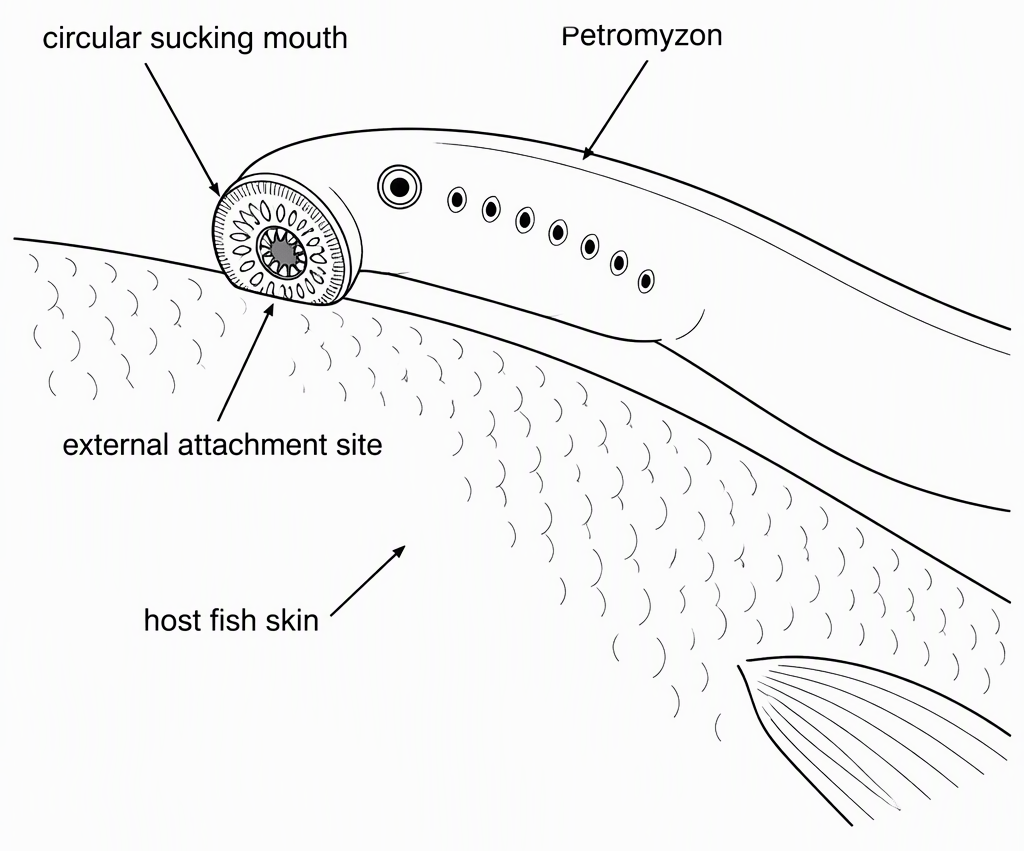
Ectoparasitism means living or feeding on the outside of a host. Petromyzon is ectoparasitic on some fishes, so the stated feeding relationship fits. The sucking mouth and external parasitism are linked: the mouth allows attachment to the host’s surface.
Check the two absences separately:
- No scales: Petromyzon has a scaleless body, matching the stem.
- No paired fins: Petromyzon lacks paired fins. This does not mean that all fins are absent.
Finally, seven pairs of gill slits matches Petromyzon. Seven pairs is the count for the animal identified here; 6–15 pairs is the broader Cyclostomata group range. The animal-level count lies within the group-level range, so there is no contradiction.
Petromyzon satisfies the entire supplied character set. Its skeleton, mouth, parasitic habit, absent scales, absent paired fins and gill-slit count all agree with the stem.
Why are the other three options incorrect?
Scoliodon, Exocoetus and Branchiostoma each fail the complete character check. Comparing the options confirms the character-by-character identification of Petromyzon:
Final answer: B) Petromyzon sp.
Why does choosing Scoliodon from cartilage alone fail?
That choice mistakes a shared feature for a unique identifier. Recognising cartilage is useful, but stopping there ignores the remaining conditions. The faulty reasoning is:
The first clue makes Scoliodon a candidate, not the answer. Apply the contradiction test: Scoliodon does not show the stated external parasitism, and its paired fins and scales contradict the stem. One confirmed match cannot cancel those mismatches.
Use this repair: propose a candidate, then check every remaining character before selecting it. Reject a candidate when a required feature contradicts it, rather than collecting only clues that support your first guess.
Keep these two claims separate: “this feature fits” and “this option fits every feature.” Only the second justifies marking the answer.
Can you apply the complete-match method to three related questions?
Use shared features to shortlist candidates and contradictions to reject them. These are original related practice questions from Diversity in Living World, not additional verified NEET PYQs.
Which feature is shared by Petromyzon and Scoliodon?
Answer to Question 1: C, cartilaginous endoskeleton. Both animals have this feature, so it cannot distinguish them. The other listed features match Petromyzon in this comparison, not Scoliodon. A shared character makes an option possible; it does not establish its identity.
Does the Cyclostomata range of 6–15 pairs exclude a specimen with seven pairs of gill slits?
Answer to Question 2: No. Seven pairs lies within the stated range:
Keep the counting unit consistent. Seven pairs means:
Compare pairs with pairs, not individual slits with a range stated in pairs. This count is compatible with Cyclostomata, but identification still requires the other characters.
Which statement about Petromyzon and Scoliodon is incorrect?
Answer to Question 3: D. Petromyzon also has a cartilaginous endoskeleton, so cartilage is not unique to Scoliodon. The first three statements agree with the supplied solution.
On your next classification question, check every stated presence and absence before marking the option. Reject a candidate that contradicts a required character, even when the first clue fits.
Next step: the past-paper archive on NEET JEEnius AI and search past NEET papers by year, subject or chapter, each with a worked solution (100 free searches a month).
Read next: Organic Compounds Containing Nitrogen NEET 2000: Nitrobenzene.
Frequently asked questions
What is the correct answer to the Cyclostomata NEET 2026 question?
The correct answer is B, Petromyzon sp., the lamprey. It matches all the stated features: a cartilaginous endoskeleton, circular sucking mouth, external parasitism, absence of scales and paired fins, and seven pairs of gill slits.
Why is Scoliodon incorrect if it has a cartilaginous skeleton?
A cartilaginous endoskeleton is shared by Scoliodon and Petromyzon, so it cannot identify the answer by itself. Scoliodon has scales and paired fins and is not the external parasite described, contradicting the remaining clues.
How many pairs of gill slits does Petromyzon have?
Petromyzon has seven pairs of gill slits, equivalent to 14 individual slits. This falls within the broader Cyclostomata range of 6–15 pairs, so the two counts do not conflict.
Does Petromyzon lack all fins or only paired fins?
Petromyzon lacks paired fins, not all fins. In an identification question, keep that distinction precise and check the absence of scales separately.