What is the starting compound in the Organic Compounds Containing Nitrogen NEET 2000 question?
Nitrobenzene is the starting compound, not aniline, in the Organic Compounds Containing Nitrogen NEET 2000 reaction-chain question. Reduction converts compound A into B; chloroform and potassium hydroxide convert B into C; reducing C gives N-methylaniline. The question asks for the original compound A.
The supplied choices are:
Answer: option B, nitrobenzene. The working follows. Keep the labels separate: compound B is an intermediate in the chain, whereas option B is a listed answer.
The question bank places this item in its hard tier, with a listed expected solving time of 60 seconds. That classification is not evidence of student error rates.
How does chloroform with KOH identify the reaction?
This reagent pair signals the carbylamine reaction, which converts a primary amine into an isocyanide. Start here, as the official solution does, because it identifies the functional group in compound B.
Both aliphatic and aromatic primary amines respond. Compound B must therefore be a primary amine, but this clue alone does not identify its attached organic group.
The terminal product, N-methylaniline, supplies the next clue: its phenyl group remains attached to nitrogen. This points to aniline as the primary amine.
Coefficient check: complete reaction of 0.20 mol of a primary amine, with sufficient chloroform, requires three moles of potassium hydroxide per mole of amine and gives one mole of isocyanide. This checks the coefficients, not the organic group’s identity.
How does isocyanide reduction confirm compounds B and C?
Compound B is aniline, and compound C is phenyl isocyanide. The phenyl–nitrogen bond stays intact during reduction, while the terminal isocyanide carbon becomes the methyl carbon attached to nitrogen. This gives the stated endpoint, N-methylaniline.
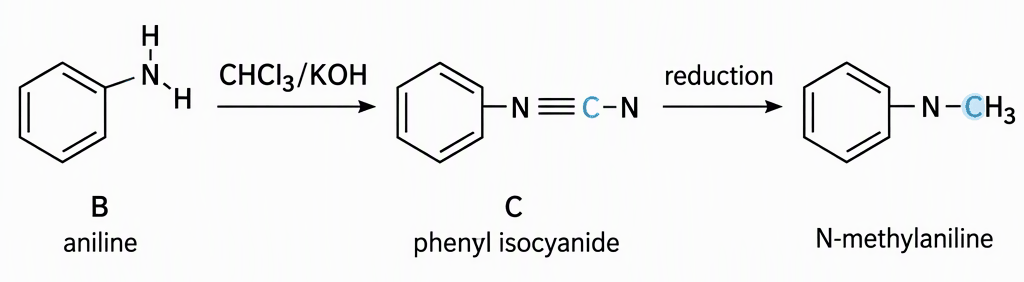
Aniline undergoes the carbylamine reaction:
The general isocyanide reduction relationship is:
Applying it here gives:
The bracketed hydrogen symbol conventionally represents reducing hydrogen. It does not name a reducing reagent specified by the question.
Isocyanide and nitrile are not interchangeable. Compare their connectivity:
In the first structure, the phenyl group bonds directly to nitrogen. In the second, it bonds to the nitrile carbon, so reduction produces a different amine.
Which supplied starting compound gives aniline on reduction?
Nitrobenzene gives aniline on reduction, so it must be compound A. Once the carbylamine step identifies B as aniline, return to the first arrow instead of selecting that intermediate.
The balanced reduction is:
The assignments are:
- Compound A: nitrobenzene.
- Compound B: aniline.
- Compound C: phenyl isocyanide.
Check all three transitions using the supplied treatments:
Every arrow agrees with the stated endpoint. The required starting compound is nitrobenzene, answer option B.
Why does choosing aniline answer the wrong part of the question?
Option A, aniline, identifies the correct intermediate but the wrong requested compound. This error comes from stopping after recognising the amine that reacts with chloroform and potassium hydroxide. The question asks for the compound one reaction earlier.
The incomplete reasoning correctly finds compound B. The missing operation is to identify the precursor that reduces to aniline: nitrobenzene.
Keep the two uses of letters separate:
- Compound B is aniline: this is its position in the reaction sequence.
- Option B is nitrobenzene: this is its position in the answer list.
Underline the requested compound label before selecting an option, then check its outgoing reaction. Here, the proposed starting compound must produce aniline on reduction.
How can I practise carbylamine and isocyanide-reduction questions?
Use these three original related practice questions to check the reaction rules and nitrogen–carbon connectivity. They are not verified PYQs or questions from the 2000 paper. Cover each answer, solve the question, then compare the product name and connectivity.
What forms when ethylamine undergoes the carbylamine reaction and its product is reduced?
Answer: ethyl isocyanide forms first, followed by N-methylethanamine. Ethylamine is a primary amine, so it undergoes the carbylamine reaction.
The ethyl group stays attached to nitrogen throughout. Reduction turns the isocyanide carbon into an N-methyl group, giving a secondary amine.
How do the reduction products of phenyl isocyanide and benzonitrile differ?
Answer: phenyl isocyanide gives N-methylaniline, whereas benzonitrile gives benzylamine. The same reducing-hydrogen count does not mean the products have the same connectivity.
The isocyanide retains a direct phenyl–nitrogen bond. The nitrile retains a phenyl–carbon bond, and that carbon becomes the methylene group between the ring and the amino group.
Which gives a positive carbylamine test, aniline or N-methylaniline?
Answer: aniline gives a positive test because it is a primary amine. N-methylaniline is secondary: its nitrogen is attached to both a phenyl group and a methyl group, so it does not give the test.
Classify the amine by counting the carbon groups directly attached to nitrogen, not by noticing the word “aniline” in its name. Before selecting an answer, mark those attachments and, for an isocyanide reduction, track which carbon becomes the N-methyl carbon.
Next step: photograph a doubt on NEET JEEnius AI and photograph any question you are stuck on and get a step-by-step solution across Physics, Chemistry and Biology (20 free a month).
Related on NEET JEEnius AI: Electromagnetic Spectrum NEET 2026: Answer and Applications.
Frequently asked questions
What is compound A in the NEET 2000 nitrogen compounds reaction chain?
Compound A is nitrobenzene, listed as option B. Reduction gives aniline, which reacts with chloroform and KOH to form phenyl isocyanide. Further reduction gives the stated final product, N-methylaniline.
Why is aniline not the correct answer to this reaction-chain question?
Aniline is compound B, the intermediate that undergoes the carbylamine reaction, but the question asks for starting compound A. Nitrobenzene reduces to aniline, so nitrobenzene is the required answer. Compound B and answer option B refer to different things.
What reaction occurs when a primary amine reacts with chloroform and KOH?
This is the carbylamine reaction, which converts a primary amine into an isocyanide. Both aliphatic and aromatic primary amines respond. In this chain, aniline forms phenyl isocyanide.
How do the reduction products of phenyl isocyanide and benzonitrile differ?
Phenyl isocyanide reduces to N-methylaniline, whereas benzonitrile reduces to benzylamine. The isocyanide retains its direct phenyl–nitrogen bond, while the nitrile carbon becomes the methylene group between the phenyl ring and the amino group.