What is the correct answer to the electromagnetic spectrum NEET 2026 question?
The electromagnetic spectrum NEET 2026 answer is option C: P-II, Q-I, R-IV, S-III. Match each radiation’s standard NCERT application independently before checking the options. One familiar pair is not enough to validate a four-pair answer.
The source is NEET UG 2026, held on 21 June 2026, Code-50, Physics, chapter Electromagnetic Waves. Its medium difficulty is the question bank’s classification, not an official NTA rating.
Match these radiation bands with their standard textbook applications:
- P: Microwaves
- Q: Ultraviolet rays
- R: Gamma rays
- S: Radio waves
The application labels are:
- I: Sterilising water
- II: Heating food
- III: AM/FM broadcasting
- IV: Cancer radiotherapy
Choose the combination in which all four pairs agree:
How do you match each radiation with its NCERT application?
Match radio waves to communication, microwaves to food heating, UV to water sterilisation and gamma rays to cancer radiotherapy. This follows the supplied official solution’s application-matching method, anchored to NCERT Class 12 Physics, Chapter 8, Electromagnetic Waves. No wavelength calculation is needed because the question asks for textbook uses.
- Radio waves match AM/FM communication: S-III. Radio waves carry signals in AM and FM communication systems. The application list names broadcasting, so assign III to S. Record that pair, but do not choose an option yet: more than one option contains it.
- Microwaves match heating food: P-II. Microwave ovens warm or cook food through dielectric heating. Food absorbs microwave energy, particularly through its water content, and that absorbed energy becomes thermal energy. This identifies II as the application for P.
- Ultraviolet rays match water sterilisation: Q-I. UV radiation kills or inactivates microorganisms and is used to sterilise water. It does not physically filter out suspended particles or remove dissolved salts. Assign I to Q: the relevant action is on microorganisms, not every impurity in the water.
- Gamma rays match cancer radiotherapy: R-IV. Gamma radiation can damage cellular DNA and is used in radiotherapy against cancer cells. Assign IV to R. This does not mean every radiation capable of biological damage should be matched to cancer treatment.
These are the standard applications requested here, not exclusive lists of everything each band can do. Match the named use, not a broad property such as “high energy” or “can kill cells”.
How do the pairs give option C in P–Q–R–S order?
The completed sequence is P-II, Q-I, R-IV, S-III, so the correct answer is C. We established the pairs in S, P, Q, R order, but the options use P, Q, R, S order. Reorder before comparing them.
Verify each radiation label, application label and reason:
- P → II: Microwaves heat food through dielectric heating.
- Q → I: UV radiation acts on microorganisms in water.
- R → IV: Gamma radiation is used in cancer radiotherapy.
- S → III: Radio waves serve AM/FM broadcasting.
Check all four pairs, not just their order. The correct S-III pair appears in both B and C, so it cannot distinguish those options.
Why is option B wrong even though its radio-wave pair is correct?
Option B has only one correct pair: S-III. Its full mapping is P-I, Q-IV, R-II, S-III. The radio-wave match does not validate the other three assignments.
The method error is treating a shared property as an application-matching rule. UV and gamma rays can both damage biological material, but that does not make their named textbook applications interchangeable. Here, UV belongs with water sterilisation, while gamma rays belong with cancer radiotherapy.
Inspect B’s incorrect assignments:
- P-I: Microwaves have been assigned water purification instead of food heating.
- Q-IV: UV rays have been assigned cancer therapy instead of water sterilisation.
- R-II: Gamma rays have been assigned food warming instead of cancer radiotherapy.
Write one application beside each radiation name before consulting the answer combinations. Prefer this to early option elimination: it keeps a partly correct option from steering your reasoning and exposes every mismatch before you mark an answer.
How can you apply this logic to three related Electromagnetic Waves questions?
Separate frequency and photon energy from suitability for a named application. The following are original related practice questions, not additional verified NEET PYQs. Use the spectrum order for the first question and the radiation’s specific action for the other two.
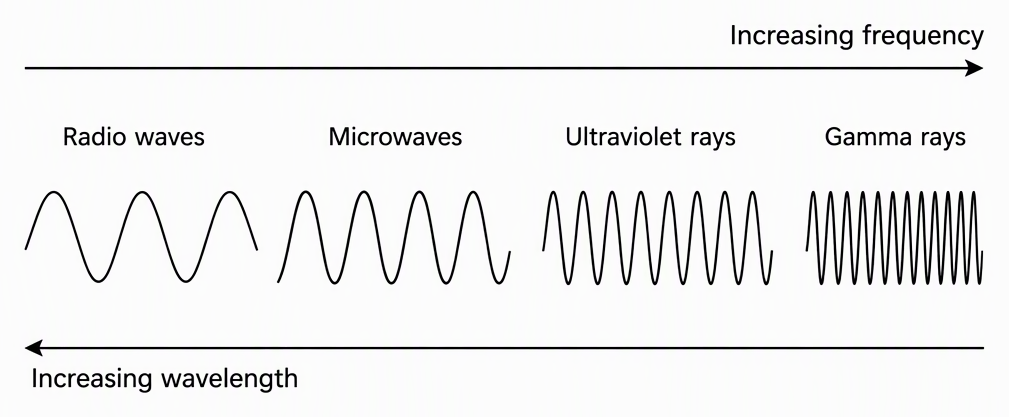
Question 1: What is the increasing-frequency order of radio waves, microwaves, UV rays and gamma rays?
Answer: Radio waves, microwaves, UV rays, gamma rays. Along this sequence, frequency increases and wavelength decreases; the increasing-wavelength order is the reverse.
Worked extension: For a wavelength of 0.3 m, calculate the frequency in vacuum. Frequency is the speed of light divided by wavelength:
This shows why a shorter wavelength means a higher frequency in vacuum. The calculation is not needed for the original matching question.
Question 2: Does a water-treatment device’s UV step sterilise water or remove dissolved salts?
Answer: It sterilises by acting on microorganisms. UV exposure is not a dissolved-salt removal process.
Worked explanation: Match the radiation step to its action. Inactivating microorganisms does not separate dissolved salts from water, so do not read “purification” as removal of every impurity.
Question 3: Is higher photon energy enough to assign gamma rays to a food-warming oven?
Answer: No. Gamma photons carry more energy than microwave photons, but higher photon energy alone does not determine suitability for an application.
Worked explanation: The required NCERT mapping assigns dielectric food heating to microwaves and cancer radiotherapy to gamma rays. Before selecting an option, replace “more energetic” with the specific interaction and application being tested.
Next step: the past-paper archive on NEET JEEnius AI and search past NEET papers by year, subject or chapter, each with a worked solution (100 free searches a month).
Keep going with How to Study Mole Concept NEET: Formulas and Practice.
Frequently asked questions
What is the answer to the electromagnetic spectrum NEET 2026 question?
For the Code-50 radiation–application matching question, the answer is option C: P-II, Q-I, R-IV, S-III. Microwaves match heating food, ultraviolet rays match water sterilisation, gamma rays match cancer radiotherapy, and radio waves match AM/FM broadcasting.
Why is option B wrong in the NEET 2026 electromagnetic spectrum question?
Option B has only one correct pair: S-III, which matches radio waves to AM/FM broadcasting. It incorrectly assigns microwaves to water sterilisation, UV rays to cancer therapy and gamma rays to food heating. Check every pair independently before selecting an option.
Do UV rays remove dissolved salts from water?
No, UV radiation kills or inactivates microorganisms; it does not remove dissolved salts or physically filter suspended particles. In this NCERT application-matching question, ultraviolet rays therefore match water sterilisation.
What is the increasing frequency order of radio waves, microwaves, UV and gamma rays?
The increasing-frequency order is radio waves, microwaves, ultraviolet rays, then gamma rays. Wavelength decreases along this sequence, so the increasing-wavelength order is the reverse.