
How do I choose the right mole formula in a NEET question?
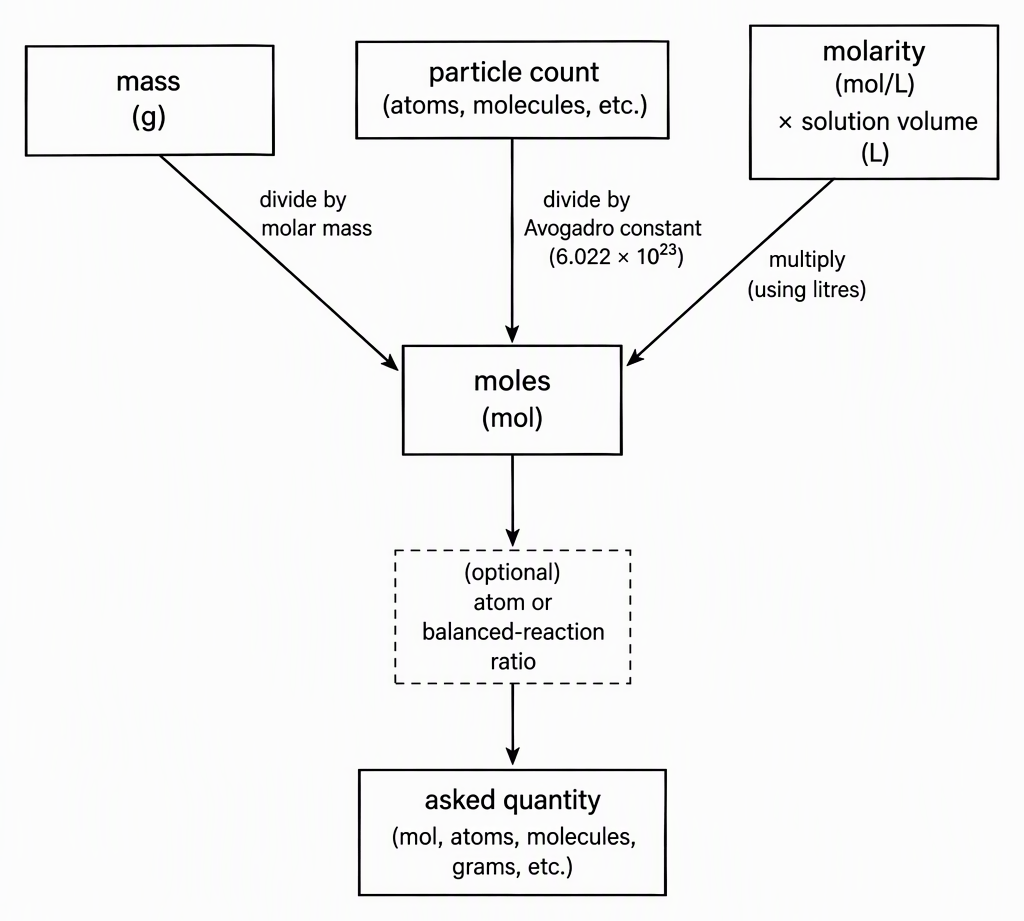
- Write the target before choosing a formula. Study Mole Concept for NEET through a unit-labelled route: given quantity, moles, required ratio, asked quantity. Write exactly what is asked, including its unit and entity: grams, moles, molecules, atoms, ions or moles per litre. Underline whether it concerns a sample, solution or reaction.
Before attempting numericals, read the NCERT explanations of atomic and molecular masses, the mole and molar mass. Use targeted reading to fix these ideas rather than restarting a full lecture.
- List the givens with units. Calculate molar mass from the chemical formula before substituting numbers. A subscript determines how many atoms contribute to that mass.
- Choose your entry into moles. Convert mass by dividing by molar mass, particle count by dividing by the Avogadro constant, or molarity by multiplying by solution volume in litres.
The symbols mean:
Check the mass conversion by cancelling units:
Gas volume needs the appropriate molar volume for the stated conditions, or the ideal-gas equation with consistent units:
Do not treat the following as a universal conversion:
How do I go from moles to the required answer?
- Choose the right ratio. Subscripts count atoms within a molecule. Coefficients in a balanced equation give ratios between reacting amounts in moles. Use a subscript for constituent atoms and the balanced equation for reactant-to-product conversions.
When quantities of multiple reactants are supplied, compare:
The smallest value identifies the limiting reactant. Coefficients are not gram ratios, and the reactant with the smaller mass is not necessarily limiting.
- Convert into the requested quantity. Use the matching exit from moles:
If atoms rather than molecules are requested, apply the formula subscript to the molecular count. For dilution without reaction or solute loss, conserve solute moles:
Use the final total solution volume, not the volume of water added.
- Check units, entity labels and physical sense. Dilution lowers concentration. Theoretical product cannot exceed what the limiting reactant permits.
Write a one-line route before arithmetic. Keep exact fractions until the final calculation where convenient:
How do I calculate molecules and hydrogen atoms from ammonia mass?
Convert ammonia mass into moles, then into molecules. Multiply the molecular count by three when counting hydrogen atoms.
Original teaching example 1: A 3.4 g sample of NH₃ contains how many molecules and hydrogen atoms? Use nitrogen atomic mass 14 and hydrogen atomic mass 1.
All three worked questions here are original teaching examples, not NEET previous-year questions or evidence of chapter weightage.
Write the route first:
Stopping at the molecular count gives a plausible-looking but wrong hydrogen-atom answer. It counts ammonia molecules, not their constituent hydrogen atoms.
Each molecule contains four atoms altogether, so total atoms would instead be:
How do I calculate molarity before and after dilution?
Find solute moles once, then divide by the solution volume in litres at each stage. Dilution changes volume and concentration, not the amount of solute, provided there is no reaction or loss.
Original teaching example 2: Dissolve 0.585 g NaCl to make 100 mL of solution. Dilute the entire solution to a final volume of 500 mL. Find both molarities, using:
Write the route first:
The same solute amount remains after dilution:
Check the result: volume increases fivefold, so concentration decreases fivefold. Watch for two traps:
- Millilitre trap: Using 100 directly as the denominator does not give molarity in moles per litre.
- Wording trap: “Diluted to 500 mL” means the final solution occupies 500 mL, not that 500 mL of water was added.
For follow-up concentration work, NEET JEEnius AI’s daily practice problems provide a fresh topic set each day, with 20 free attempts a month.
How do I find the limiting reactant and leftover mass?
Compare available moles divided by balanced-equation coefficients before calculating product. Initial masses alone cannot identify the limiting reactant because different substances have different molar masses. Use the limiting reactant to calculate both product formed and excess reactant consumed.
Original teaching example 3: Hydrogen, 4 g, reacts with oxygen, 16 g, to form water. Assuming complete reaction, find the theoretical water mass and leftover reactant mass. Use:
Balance first:
Write the route before calculating:
Convert both reactants:
Compare the coefficient-adjusted amounts:
Oxygen is limiting despite its larger initial mass. Use its amount to find water:
Hydrogen consumption follows the same coefficient ratio:
Check mass conservation:
Using all the supplied hydrogen would incorrectly predict 36 g water. That calculation assumes oxygen that is not available.
What should I practise next if my mole calculations keep going wrong?
Reproduce the conversion map from memory, then redo these three examples without looking at the solutions. Choose your next questions by where your route breaks.
Practise in this order:
- Molar mass and mass-to-mole conversions.
- Molecules versus constituent atoms or ions, always naming the entity.
- Molarity and dilution.
- Balanced-equation mole ratios.
- Limiting reactants.
Once these are secure, extend the route to percentage purity, empirical and molecular formulas, and gas questions with explicitly stated conditions. Start with NCERT worked examples and exercises, then use NEET previous-year questions whose year and source you can check.
Keep an error log with four labels:
- Target/entity: You counted molecules when atoms were requested.
- Conversion/unit: You used millilitres where litres were required.
- Reaction ratio: You used masses as coefficient ratios or chose the wrong limiting reactant.
- Arithmetic: The setup was correct, but an operation failed.
Write the corrected setup beside each error. If the setup was wrong, solve another question of that subtype. If only arithmetic failed, repair that operation rather than restarting the chapter.
Move to mixed timed practice only when you can explain the setup without notes. A fixed seconds-per-question target is not an official NEET rule.
Keep manual reattempts of wrong questions separate from unseen-question practice. For the unseen set, NEET JEEnius AI’s practice mode offers topic sets that skip questions already seen, with 60 free sets a month.
Next step: practice mode on NEET JEEnius AI and practise a topic in sets that skip questions you have already seen (60 free sets a month).
For a worked example of the same idea, see Free NEET Preparation App: Mocks or YouTube Lessons?.
Frequently asked questions
How do I choose the right formula in mole concept questions?
Write the required quantity, unit and entity before choosing a formula. Convert the givens into moles: divide mass by molar mass, divide particle count by the Avogadro constant, or multiply molarity by solution volume in litres. Apply any required atom-count or balanced-equation ratio, then convert to the requested quantity.
Do I use water volume or solution volume for molarity?
Molarity is solute moles divided by total solution volume in litres, not the volume of water added. During dilution without reaction or solute loss, solute moles remain constant, so initial molarity times initial volume equals final molarity times final volume. Use the final total solution volume for the diluted concentration.
How do I find the limiting reactant from given masses?
Balance the equation and convert each reactant mass into moles. Divide each available mole amount by its balanced-equation coefficient; the smallest value identifies the limiting reactant. Use that reactant to calculate product formed and excess reactant consumed.
What should I practise first if my mole concept calculations keep going wrong?
Practise molar mass and mass-to-mole conversions first, followed by particle counts, molarity and dilution, balanced-equation ratios, and limiting reactants. Start with NCERT worked examples and exercises, then attempt NEET previous-year questions with verifiable sources. Log errors as target/entity, conversion/unit, reaction ratio or arithmetic, and write the corrected setup beside each error. Begin mixed timed practice only when you can explain the setup without notes.