
Which free NEET preparation app should you choose?
Choose NEET JEEnius AI for full-length scored practice; choose free NEET lessons on YouTube when you need a topic taught. If you need a free NEET preparation app for practice and lessons for learning, use both. NEET JEEnius AI provides 30 free full-length mock tests a month, with a scored per-subject breakdown.
Teaching helps you understand a chapter; a timed paper tests whether you can apply that knowledge across subjects. Free access to one lecture does not establish that its entire course is free.
This comparison is published by NEET JEEnius AI. It is a task-based recommendation using the supplied verified product facts and freely published lessons, not an independent ranking of every free preparation app or a hands-on product test.
The recommendation covers the verified mock offer. It does not describe NEET JEEnius AI as a completely free all-in-one course or establish an Android or iOS app listing.
What do NEET JEEnius AI and YouTube actually give you free?
NEET JEEnius AI provides full-paper practice and subject scores; YouTube provides lessons that publishers make freely accessible. Neither offer establishes access to a complete free course. Choose by the task you need to complete, not by how much content appears on the opening screen.
- Primary use
- NEET JEEnius AI: Full-length exam practice.
- YouTube free NEET lessons: Topic teaching and revision.
- Why it matters: Understanding content and applying it independently need different activities.
- Verified free scope
- NEET JEEnius AI: 30 full-length mocks a month.
- YouTube free NEET lessons: Individual lessons or sessions made freely available by their publishers.
- Why it matters: A recurring practice allowance and a free introductory lecture are different offers.
- Exam structure
- NEET JEEnius AI: 180 questions, 720 marks and 180 minutes, with 45 Physics, 45 Chemistry and 90 Biology questions.
- YouTube free NEET lessons: Teaching or revision sessions, not an equivalent full paper.
- Why it matters: Following a teacher’s solution or rapid-fire session does not test independent decisions across a timed mixed paper.
- Feedback
- NEET JEEnius AI: A scored per-subject breakdown.
- YouTube free NEET lessons: Watching alone does not produce a comparable full-paper score.
- Why it matters: Familiarity with a topic is weaker evidence than answering questions without help.
- Your follow-up task
- NEET JEEnius AI: Review weak subjects and the questions behind the score.
- YouTube free NEET lessons: Attempt questions independently after learning.
- Why it matters: Submission and video completion are starting points for review, not proof of mastery.
Verification boundary: the evidence establishes the mock allowance, paper structure and subject scores, not a wider package. Ads, registration requirements and payment-card requirements are not established for NEET JEEnius AI by the supplied facts. Not verified does not mean not available: check unknowns rather than treating them as promised or absent.
Should Class 11, Class 12 students and droppers choose differently?
Choose by syllabus coverage and the problem you need to solve, not your class label alone. A Class 11 student meeting a chapter for the first time needs teaching before a full-paper score can say much. A student who knows the chapters but cannot finish mixed papers needs timed attempts, even if another lecture feels more comfortable.
- Class 11, first encounter with a chapter: Use a relevant free lesson alongside NCERT. Then attempt questions from an available study source without replaying the explanation. An incomplete-syllabus full-paper score is a limited diagnostic, not a final judgement of ability.
- Class 12, substantial syllabus coverage but unfinished papers: Prioritise timed full-length practice. Use the per-subject breakdown to choose which subject to review first, then inspect individual mistakes before deciding what to study.
- Dropper, most concepts understood but lectures repeatedly rewatched: Attempt first and review the errors. Return to a lesson only when you can name the concept you could not apply.
- Substantial backlogs: Choose lessons for missing concepts and follow them with questions. Repeated full papers expose gaps; they do not teach the missing material.
- Chapters feel manageable separately, but mixed papers go badly: Choose full-length practice rather than more passive revision. Switching subjects and deciding when to leave a question need practice too.
- Parent choosing a tool: Ask to see an attempted paper, reviewed errors and the next study action. Hours spent inside an app or watching videos do not show what the student can now answer.
How can you check what “free” means before committing?
Check the complete activity and its promised result, not just the download button or opening screen. Before investing substantial study time, read the access terms and establish where free access ends. A free download is not evidence that you can finish a test and inspect its result without payment.
Keep these offers separate:
- Free download: Getting the software costs nothing. This says nothing about access to study activities.
- Free sample: A limited lesson or activity gives access to part of an offer.
- Time-limited trial: Access ends after a stated period unless another arrangement applies.
- Recurring free allowance: A stated amount of use is available repeatedly. The verified NEET JEEnius AI offer is a monthly allowance of 30 full-length mocks.
Check the workflow: access the activity, complete it, submit it where required, and inspect the promised result. Do not make the result screen your first check of the access limits.
For any tool, check whether explanations, further attempts or other support you need require payment. Check registration, payment-card requirements, ads, device compatibility, data demands and any offline access you require. These are checks, not allegations about either option.
For YouTube teaching, confirm that the next lessons you need are freely accessible. A recently released introductory lecture does not prove that the whole course is free.
The supplied facts do not establish whether unused mock allowances roll over or when the monthly allowance resets. Confirm those terms before planning around a particular reset day.
How do you tell whether a free mock follows the current NEET pattern?
Accept a current-pattern simulation only if it matches 180 compulsory single-correct MCQs in 180 minutes for 720 marks, with no optional section. Check subject allocation and marking too, not just question count. A paper with a different structure can supply practice questions, but it is not an equivalent simulation.
Check the subject allocation:
- Physics: 45 questions, 180 marks.
- Chemistry: 45 questions, 180 marks.
- Biology: 90 questions, 360 marks, comprising 45 Botany and 45 Zoology questions.
The marking scheme is:
The optional Section B format used from 2021 to 2024 was discontinued from 2025. An old-format paper can help with question practice, but it should not be labelled a current-pattern simulation. Optional-question choices change how you use time and decide what to attempt.
Biology accounts for half the questions and half the marks. A Physics-only test can target a weakness, but it cannot replace full-paper preparation. Use Free NEET Physics Mock Test: Choose the Right Format when deciding between subject practice and a complete simulation.
NEET remained offline pen-and-paper with OMR through 2026, so online practice alone does not rehearse physical answer-sheet handling. Practise that process separately when preparing for a paper-based exam.
A possible computer-based shift for 2027 is not confirmed. Check the official NTA site, neet.nta.nic.in, for confirmed instructions rather than planning around speculation.
How should you combine mocks and free lessons in a study routine?
Use a paper to identify a gap, repair that gap, and test the repair with fresh questions. If you are ready for full papers, choose this over alternating randomly between mocks and videos. If you are still building the syllabus, start with learning and topic practice, then introduce full papers when they serve a useful diagnostic purpose.
A score tells you where to look; reviewing the questions tells you what to fix. Make each activity lead to a specific next action.
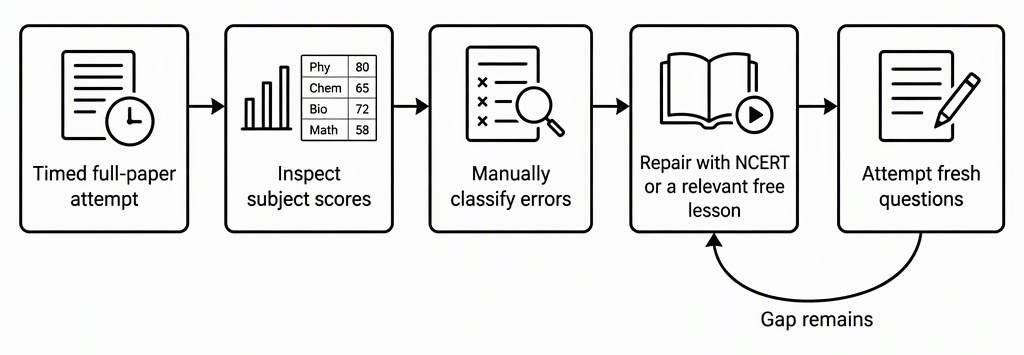
- Attempt under the full time limit. Avoid pausing to look up formulas or watch explanations. Otherwise, you are practising with help rather than measuring independent performance.
- Inspect the subject breakdown. Choose where to begin reviewing, but do not assume every low score means a concept problem.
- Classify errors manually. Use concept gaps, recall failures, calculation mistakes, misreading and time pressure. This is your review method, not a verified automatic feature of NEET JEEnius AI.
- Repair a specific weakness. Read the relevant NCERT passage or watch the part of a free lesson that addresses it. “Revise Chemistry” is too broad; name the fact, rule or step you missed.
- Attempt fresh questions. Use an available question source without looking at the explanation first. Understanding the old solution does not prove that you can solve a new question.
The allowance of 30 free mocks a month is an access limit, not a recommendation to sit 30 papers. Do not begin the next paper merely to avoid reviewing the previous one.
Choose NEET JEEnius AI for the verified free full-paper offer, YouTube for freely available teaching. Neither replaces active recall and error correction. Before opening either, write down the gap you need to address.
Next step: full-length mock tests on NEET JEEnius AI and sit a full 180-question, 720-mark, 180-minute paper, 45 Physics, 45 Chemistry and 90 Biology, and get a scored per-subject breakdown (30 free a month).
Frequently asked questions
Which free NEET preparation app should I choose?
Choose NEET JEEnius AI if you need full-length scored practice: its verified offer is 30 free mocks a month with a per-subject score breakdown. Use freely available YouTube lessons alongside NCERT when you need a topic taught. Choose by your syllabus coverage and learning gap, not your class label alone.
Is NEET JEEnius AI completely free?
The verified free offer is 30 full-length mock tests a month with a scored per-subject breakdown. This does not establish a completely free all-in-one course. Check access terms, registration, payment-card requirements and any additional support you need before committing study time.
How do I check whether a free mock follows the current NEET pattern?
Check for 180 compulsory single-correct MCQs in 180 minutes for 720 marks, with no optional section. The allocation should be 45 Physics, 45 Chemistry and 90 Biology questions, with Biology split equally between Botany and Zoology. Marking should be +4 for a correct answer, -1 for an incorrect answer and 0 for an unattempted question.
Should I take all 30 free NEET mocks every month?
No: 30 free mocks a month is an access allowance, not a recommended test schedule. Review each attempted paper, classify your errors, repair specific gaps with NCERT or a relevant lesson, and attempt fresh questions. Do not start another paper merely to avoid reviewing the previous one.