
Which free NEET Physics mock test should I choose?
Choose chapter tests for weak or unfinished chapters, Physics-only sectionals for mixed-topic practice, and full NEET mocks for whole-paper pacing. A free NEET Physics mock test should measure the problem you need to fix. These formats are complementary, not interchangeable: none is universally best.
NEET JEEnius AI’s verified free offering is 30 full-length NEET mocks a month, not a verified standalone Physics test. This article compares formats by coverage, timing, scoring and review needs. It does not rank free-test websites or assume that their access, solutions or registration rules have been checked.
Choose the narrowest test that can diagnose your current weakness. A full-paper score cannot separate a Class 11 student’s weak chapters from an unfinished syllabus. Equally, success in a familiar chapter cannot establish that Physics will fit comfortably alongside Chemistry and Biology.
How do chapter tests, Physics sectionals and full NEET mocks compare?
Chapter tests isolate understanding, sectionals assess execution across Physics, and full mocks test subject trade-offs. Compare coverage and timing before comparing marks: the formats answer different questions about your preparation.
- Syllabus coverage
- Chapter-focused Physics test: One chapter or selected subtopics.
- Physics-only sectional: Mixed Physics content. Check its stated syllabus.
- Full-length NEET mock: Physics, Chemistry and Biology across the stated full syllabus.
- Weakness diagnosed
- Chapter-focused Physics test: Local concept gaps and recurring method errors.
- Physics-only sectional: Topic switching, equation selection and Physics-wide execution.
- Full-length NEET mock: Physics performance alongside competing demands from Chemistry and Biology.
- Question count and scoring comparability
- Chapter-focused Physics test: Question count depends on the resource; raw totals need context.
- Physics-only sectional: Current-pattern alignment benchmark: 45 questions, 180 marks.
- Full-length NEET mock: 180 compulsory questions, 720 marks: Physics 45, Chemistry 45, Biology 90.
- Timing relevance
- Chapter-focused Physics test: Duration depends on the resource.
- Physics-only sectional: Any Physics time budget is a practice choice, not an official subject limit.
- Full-length NEET mock: 180 minutes for the whole paper.
- Review burden
- Chapter-focused Physics test: Review centres on the tested concepts.
- Physics-only sectional: Review spans the Physics topics tested.
- Full-length NEET mock: Review covers all subjects and time allocation.
- Verified free access
- Chapter-focused Physics test: Standalone availability is unverified by the supplied information.
- Physics-only sectional: Standalone availability is unverified; a Physics score breakdown does not establish a sectional launch option.
- Full-length NEET mock: The verified offering includes 30 free mocks monthly with scored per-subject breakdowns.
A sectional assesses Physics in isolation. Only the full paper tests whether time spent on Physics leaves enough time for Chemistry and Biology. Choose by that distinction, not by which format produces the higher score.
Which format should Class 11, Class 12 students and droppers pick?
Choose by readiness and error type, not by class label alone. A Class 12 student may need chapter repair, while a syllabus-complete student may need whole-paper practice. Base the choice on the previous difficulty: missing understanding, trouble switching topics, or poor allocation of time across subjects.
- Class 11, Laws of Motion just completed: If force diagrams still cause trouble, choose focused chapter practice. Treating a full-syllabus score as a verdict would mix an actual weakness with content you have not studied.
- Class 12, substantial Physics coverage completed: Choose a mixed Physics sectional whose stated coverage matches completed content. This checks whether you can identify the right method when consecutive questions come from different chapters.
- Dropper or syllabus-complete student, adequate isolated Physics performance: Choose a full NEET mock if time runs short only in the complete paper. Another isolated Physics test cannot measure what happens when Chemistry and Biology also need attention.
- Any student repeating the same conceptual error: Return to an explanation and targeted questions before another broad mock. Repeating an incorrect force model under a timer does not repair it.
For the verified full-mock route described above, sit the whole paper and use its scored Physics breakdown. Do not assume a separate Physics timer, sectional launch button or chapter-test library.
Parents should treat the free allowance as access, not a target to exhaust. A completed test followed by corrected reasoning is useful evidence of preparation; a pile of unrevised scores is not.
What should I check before starting a free test?
Confirm that submission and scoring are free, then check review access, syllabus coverage and paper pattern. For any free NEET Physics mock test, access to questions alone is not enough. Check what remains available after submission before committing a full sitting.
- Check the payment boundary. Confirm that submission and the score are free. Check whether registration is required and whether answers or explanations become paid after submission. These are screening questions, not claims about any particular service.
- Separate an answer key from worked solutions. A key identifies an option; a worked solution explains the reasoning. Neither is established as a NEET JEEnius AI feature by the supplied product facts, so verify review access separately.
- Match coverage to your purpose. A chapter title is not enough if the test excludes the subtopic you need. A mixed sectional should cover the completed content you intend to assess.
- Check the simulation format. A current-pattern full mock must contain 180 compulsory single-correct questions. The optional Section B structure used from 2021 to 2024 was discontinued from 2025.
- Check question usability. Diagrams must be readable, units clear, and the answer key checkable against a trusted explanation.
Older papers remain useful question practice, but their original optional structure is not the current simulation format. Use them for questions, not as an unchanged timed simulation.
The exam remained offline pen-and-paper OMR through 2026. A move to computer-based testing from 2027 is unconfirmed, so there is no confirmed basis for expecting that change. Check neet.nta.nic.in for official updates rather than treating a practice website’s interface as evidence of the exam mode.
How can I make my Physics mock scores comparable?
Match coverage and testing conditions, then apply the official marking rule. Award 4 marks for each correct answer, deduct 1 for each wrong answer, and award 0 for an unattempted question. Count guessed correct answers separately during review, even though they receive full marks.
For a 45-question Physics section, the maximum is 180 marks. Do not compare a shorter chapter-test raw score directly with that total. Keep a student-maintained log with these fields:
- Format: Chapter test, Physics sectional or full mock.
- Coverage: Chapters and subtopics included.
- Responses: Correct, wrong and unattempted question counts.
- Timing: Actual time spent, including pauses or interruptions.
- Conditions: Repeated questions, help used, or access to notes.
There is no official standalone Physics time limit. Set a sectional budget if it serves your practice goal, but label it as your decision, not an NTA rule.
For a full mock, preserve the 180-minute whole-paper limit. Record Physics time manually if the platform does not provide it, including later returns to Physics questions.
Coverage, difficulty and remembered questions can all change your result. A higher score on another resource does not by itself prove improvement. Use a free NEET Physics mock test to identify better decisions and fewer repeat errors, not to infer a percentile, rank, admission chance or guaranteed score gain.
What should I revise before taking the next mock?
Review every wrong answer, every unattempted question and every correct answer reached by guessing. Correctness alone does not establish mastery. Choose the next test by the cause of difficulty: chapter practice for a concept gap, a sectional for mixed-topic execution, or a full mock for whole-paper pacing after review.
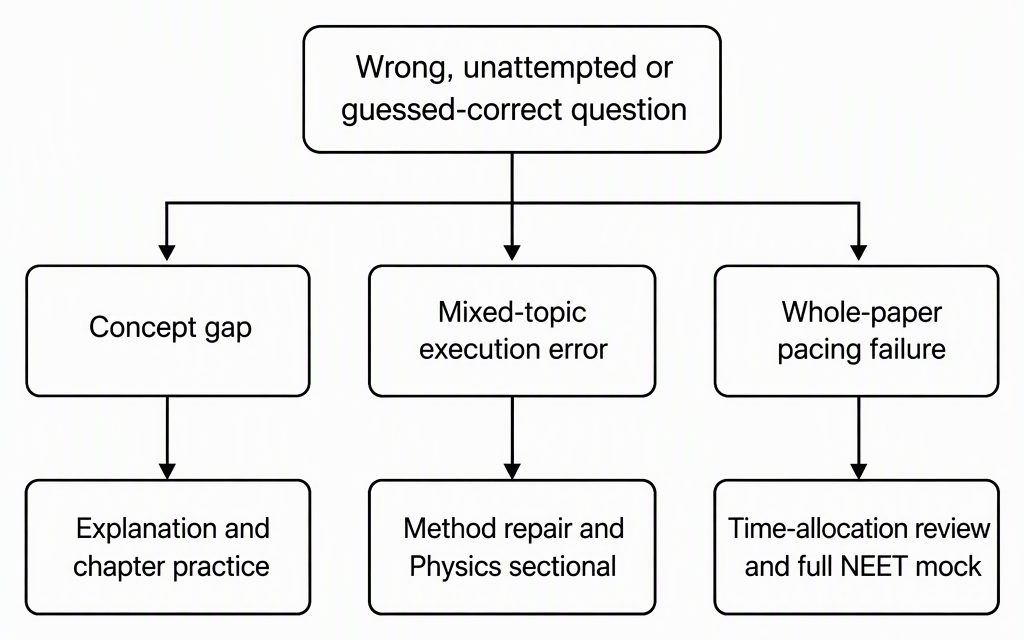
Create a manual review sheet with these five columns. Give each reviewed question its own entry:
- Question or topic: Record the question reference and tested idea.
- Outcome: Wrong, unattempted or guessed correct.
- Cause of difficulty: Name the specific error.
- Corrective action: Write what must change in your reasoning or working.
- What to practise next: Choose a question type and then the appropriate test format.
Use these causes rather than labelling everything “careless”:
- Conceptual gap: Revisit the explanation, then practise that chapter. For force-diagram or friction errors, use How to Study Laws of Motion NEET: FBDs and Friction.
- Equation-selection error: Write the conditions under which the chosen relation applies. Practise distinguishing similar-looking problems.
- Algebra or unit mistake: Redo the working with explicit conversions and units.
- Misreading: Identify the missed word or condition and practise marking it before solving.
- Time-pressure omission: Separate questions you could solve from questions you did not understand. Only the former clearly support a pacing diagnosis.
Re-solve missed questions without looking at the key. Then try an unfamiliar question using the same idea: remembering an option is not proof that the method transfers.
If that review points to whole-paper practice, NEET JEEnius AI offers 30 free full-length mocks a month with scored per-subject breakdowns. Use the next one to test a specific revised Physics time-allocation plan.
Next step: full-length mock tests on NEET JEEnius AI and sit a full 180-question, 720-mark, 180-minute paper, 45 Physics, 45 Chemistry and 90 Biology, and get a scored per-subject breakdown (30 free a month).
Frequently asked questions
Which free NEET Physics mock test should I choose?
Choose chapter tests for weak or unfinished chapters and Physics sectionals for mixed-topic practice across completed content. Choose full NEET mocks when you need to test Physics time allocation alongside Chemistry and Biology. Base the choice on your readiness and error type, not your class label alone.
Does NEET JEEnius AI offer free Physics-only mock tests?
The verified free offering is 30 full-length NEET mocks a month with scored per-subject breakdowns. Standalone Physics sectionals and chapter tests are not verified offerings. Sit the whole paper and use its Physics score breakdown rather than assuming a separate sectional launch option.
What is the time limit for Physics in NEET?
There is no official standalone Physics time limit; the full NEET paper has a 180-minute limit. You can set a Physics sectional budget for practice, but it is your choice, not an NTA rule. During full mocks, track Physics time without exceeding the whole-paper limit.
How do I calculate my NEET Physics mock score?
Award 4 marks for each correct answer, deduct 1 for each wrong answer and award 0 for each unattempted question. A 45-question Physics section has a maximum of 180 marks. Compare scores only after checking coverage, difficulty and testing conditions, and record guessed-correct answers separately during review.
What should I review after a NEET Physics mock test?
Review every wrong, unattempted and guessed-correct answer, recording the specific cause and corrective action. Re-solve missed questions without the key, then attempt unfamiliar questions using the same idea. Choose chapter practice for concept gaps, sectionals for mixed-topic execution errors and full mocks for whole-paper pacing problems.