
How should I start studying Laws of Motion for NEET?
Study Laws of Motion for NEET by choosing the body and drawing its forces before choosing an equation. The worked routine below focuses on force-equation MCQs; momentum, impulse and circular-motion applications belong in the later practice sequence.
- Revise the essentials. Start with vector components and the difference between velocity and acceleration. Then read NCERT’s explanations of inertia, momentum, Newton’s laws and friction before attempting numericals.
For constant mass in an inertial frame, Newton’s second law gives:
Equilibrium means zero acceleration, not necessarily zero velocity. A body moving at constant velocity can be in equilibrium.
- Select the body or combined system. Identify the reference frame and choose positive axes before writing equations. For these examples, treat the ground as an inertial frame.
- Draw only actual forces on that body. Include weight, normal reaction, tension, friction and applied forces wherever present. Label each force by its source if you are unsure.
Mass times acceleration is not another force arrow: it equals the net external force. Third-law partners act on different bodies, so they cannot cancel on one body’s free-body diagram.
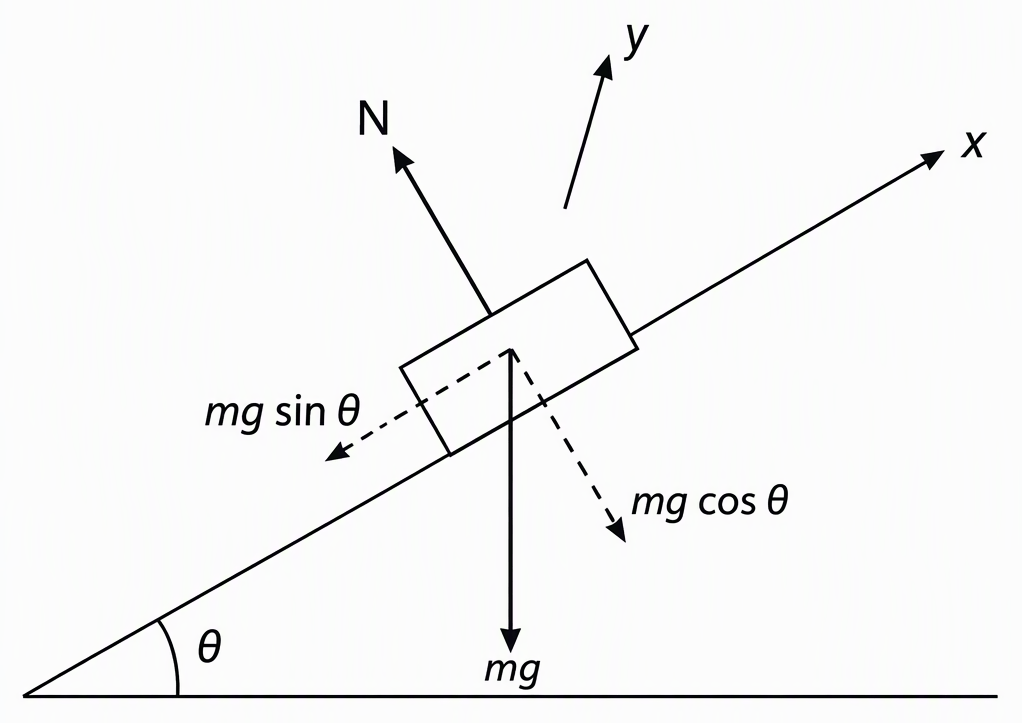
On an incline, axes parallel and perpendicular to the surface usually save algebra. Resolve weight along these axes, without counting both weight and its components as separate forces.
How do I choose friction and connect the force equations?
Test whether the surfaces can remain at rest relative to each other before using kinetic friction. Then write the force equations and the connection constraint. This avoids assigning maximum friction automatically or assuming equal accelerations in every pulley arrangement.
- Test relative motion at the contact. If the surfaces are initially at rest relative to each other, calculate the friction required to keep them that way. Compare it with the static limit:
Static friction adjusts up to this limit. During sliding, use:
Its direction opposes relative sliding between the surfaces, not blindly the object’s ground velocity. Find the normal reaction from the perpendicular force equation; the following is a special case, not a default:
- Write the equations and constraints. Apply Newton’s second law along the selected axes:
For two bodies connected over an ideal fixed pulley, a taut, inextensible string gives equal acceleration magnitudes. Tension is uniform for a massless string and a frictionless, massless pulley.
A combined-system equation eliminates internal forces. Return to one body when finding contact force or tension.
- Check dimensions, direction and physical admissibility. Negative acceleration reverses your assumed acceleration direction. If a friction calculation contradicts its assumed sliding state, reconsider that friction choice.
Keep this answer-sheet sequence visible: body → forces → motion test → equations → check. For optional repetition, NEET JEEnius AI’s daily practice problems provide a fresh set on a topic every day, with 20 free attempts a month.
How do I find the contact force between two blocks?
Find the common acceleration using both blocks, then isolate the block pushed only by contact. All three examples here are original practice questions, not NEET previous-year questions; their values are teaching inputs, not exam statistics.
Two blocks of 2 kg and 3 kg touch on a smooth horizontal surface. A horizontal force of 20 N pushes the 2 kg block towards the 3 kg block. Find the contact force.
- A: 8 N
- B: 10 N
- C: 12 N
- D: 20 N
Body and forces: choose both blocks, with positive horizontal direction along the push. Vertical forces balance; there is no friction, and contact is internal.
Motion and equations: both blocks stay in contact and share one acceleration. For the whole system:
For the 3 kg block alone, contact is the only horizontal force:
Check using the 2 kg block:
Option C is correct. 20 N accelerates the whole system; it is not the contact force.
Transfer check: push the 3 kg block towards the 2 kg block instead. Acceleration stays unchanged, but contact becomes:
How do I decide whether friction keeps a block at rest?
Calculate the friction needed for rest and compare it with the static limit. Do not subtract maximum static friction automatically: below the limit, static friction supplies only what is needed to prevent relative sliding.
A 4 kg block initially rests on a horizontal surface. The applied force is horizontal, with:
The vertical equation gives:
Case A: apply 15 N. Rest requires 15 N of opposing friction, which is below the limit. Therefore:
The friction is not 20 N. Using that value would incorrectly make the initially stationary block accelerate against the push.
Case B: separately start from rest and apply 25 N. Choose the acceleration:
- A: 0 m/s²
- B: 1.25 m/s²
- C: 3.75 m/s²
- D: 6.25 m/s²
The required static friction exceeds 20 N, so sliding begins. Kinetic friction then acts against the sliding:
Option C is correct, in the applied-force direction. Option B incorrectly retains maximum static friction:
Maximum static friction is a threshold, not a permanent force value. Reaching that limit alone does not justify switching to kinetic friction; sliding must begin.
How do I solve an incline connected to a hanging mass?
Use one acceleration magnitude but separate force equations for the two bodies. Choose corresponding positive directions along the string, then add the equations to eliminate tension. Here the hanging weight exceeds the incline block’s downslope weight component, so assume downward acceleration for the hanging mass.
A 2 kg block on a smooth 30° incline connects to a hanging 3 kg mass over an ideal fixed pulley. The string is massless, taut and inextensible. Find tension using:
- A: 10 N
- B: 18 N
- C: 20 N
- D: 30 N
The incline block has tension upslope, weight downward and normal reaction perpendicular to the plane. The hanging mass has tension upward and weight downward.
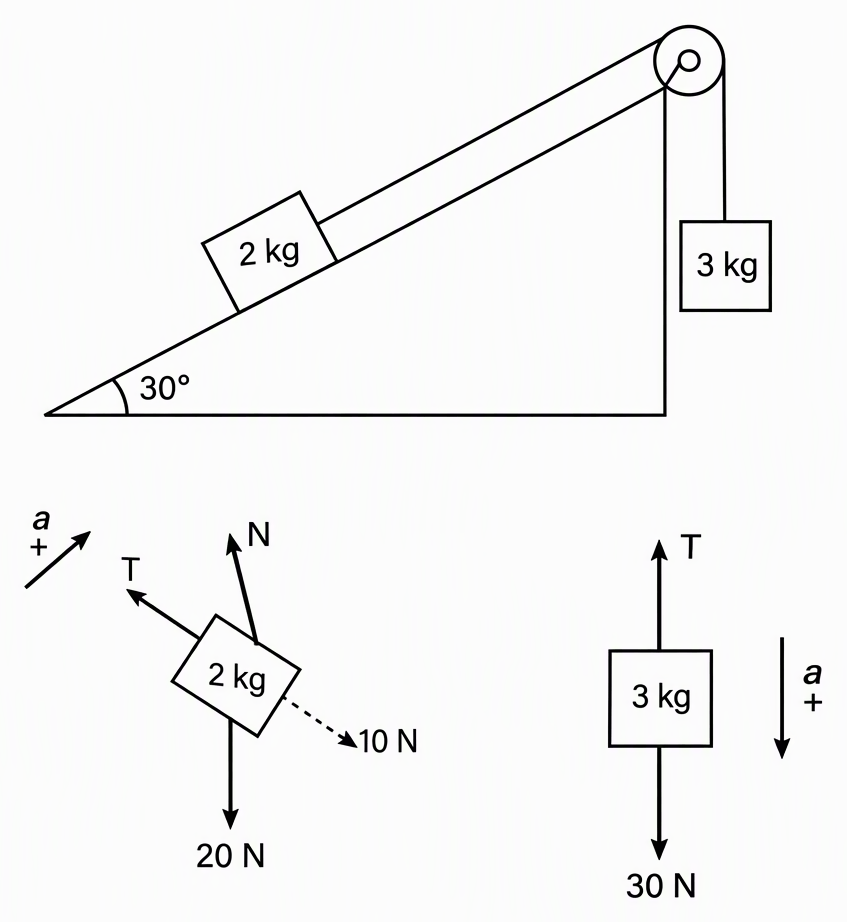
The downslope weight component is:
Choose hanging-down and incline-up as positive. The equations are:
Adding gives:
Substitute into either equation:
Option B is correct. Positive acceleration agrees with the assumed directions, and tension below 30 N permits downward acceleration of the hanging mass.
Tension does not equal the hanging weight because that mass accelerates. Nor is tension the incline block’s net force:
Across all three examples, forces and constraints produce the equations. The problem’s appearance does not select a memorised formula.
What should I practise after these Laws of Motion examples?
Start untimed with compulsory free-body diagrams, then move to mixed timed sets. This is a study recommendation, not an official timing requirement. Measure progress by decisions you can justify, not pages read or formulas copied.
Use NCERT examples and exercises first, followed by chapter-wise NEET previous-year questions. Keep this progression:
- Single-body diagrams and equilibrium.
- Contact forces and lifts.
- Static versus kinetic friction.
- Inclines and ideal pulleys.
- Mixed force-equation questions.
Make a separate completion pass for momentum, impulse and circular-motion forces. The three worked examples do not cover the whole chapter.
For impulse, identify the system and relate net external impulse to momentum change:
Use conservation of system momentum when net external impulse is negligible. For circular motion, choose inward as positive and write:
Do not add a “centripetal force” arrow. Existing forces supply the inward net force.
Classify every wrong answer by its cause:
- Missing force: redraw the body and identify each interaction.
- Incorrect friction branch: repeat the rest-versus-sliding test.
- Sign or constraint error: rewrite positive directions and the string relation.
- Algebra/unit error: redo substitution with units.
Reattempt without viewing the solution, then explain the corrected decision in one sentence. Progress means you can justify every force, the friction choice and the acceleration constraint without copying.
For optional topic practice, NEET JEEnius AI’s practice mode offers sets that skip questions already seen, with 60 free sets a month. Keep your own error record, and use it to choose what you reattempt next.
Next step: practice mode on NEET JEEnius AI and practise a topic in sets that skip questions you have already seen (60 free sets a month).
For a worked example of the same idea, see Muscle Contraction NEET 2026: Why Option D Is Correct.
Frequently asked questions
How should I start studying Laws of Motion for NEET?
Revise vector components and the difference between velocity and acceleration, then read NCERT on inertia, momentum, Newton’s laws and friction. For numericals, choose the body and positive axes, draw actual forces, test the motion, write equations and check the result.
How do I know whether to use static or kinetic friction?
If the surfaces are initially at rest relative to each other, calculate the friction needed to maintain that state and compare it with the maximum static friction, μsN. Static friction supplies only the required amount up to that limit; use kinetic friction, μkN, once sliding begins. Reaching the static limit alone does not mean sliding has started.
How do I find the contact force between two blocks?
For touching blocks that remain in contact on a smooth horizontal surface, first treat both blocks as one system to find their common acceleration. Then isolate the block pushed only by contact and apply Newton’s second law. In the article’s example, a 20 N push on the 2 kg block accelerates both blocks at 4 m/s², giving a contact force of 12 N on the 3 kg block.
What should I practise after NCERT Laws of Motion examples?
Finish NCERT exercises, then attempt chapter-wise NEET previous-year questions, moving from untimed free-body diagrams to mixed timed sets. Progress through equilibrium, contact forces and lifts, friction, inclines and ideal pulleys. Make a separate completion pass for momentum, impulse and circular-motion forces, and classify each error before reattempting.