
What is the correct answer to the muscle contraction NEET 2026 question?
Option D (4), A, B, D and E only, is correct for the muscle contraction NEET 2026 question. Calcium exposes sites for cross-bridge formation; it does not switch actin off.
This Biology question belongs to Human Physiology and is tagged medium on the supplied question bank’s scale, not an official NEET difficulty scale. For this medium-tagged question, use 60 seconds as an expected solving-time target, not a guarantee.
Choose every correct statement:
- Statement A: A motor neuron carries the CNS instruction to the muscle-fibre membrane.
- Statement B: The resulting action potential causes calcium release into the sarcoplasm.
- Statement C: Rising calcium switches actin off and breaks cross bridges.
- Statement D: Attachment between actin and a myosin head creates a cross bridge.
- Statement E: Actin moves towards the middle of the A band as the sarcomere shortens.
The answer-option labels are separate from the statement labels:
- Option A (1): C and D only.
- Option B (2): A and B only.
- Option C (3): C and E only.
- Option D (4): A, B, D and E only.
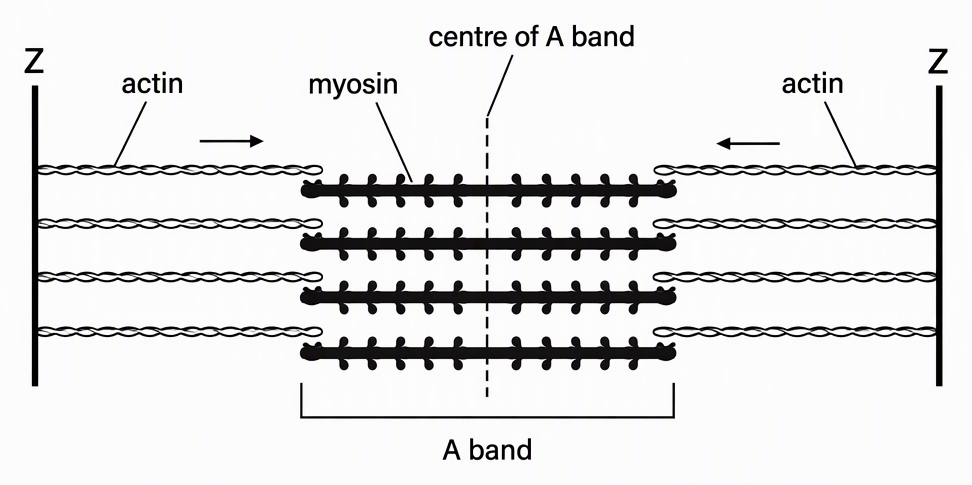
For statement E, track filament position, not filament length. A sarcomere extends between two Z lines, with thick filaments centrally placed and thin filaments extending inward from the Z lines.
Why are statements A and B correct?
Nerve signalling excites the muscle membrane, and that excitation releases stored calcium. The official solution supplies the link compressed in statement A: acetylcholine carries the message across the neuromuscular junction.
Step 1: The motor neuron carries the CNS instruction to the neuromuscular junction. Its nerve terminal releases acetylcholine, which triggers an action potential in the sarcolemma.
Sarcolemma means muscle-fibre membrane. The neuron does not have to enter the fibre to transmit the instruction. Statement A is correct, with acetylcholine providing the omitted junctional link.
Step 2: Excitation spreads through the muscle fibre and triggers calcium release from the sarcoplasmic reticulum into the sarcoplasm. Statement B is correct: the sarcoplasm receives the released calcium.
Keep the compartments separate: the sarcoplasmic reticulum is the calcium store, while the sarcoplasm is the receiving compartment. They are not two names for the same structure.
Why is statement C wrong about calcium and cross bridges?
Calcium permits cross-bridge formation by exposing binding sites on actin. Statement C reverses that role: calcium does not inactivate actin to break bridges.
Step 3: Released calcium ions bind to a subunit of troponin associated with the thin filament. This regulatory change moves tropomyosin away from the myosin-binding sites on actin, removing their masking.
Exposed sites permit myosin heads to attach to actin. Calcium therefore facilitates cross-bridge formation, so statement C is incorrect.
Site exposure and detachment have different triggers. Binding of a fresh ATP molecule to myosin causes an attached actin–myosin cross bridge to detach. ATP hydrolysis subsequently re-energises the head; hydrolysis itself is not the direct detachment trigger. Keep calcium-mediated exposure separate from ATP-mediated detachment when checking a statement about bridges breaking.
Why are statements D and E correct, and which option matches?
Myosin-head attachment forms a cross bridge, and its power stroke pulls actin towards the A-band centre. These mechanisms make D and E correct, completing the true set with A and B.
Step 4: A myosin head attaches to an exposed binding site on actin. That attachment forms a cross bridge, making statement D correct.
Step 5: The myosin power stroke pulls the thin filament towards the sarcomere centre, at the centre of the A band. Statement E is therefore correct.
In the figure, actin extends inward from each Z line, so inward sliding brings the Z lines closer together. The sarcomere shortens, but actin and myosin filaments do not shorten; the A band retains its length.
- A, true: Acetylcholine links motor-neuron signalling to sarcolemma excitation.
- B, true: Excitation releases stored calcium into the sarcoplasm.
- C, false: Calcium exposes binding sites rather than breaking bridges.
- D, true: Myosin-head attachment to actin forms a cross bridge.
- E, true: The power stroke pulls actin towards the A-band centre.
Final answer: option D (4), A, B, D and E only. Answer option D is the combination, not statement D alone.
Why does option B (2) fail even though A and B are true?
Its word “only” excludes D and E, which are also correct. A true pair is not enough when the question asks for the complete set.
The method error is stopping after confirming the early signalling events in A and B, leaving the mechanical steps unchecked. Assign true or false to every statement before matching an option.
- Option A (1): Reject it because it includes false statement C.
- Option B (2): Reject it because it omits true statements D and E.
- Option C (3): Reject it because it includes false statement C.
- Option D (4): Retain it because it includes every true statement and excludes C.
Which three related practice questions check this mechanism?
These original related Human Physiology practice questions test site exposure, detachment and filament overlap. They are not verified PYQs or additional NEET 2026 questions.
- Calcium is released normally, but its binding site on troponin is blocked. Which immediate step is impaired?
Exposure of myosin-binding sites on actin is impaired. Calcium cannot trigger the troponin change, so tropomyosin continues masking the sites and cross-bridge formation is impaired.
- A myosin head is attached to actin. Which molecular event directly allows it to detach?
A fresh ATP molecule binds to myosin and causes detachment. Subsequent ATP hydrolysis re-energises the head; it does not directly trigger detachment.
- During sarcomere contraction, what happens to the A band, I band and H zone?
- A band: Its length stays unchanged because thick-filament length stays unchanged.
- I band: It narrows as increased overlap reduces the thin-only region.
- H zone: It narrows and may disappear as actin enters the central thick-only region.
Increased overlap explains these changes, not filament shortening. For a worked numerical check, assume a sarcomere shortens from 2.4 to 2.0 micrometres while its A band remains 1.6 micrometres. The combined I-band portions within that sarcomere are:
Cover the answers and identify the trigger for each event: site exposure, attachment and detachment. Then check that each explanation names the correct molecule and action.
Next step: photograph a doubt on NEET JEEnius AI and photograph any question you are stuck on and get a step-by-step solution across Physics, Chemistry and Biology (20 free a month).
If that step was the hard part, work through Organic Compounds Containing Halogens NEET 2001: Wurtz Solution.
Frequently asked questions
What is the correct answer to the muscle contraction NEET 2026 question?
Option D (4), containing A, B, D and E only, is correct. Statement C is false because calcium exposes myosin-binding sites on actin rather than switching actin off and breaking cross bridges.
What does calcium do during muscle contraction?
Calcium released from the sarcoplasmic reticulum binds to troponin on the thin filament. This causes tropomyosin to move away from the myosin-binding sites on actin, allowing cross bridges to form.
Does ATP binding or ATP hydrolysis break the actin–myosin cross bridge?
Binding of a fresh ATP molecule to myosin directly causes the actin–myosin cross bridge to detach. ATP hydrolysis subsequently re-energises the myosin head; it is not the direct detachment trigger.
What happens to the A band, I band and H zone during contraction?
The A band retains its length, while the I band narrows and the H zone narrows and may disappear. These changes result from increased overlap between actin and myosin, not shortening of either filament.
Why is option B wrong if statements A and B are correct?
Option B (2) says A and B only, excluding statements D and E, which are also correct. The question requires the complete set of true statements, so option D (4) is the correct match.