What is the answer to the Diversity in Living World NEET 2026 symmetry question?
Option C is correct in this Diversity in Living World NEET 2026 question: Statement I is true, but Statement II is false. To assess the claims, consider sectioning an animal through its central body axis and checking whether the halves match. The model below illustrates the definition, not literal echinoderm anatomy.
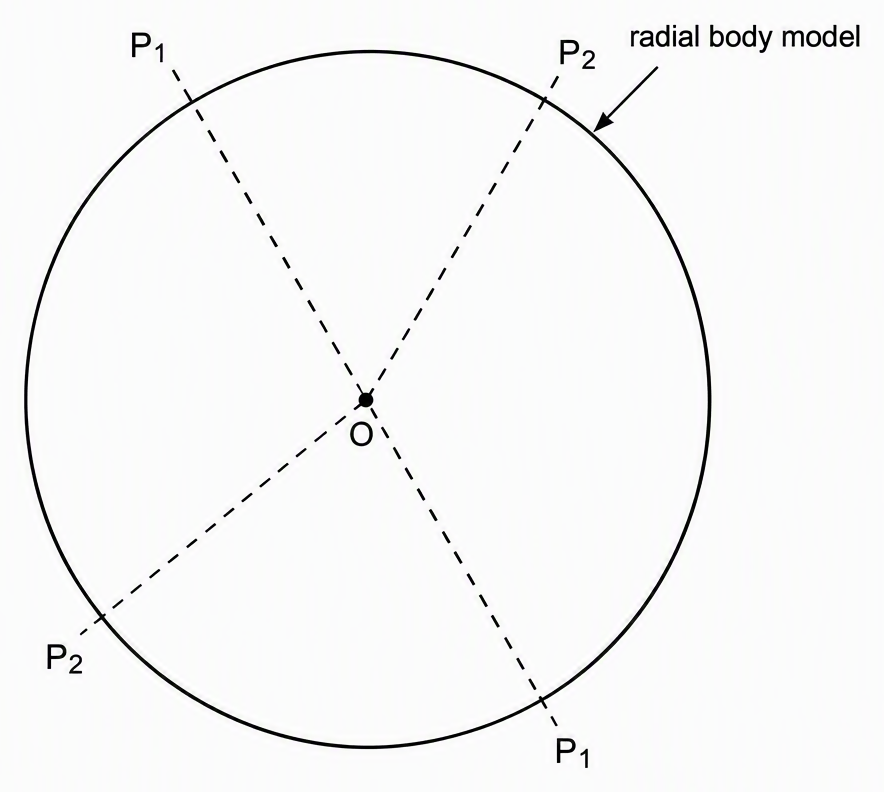
Source: NEET 2026 Biology, chapter Diversity in Living World, topic Symmetry in animals and Echinodermata. This question bank classifies it as medium difficulty, with an expected solving time of 45 seconds, not a measured student average.
- Statement I: Any cutting plane containing the central axis produces matching body halves in radial symmetry.
- Statement II: Both mature echinoderms and their larvae have radial symmetry.
The original option mapping is:
Why is Statement I true?
Statement I satisfies the two conditions in the official solution’s radial-symmetry definition: the cutting plane passes through the central axis, and the resulting body halves match. Merely cutting an animal into two pieces does not establish symmetry.
In the model, P1 and P2 show different plane orientations through the same axis. Each produces matching halves. The definition permits any plane through that axis, not any arbitrary cut anywhere through the body.
Compare this with bilateral symmetry: only one plane divides the body into matching left and right halves. The distinction is which planes produce matching halves, not simply whether the body can be divided. First result: Statement I is true.
Why is Statement II false for echinoderms?
Echinoderm adults are radial, while their larvae are bilateral. Follow the official solution by checking these stages separately. Do not assign one symmetry label to the entire life cycle just because the statement names a single phylum.
- Adult echinoderms: Radial symmetry. The adult part of the statement is true.
- Echinoderm larvae: Bilateral symmetry. The claim that larvae are radial is false.
The word “both” makes Statement II a compound claim. It requires the adult claim and the larval claim to be true together. A correct adult clause cannot rescue an incorrect larval clause.
The statement therefore fails at the larval check, not the adult check. Second result: Statement II is false.
How do the two results give option C?
Statement I is true; Statement II is false. Therefore, option C is correct: the first statement is correct, but the second is incorrect. Retain that meaning rather than memorising the letter alone.
Eliminate the other choices:
- A fails because it requires Statement II to be true.
- B fails because it requires Statement I to be false.
- D fails because it requires Statement II to be true and Statement I to be false.
This is a two-statement truth-value question, not a test of whether a reason explains an assertion. Definition correct; adults radial; larvae bilateral; C.
How can an adult-only rule lead to wrong option A?
Option A follows from wrongly extending an adult characteristic to larvae. The faulty chain is: recall “echinoderms are radial”, apply that label to every life stage, accept Statement II, then combine it with the true Statement I to select A.
The mistake is not in the radial-symmetry definition. It is the unchecked qualifier “both adults and larvae”. Repair the method before selecting an option:
- Underline “both”.
- Split the statement into adult and larval claims.
- Verify each claim independently.
This explains how A can arise, not how frequently students choose it. If correct option C earns 4 marks and wrong option A earns minus 1 mark, the score difference is:
For the separate task of testing explanation links, see NEET Assertion Reason Questions: Method and Examples. Here, truth checking is sufficient; there is no assertion–reason explanation link to judge.
Can you solve three related symmetry questions using this method?
Use the plane condition for a definition question and separate life stages for an echinoderm question. These are related practice questions created for Diversity in Living World NEET 2026 revision, not additional NEET PYQs. Answer each before reading its worked explanation.
What symmetry allows matching left and right halves through only one plane?
Question 1: An animal can be divided into matching left and right halves by only one plane. Identify its symmetry.
Answer: Bilateral symmetry. One qualifying plane, rather than any plane through the central axis, is the defining condition. Naming the animal or its phylum is unnecessary.
Which adult–larva symmetry pair is correct for Echinodermata?
Question 2: Select the correct pair, keeping adult first and larva second:
- Radial–radial.
- Bilateral–radial.
- Radial–bilateral.
- Bilateral–bilateral.
Answer: Radial–bilateral. Check the entries independently: the adult has radial symmetry, and the larva has bilateral symmetry. Radial–radial repeats the original question’s error by carrying the adult label into the larval stage.
Does a bilateral larva rule out an organism being an echinoderm?
Question 3: A student rejects an organism’s identification as an echinoderm solely because its larva is bilateral. Is that rejection justified?
Answer: No. Bilateral larval symmetry agrees with the echinoderm life-stage pattern. It is not a contradiction, although that feature alone does not establish the organism’s identity.
Now look away and restate the adult–larva contrast from memory. Include both stages, not just the phylum’s name.
Next step: photograph a doubt on NEET JEEnius AI and photograph any question you are stuck on and get a step-by-step solution across Physics, Chemistry and Biology (20 free a month).
Frequently asked questions
What is the correct answer to the Diversity in Living World NEET 2026 symmetry question?
The correct answer is option C: Statement I is true and Statement II is false. Statement I matches the solution’s radial-symmetry definition, but Statement II incorrectly assigns radial symmetry to both adult echinoderms and their larvae.
Are echinoderm larvae radial or bilateral?
Echinoderm larvae have bilateral symmetry, while adults have radial symmetry. A statement assigning radial symmetry to both stages is therefore false.
What is the difference between radial and bilateral symmetry?
In the question’s radial-symmetry model, any plane through the central axis produces matching halves. In bilateral symmetry, only one plane divides the body into matching left and right halves.
Is this symmetry question an assertion–reason question?
No, it is a two-statement truth-value question. Assess each statement independently and match the results to the options; there is no assertion–reason explanation link to test.