
How do you solve NEET assertion reason questions reliably?
- Read the printed answer choices first. For NEET assertion reason questions, option numbering is not universal. Identify what each choice means before judging the statements. A Statement I/Statement II question needs only separate truth checks unless its instructions also ask whether one statement explains the other.
- Judge the assertion independently. Recall the relevant NCERT fact and mark the assertion true or false, using T or F in your rough work. Do not let a convincing reason rescue a false assertion. If the assertion contains several claims, check each one.
- Judge the reason independently. Use Biology knowledge rather than its apparent fit with the assertion. Inspect words such as all, only, always, never, increases and decreases. These words prompt you to check scope or direction; they are not automatic signs that a statement is false.
- Test the explanation only when both statements are true. Check the direction from reason to assertion. Read “A is true because R”, then name the biological mechanism or principle connecting them.
Sharing a chapter, organism or keyword is not an explanation. The “because” sentence is a diagnostic, not proof: natural wording cannot replace correct Biology, supply an invented missing premise or reverse the explanatory direction.
- Match your category to the printed choice, then mark the OMR response. Decide the category before selecting its number. Never carry a remembered option number from another book or test.
Use this compact decision key for the worked examples below. It is this article’s practice key, not a universal exam convention:
- T/T, explanation yes: Option (1), both statements are true and R correctly explains A.
- T/T, explanation no: Option (2), both statements are true but R does not correctly explain A.
- T/F: Option (3), A is true and R is false. Stop before the explanation check.
- F/T: Option (4), A is false and R is true. Stop before the explanation check.
If both statements appear false and no matching option is offered, recheck the wording and question. Do not force either statement into a true category to fit the choices.
Record truth and explanation separately in your rough work. This distinguishes a wrong Biology fact from a wrong explanation check.
The pairs below are original teaching examples, not claimed previous-year questions. This article makes no claim about a fixed assertion–reason question count in NEET.
How do you solve an assertion–reason pair about S-phase DNA replication?
Separate DNA amount from chromosome number: replication doubles DNA content, but chromosome number stays unchanged during S phase. Classify the pair using the practice key before reading the worked answer.
- Assertion: During the S phase of a normal mitotic cell cycle, the amount of nuclear DNA per cell doubles.
- Reason: Nuclear DNA replication takes place during the S phase.
Worked answer: The assertion is true, and the reason is independently true. DNA replication produces the increase in nuclear DNA amount, so R explains A.
For a numerical check, take a hypothetical cell entering S phase with 6 pg of nuclear DNA and 4 chromosomes. Replication copies the DNA without separating the sister chromatids into independent chromosomes.
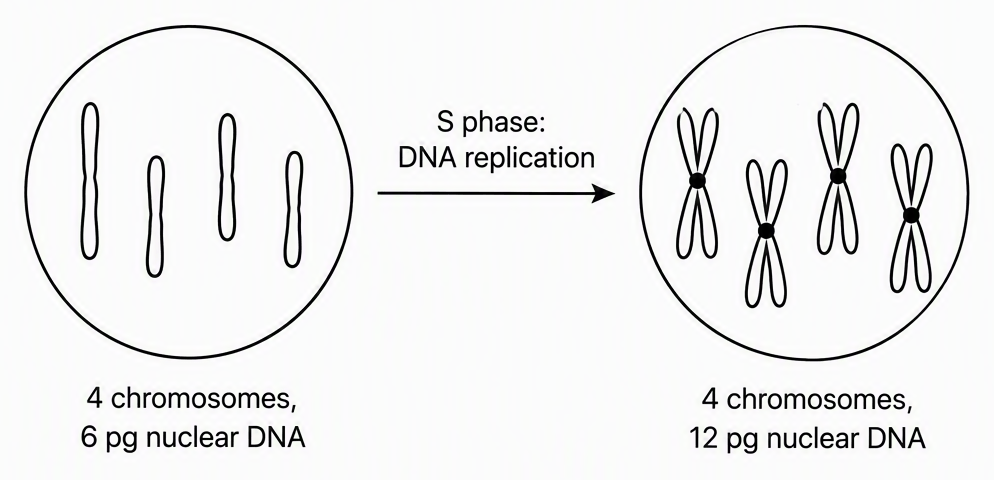
Count chromosomes by centromeres, not chromatids. Two sister chromatids do not become two independent chromosomes during S phase.
Copy this short working:
Final answer: option (1), both statements true and R correctly explains A. Check that the printed option matches this category.
Why do two true facts about gymnosperms not necessarily explain each other?
Heterospory describes spore types; it does not explain whether an ovary wall encloses the ovules. Both facts in this pair are true, but being facts about the same plant group does not give them an explanatory link.
- Assertion: Gymnosperm ovules are not enclosed by an ovary wall.
- Reason: Gymnosperms are heterosporous, producing microspores and megaspores.
Truth checks: Both statements are true. The assertion correctly describes the exposed ovules, and the reason correctly identifies the two spore types.
Explanation check: Heterospory does not establish the absence of an enclosing ovary wall. Angiosperms are also heterosporous, yet their ovules are enclosed within an ovary.
That comparison tests the proposed explanation directly. The property given in the reason occurs in both groups, although the condition described in the assertion differs.
Final answer: option (2), both true but R does not correctly explain A. The error is confusing two facts about the same group with an explanatory relationship.
If you marked either statement false, repair the plant facts with Gymnosperm gametophytes and seeds. If you marked both true but chose an explanatory link, revisit the angiosperm comparison.
For continued topic practice, NEET JEEnius AI’s daily practice problems provide a fresh set on a topic every day, with 20 free attempts a month.
How can one word make an enzyme assertion false?
The word all makes this assertion false because catalytic RNA provides an exception. Once either statement is false, stop the both-true explanation test: the independent truth checks have already determined the category.
- Assertion: All enzymes are proteins.
- Reason: Ribozymes are RNA molecules with catalytic activity.
Truth checks: The assertion is false because ribozymes are catalytic RNA, not proteins. The reason is true.
The NCERT-aligned statement is “almost all enzymes are proteins”, not “all enzymes are proteins”. Removing almost changes the scope and therefore the truth value.
Final answer: option (4), A false and R true. Do not select the both-true explanatory option because the reason helps you spot the assertion’s error. Explaining why an assertion is false is not the same as explaining a true assertion.
Reverse the factual roles in a brief variation. Judge each statement independently again:
- Assertion: Ribozymes have catalytic activity.
- Reason: All enzymes are proteins.
Recognising the ribozyme exception is knowledge-based checking. It is not a shortcut that treats every absolute statement as false; an absolute claim can be correct within its stated biological scope.
What should you practise after getting an assertion–reason answer wrong?
Classify 8–12 assertion–reason pairs from recently revised Biology topics, recording the truth of A, truth of R, explanation verdict and selected option. Choose this over recording only correct or incorrect: it identifies which decision needs repair.
Use four error labels:
- Assertion fact: You misjudged A. Reread the relevant NCERT passage and rewrite the assertion correctly.
- Reason fact: You misjudged R. Reread the relevant passage, checking its qualifiers and exceptions.
- Explanatory link: Your truth checks were correct, but the connection was wrong. Write the mechanism that explains A, or state why R does not establish it.
- Option mapping: Your category was correct, but the selected number was wrong. Remap the printed choices before answering again.
For each wrong answer, write a one-line correction. For example: “Heterospory specifies two spore types, not whether ovules are enclosed.”
Retest the concept the next day without looking at the previous answer. This is a recommended routine, not a score-improvement guarantee.
If cell-cycle facts are weak, use Cell cycle practice questions: 8 MCQs explained to strengthen that base. For mistakes recurring across tests, follow NEET mock test analysis: errors, repairs and retests.
For further topic practice, NEET JEEnius AI’s practice mode offers topic sets that skip questions already seen, with 60 free sets a month. Keep this checklist beside your next practice set:
Next step: daily practice problems on NEET JEEnius AI and get a fresh set on a topic every day (20 free attempts a month).
Frequently asked questions
How do I solve NEET assertion reason questions step by step?
Read the printed answer choices first, then judge the assertion and reason independently using the relevant NCERT facts. Only when both are true should you test whether the reason correctly explains the assertion. Match your verdict to the printed option before marking the OMR response.
Are assertion reason option numbers always the same?
No, assertion–reason option numbering is not universal across books and tests. Decide the truth values and explanatory link first, then select the printed choice that matches. Never carry a remembered option number into another question.
How do I check whether the reason explains the assertion?
When both statements are true, read them as “A is true because R” and identify the biological mechanism or principle connecting them. Natural wording or a shared topic does not establish an explanation. For example, gymnosperms are heterosporous, but heterospory does not explain why their ovules are not enclosed by an ovary wall.
What should I practise after getting assertion reason questions wrong?
Practise 8–12 pairs from recently revised Biology topics, recording each statement’s truth value, the explanation verdict and the selected option. Label each mistake as an assertion fact, reason fact, explanatory link or option-mapping error. Write a one-line correction and retest the concept the next day without looking at the previous answer.