What is the correct answer to the gymnosperms NEET 2026 question?
The gymnosperms NEET 2026 answer is A: both statements are correct. Assess two claims independently: male and female gametophytes are retained within sporangial structures, and gymnosperms produce naked seeds.
Answer: A, both statements are correct. This is a two-statement correctness question, not an assertion–reason question: Statement II need not explain Statement I.
The question bank tags it medium, with an expected solving time of 45 seconds. That is the question bank’s estimate, not a measured student-performance result.
Where do gymnosperm gametophytes develop?
Gymnosperm gametophytes are highly reduced and dependent on the sporophyte, which is the official solution’s starting point. They do not form independent, free-living plants. Check the male and female pathways separately, keeping the starting spore distinct from the gametophyte that develops from it.
- Male pathway: A microspore develops into the male gametophyte inside the microsporangium.
- Female pathway: The retained megaspore develops into the female gametophyte within the megasporangium of the ovule.
Within the ovule, the megasporangium is also called the nucellus. The integument surrounds it.
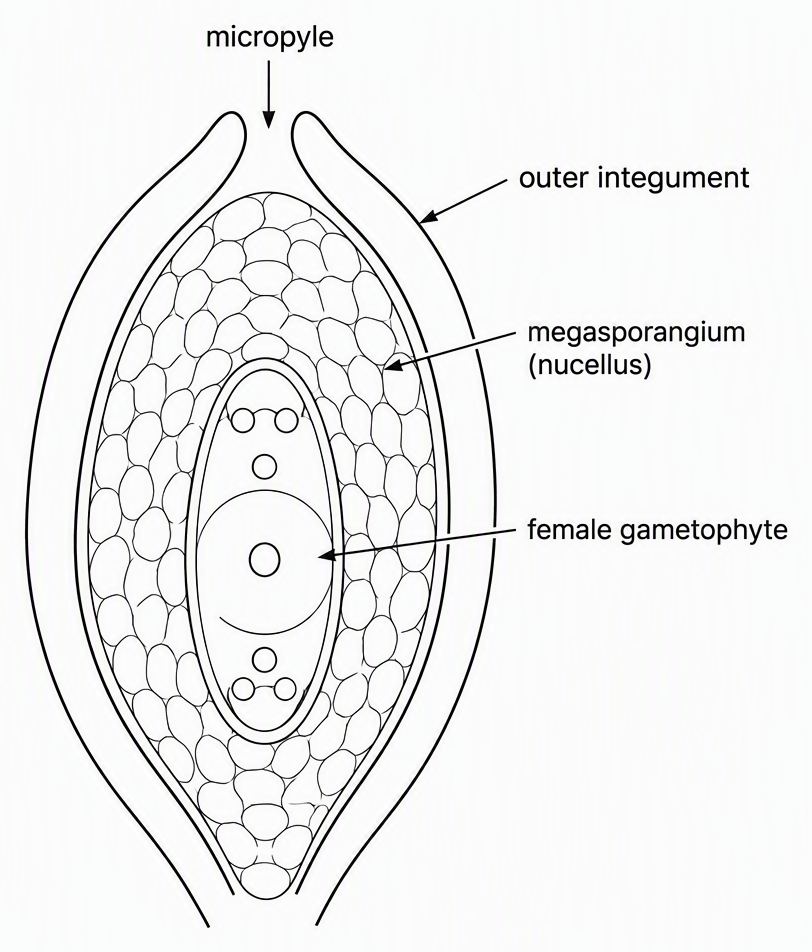
- Spore: The cell from which the gametophyte develops.
- Gametophyte: The reduced generation that develops from that spore.
- Sporangium: The structure where spores are produced and the development described here occurs.
Statement I is correct under the supplied official interpretation. This developmental explanation does not mean that every male stage remains permanently confined inside the original microsporangium.
What does a naked gymnosperm seed actually lack?
A naked gymnosperm seed lacks fruit enclosure, not a seed coat. Gymnosperm ovules are not enclosed within an ovary. After fertilisation and seed development, the resulting seeds are not enclosed within a fruit.
The word “naked” has a specific botanical meaning here. Read it as “without ovary enclosure at the ovule stage or fruit enclosure at the seed stage”, not “without any protective covering”.
In angiosperms, ovules are enclosed within an ovary, and seeds are enclosed within a fruit. A seed coat is different from either enclosure. Statement II is correct: “naked” does not mean that every protective layer around the embryo is absent.
Why does the pair of verdicts give option A?
The independent checks give Statement I correct and Statement II correct. That pair maps directly to option A in this gymnosperms NEET 2026 question; no causal link between the statements is needed. Recall: reduced, dependent gametophytes; seeds without fruit enclosure.
- B is eliminated: It rejects both statements.
- C is eliminated: It wrongly rejects Statement II.
- D is eliminated: It wrongly rejects Statement I.
How does confusing a seed coat with a fruit produce option C?
Option C results when Statement I is accepted but “naked” is wrongly read as “having no covering”. The mistaken chain is: gymnosperm seeds have a seed coat, so they cannot be naked; therefore Statement II must be false.
This substitutes the everyday meaning of covered for the botanical meaning of enclosed within an ovary or fruit. The repair is structural: the seed coat develops from the integument, whereas the fruit develops from the ovary.
Before judging “naked seeds”, ask: “Not enclosed by which structure?” A seed coat does not make a gymnosperm seed fruit-enclosed.
Marking example: Suppose correct option A earns four marks, while incorrect option C loses one mark. The difference between those outcomes is:
Record the repair as “seed coat confused with fruit enclosure”, rather than “forgot gymnosperms”. Use NEET Mock Test Analysis: Errors, Repairs and Retests to turn that terminology error into a retest.
Can you apply these distinctions to three related questions?
Identify the structure first, then judge the statement. These are original practice questions from the same chapter, not additional verified NEET PYQs. Attempt each before reading its answer.
Which pair of spores is produced by gymnosperms?
Answer: A. Gymnosperms are heterosporous, meaning they produce two spore types. Microspores give rise to male gametophytes; megaspores give rise to female gametophytes. Pollen tubes and eggs are not the two spore categories.
Within which structure is the megaspore that develops into the female gametophyte retained?
Answer: B. The megaspore is retained within the megasporangium of the ovule and develops there into the female gametophyte. Distinguish the starting cell, the megaspore, from its surrounding structure, the megasporangium.
Is a gymnosperm seed with a seed coat but no enclosing fruit still naked?
Answer: A. A seed coat and fruit enclosure are different structures, so the seed remains naked in the botanical sense. If you chose B, write “integument forms seed coat; ovary forms fruit” in your error log, then reattempt this question without looking at the explanation.
Next step: the past-paper archive on NEET JEEnius AI and search past NEET papers by year, subject or chapter, each with a worked solution (100 free searches a month).
Frequently asked questions
What is the correct answer to the gymnosperms NEET 2026 question?
The correct answer is A: both statements are correct under the supplied official interpretation. Statement I concerns gametophyte development within sporangial structures, while Statement II identifies gymnosperm seeds as naked.
Where do male and female gametophytes develop in gymnosperms?
A microspore develops into the male gametophyte inside the microsporangium. The retained megaspore develops into the female gametophyte within the megasporangium, or nucellus, of the ovule. This does not mean every male stage remains permanently inside the original microsporangium.
Why are gymnosperm seeds called naked if they have a seed coat?
Naked means the seeds are not enclosed within a fruit, not that they lack a seed coat. The seed coat develops from the integument, whereas a fruit develops from an ovary. Gymnosperm ovules lack ovary enclosure, and their seeds lack fruit enclosure.
Does Statement II have to explain Statement I in this question?
No. This is a two-statement correctness question, not an assertion–reason question. Judge each statement independently; both being correct maps to option A without requiring a causal link.