What is the DNA Replication NEET 2022 question asking?
The DNA Replication NEET 2022 answer is 60 cells. Ten heavy-labelled cells divide three times in light-nitrogen medium, producing 80 cells. Of these, 20 still contain conserved 15N parental strands in hybrid DNA. Therefore, only 60 cells contain completely light 14N/14N DNA.
Ten E. coli cells initially contain double-stranded DNA labelled with 15N. The cells are transferred to a medium supplying 14N nucleotides and allowed to grow for 60 minutes.
Use the 20-minute division time and semiconservative replication to determine how many cells contain only 14N/14N DNA.
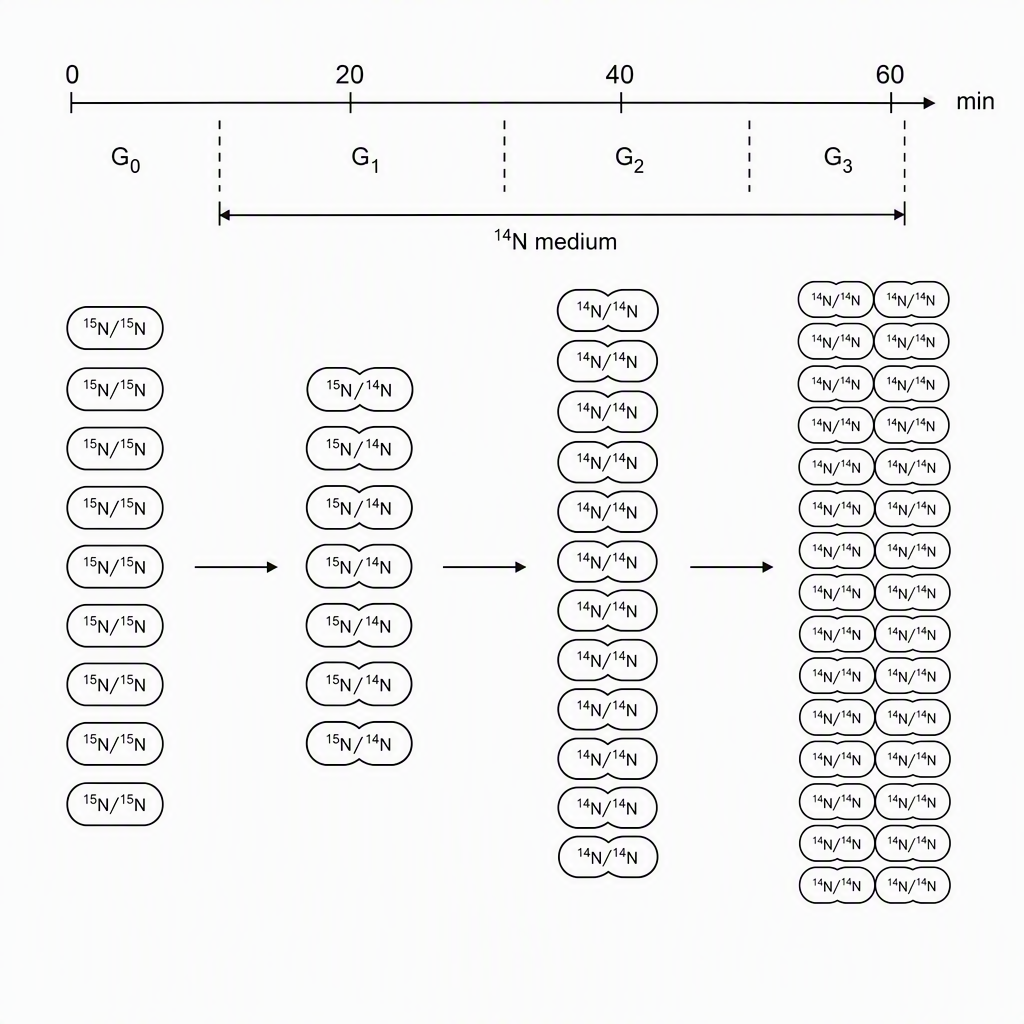
This is a single-correct NEET 2022 Biology PYQ from Genetics and Evolution. It is tagged hard, with a 90-second solving target.
The choices, paraphrased, are:
How do you track every generation in this DNA replication question?
Three complete generations produce 20 hybrid cells and 60 fully light cells. The official method tracks population growth and nitrogen-label inheritance separately. Cell division gives the total population, while semiconservative replication shows how many cells retain 15N.
First, calculate the number of generations:
The total number of cells after three generations is:
Use five columns: generation, elapsed time, total cells, hybrid cells and fully light cells.
- Generation 0: Elapsed time = 0 minutes; total cells = 10; hybrid cells = 0; fully light cells = 0. All 10 cells contain 15N/15N DNA.
- Generation 1: Elapsed time = 20 minutes; total cells = 20; hybrid cells = 20; fully light cells = 0. All cells contain hybrid 15N/14N DNA.
- Generation 2: Elapsed time = 40 minutes; total cells = 40; hybrid cells = 20; fully light cells = 20. The fully light cells contain 14N/14N DNA.
- Generation 3: Elapsed time = 60 minutes; total cells = 80; hybrid cells = 20; fully light cells = 60.
At generation 3, each of the 20 hybrid cells produces one hybrid descendant and one light descendant. These cells therefore produce 20 hybrid descendants and 20 light descendants.
The 20 fully light cells from generation 2 each produce two light descendants:
The final fully light count is:
The generation-3 population is:
Therefore, 60 cells are totally free from 15N, so option D is correct.
Why does the number of hybrid cells remain 20?
The hybrid count remains 20 because the starting DNA contains exactly 20 heavy parental strands, and semiconservative replication preserves every parental strand. The population grows, but the 14N medium cannot supply new 15N strands. Each conserved heavy strand therefore remains in one hybrid DNA molecule.
The 10 original 15N/15N DNA molecules contain:
These are 20 individual 15N parental strands. After the first replication, each original 15N strand pairs with one newly synthesised 14N strand, producing 20 hybrid DNA molecules.
No additional 15N is available in the new medium, so no new heavy strands can form. During each later replication, every hybrid molecule produces:
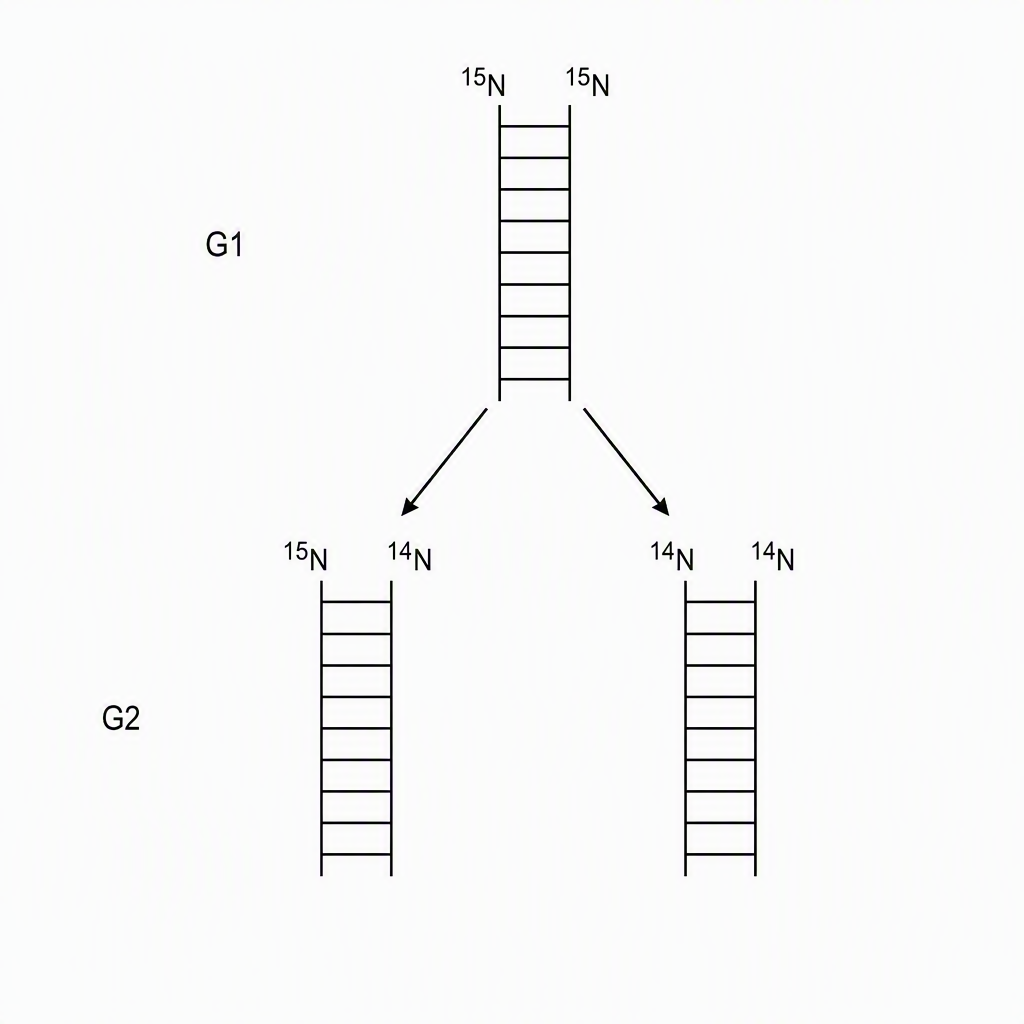
- One hybrid molecule that retains the original 15N strand
- One fully light 14N/14N molecule
The 20 conserved heavy strands remain distributed among 20 hybrid molecules. The fully light population continues to increase.
For this starting setup, use the following shortcut only after establishing the biology:
For the DNA Replication NEET 2022 question:
Why does the wrong method give 80 cells?
The calculation giving 80 is correct for the total population, not for the number of cells free from 15N. Calling all 80 cells light assumes that the original 15N strands disappear or are diluted out of existence. Semiconservative replication does not allow that.
The total population calculation is:
After the third generation, 20 cells still carry hybrid 15N/14N DNA. Each original parental strand remains part of a daughter DNA molecule.
The required subtraction is:
Dilution lowers the percentage of cells containing 15N, but it does not destroy the conserved 15N strands.
Which three related DNA replication questions should you practise?
These three Genetics and Evolution questions use the same isotope-tracking method. Calculate the total population first, keep the hybrid count at 20 from generation 1 onward, and subtract the hybrid cells only when the question asks for fully light cells.
How many cells are fully light after two generations?
Starting with the same 10 heavy-labelled cells, 20 out of 40 cells are fully light after two generations. The other 20 cells remain hybrid.
How many cells are hybrid and fully light after four generations?
After four generations in 14N medium, there are 20 hybrid cells and 140 fully light cells out of 160. The number of hybrid cells remains fixed because only 20 original heavy strands exist.
What fraction of cells still contains any 15N after three generations?
After three generations, one-fourth, or 25 percent, of the cells still contain 15N. These are the 20 hybrid cells within the total population of 80 cells.
For another Molecular Basis of Inheritance PYQ, work through Lac Operon NEET 2022: Correct Answer and Mutation Logic.
What do students need to know about hybrid and light DNA?
Semiconservative replication means each daughter DNA molecule receives one parental strand and one newly synthesised strand. In this question, the original 15N strands persist, while every strand made in the new medium contains 14N. This separates hybrid DNA from DNA completely free of 15N.
Why do hybrid cells remain 20 while their percentage falls?
The number of conserved 15N strands stays fixed at 20, so 20 cells remain hybrid. The total population doubles each generation, causing the hybrid percentage to fall.
At generation 3:
What is the difference between some 15N and no 15N?
A cell containing hybrid 15N/14N DNA still contains some 15N. It is not completely light.
A cell is totally free from 15N only when both DNA strands contain 14N, giving 14N/14N DNA.
Why are there three generations in 60 minutes?
The 20-minute generation time gives three complete generations in 60 minutes.
For a 90-second solution, write five columns immediately: generation, elapsed time, total cells, hybrid cells and fully light cells. Never equate the doubled population with the fully light population.
Frequently asked questions
Why is the DNA Replication NEET 2022 answer 60 cells?
Ten cells undergo three divisions, producing 10 × 2³ = 80 cells. Since 20 cells retain conserved 15N strands in hybrid DNA, the number containing only 14N/14N DNA is 80 − 20 = 60.
Why do 20 hybrid cells remain after every generation?
The 10 original DNA molecules contain 20 individual 15N parental strands. Semiconservative replication preserves these strands, so they remain distributed among 20 hybrid DNA molecules while no new 15N strands are formed.
How many generations occur in 60 minutes?
The generation time is 20 minutes, so 60 ÷ 20 = 3 complete generations occur. The total cell population therefore becomes 10 × 2³ = 80.
How many cells contain 15N after three generations?
Twenty of the 80 cells contain some 15N after three generations. These are hybrid 15N/14N cells, representing one-fourth or 25% of the population.
How many fully light cells are present after four generations?
Four generations produce 10 × 2⁴ = 160 cells. With 20 cells remaining hybrid, 160 − 20 = 140 cells contain fully light 14N/14N DNA.