What does the energy flow in ecosystem NEET 2026 question ask?
Energy transfer between trophic levels follows the approximate 10% law, not a 1% rule. That distinction decides the energy flow in ecosystem NEET 2026 question from NEET UG 2026, held on 21 June 2026, Code-50, Biology. “Medium” is the question bank’s difficulty rating, not an official exam classification.
Decide which claims are correct, testing each independently before selecting an option:
The answer choices are:
Why is statement (a) about one-way energy flow correct?
Energy passes through an ecosystem; it does not cycle back as a reusable supply. NCERT Class 12 Biology’s Ecosystem discussion is the basis of the supplied solution. Solar energy enters through producers, which capture it through photosynthesis, and passes onward to consumers through feeding.
Decomposers obtain energy from dead organic matter originating at different trophic levels. They are not restricted to material from the final consumer in a food chain.
Energy dissipated as heat during biological processes does not return to producers as recycled, usable energy. Nutrients can cycle through organisms and the environment, but producers need a continuing energy input. This distinction between energy flow and nutrient cycling makes statement (a) correct.
Why does statement (b) say the energy pyramid cannot be inverted?
Available energy decreases at each successive trophic level, so the energy pyramid stays upright. Only a fraction of the energy at one level becomes available to the next. Biological processes dissipate energy as heat, leaving less for onward transfer.
The official solution uses the typical 10% transfer model: the next trophic level receives about one-tenth of the energy available at the preceding level. This is an approximate model, not an exact efficiency for every organism or ecosystem.
Producers therefore have more available energy than primary consumers, which have more than secondary consumers. This decreasing availability makes statement (b) correct. Keep the always-upright rule specific to energy: pyramids of numbers and biomass can be inverted.
Why is option B correct for energy flow in ecosystem NEET 2026?
Statement (c) is incorrect because Lindeman’s 10% law describes transfer between successive trophic levels. The supplied solution associates approximately 1% with producers capturing incident solar radiation. These percentages describe different processes, so identify where the energy starts and where it arrives.
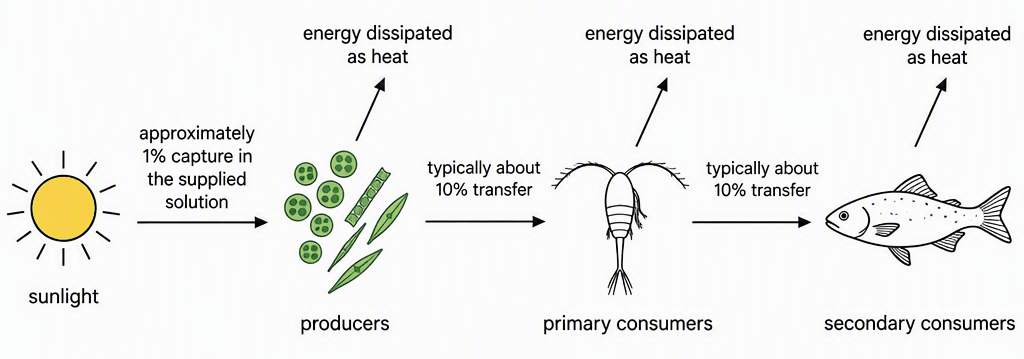
Keep the two boundaries separate:
- Incident sunlight to producers: approximately 1% refers here to solar energy captured through photosynthesis.
- One trophic level to the next: typically about 10% refers to energy becoming available at the next feeding level.
Neither percentage is an exact universal constant. A percentage of incident sunlight also has a different starting quantity from a percentage of energy already stored at a trophic level.
The completed truth pattern is (a) correct, (b) correct, (c) incorrect. A includes all three statements; C and D also include the false statement (c), so all three are eliminated.
Final answer: B, a and b only.
How does confusing solar capture with trophic transfer produce option A?
Option A results from attaching a remembered percentage to the wrong process. The mistaken route begins with two correct judgements: accept unidirectional energy flow in (a), then accept the upright energy pyramid in (b). Next, recall a 1% figure associated with producers.
Using that solar-capture figure to validate transfer between trophic levels in (c) produces A, all three statements. The first two judgements remain sound; the percentage has been applied to the wrong boundary.
The method error is applying a remembered percentage without identifying the energy source and receiving stage. Before choosing between 1% and 10%, ask: “Energy transferred from where to where?” Distinguish sunlight-to-producer capture from producer-to-consumer transfer before assigning either percentage.
Can you solve three related Ecosystem questions using this distinction?
Track the transfer steps, and separate energy flow from standing biomass and nutrient recycling. The following are original practice questions from the Ecosystem chapter, not additional verified PYQs.
Applying the 10% law at each step, what percentage of producer energy reaches secondary consumers?
Answer: 1% of producer energy reaches secondary consumers under this model. The sequence is producers to primary consumers to secondary consumers, so apply the transfer fraction twice.
Primary consumers receive about 10% of producer energy. Secondary consumers receive about 10% of that amount: 1% across two transfers does not establish a 1% law for each transfer.
Can an inverted biomass pyramid in an aquatic ecosystem imply an inverted energy pyramid?
Answer: No. Biomass measures the standing mass of living material at a given time; energy flow concerns energy passing through trophic levels.
Aquatic producers can have low standing biomass yet replenish it rapidly enough to support a larger consumer biomass. Energy still decreases through successive transfers, so the energy pyramid remains upright.
When decomposers release nutrients for producers to reuse, is energy also recycled?
Answer: No. Decomposition releases nutrients that producers can absorb again. Decomposers obtain energy from organic matter, but their biological processes also dissipate energy as heat.
Nutrient reuse does not return that dissipated energy to producers. Before selecting an option, write “source → receiving stage” beside each percentage.
Next step: the past-paper archive on NEET JEEnius AI and search past NEET papers by year, subject or chapter, each with a worked solution (100 free searches a month).
Keep going with Hydrocarbons NEET 2024: Diborane Question Explained.
Frequently asked questions
What is the correct answer to the energy flow question in NEET 2026?
The correct answer is B: a and b only. Energy flow is unidirectional, and an energy pyramid cannot be inverted. Statement (c) is incorrect because transfer between successive trophic levels follows the approximate 10% law, not a 1% rule.
Is energy transfer in an ecosystem 1% or 10%?
Lindeman’s 10% law describes the approximate energy transfer from one trophic level to the next. The supplied solution uses approximately 1% for producers capturing incident solar energy, which is a different process. Neither percentage is an exact universal constant.
Why can an energy pyramid never be inverted?
Available energy decreases at each successive trophic level because biological processes dissipate energy as heat. Only a fraction becomes available to the next level, so the energy pyramid remains upright. Pyramids of numbers and biomass can be inverted.
What percentage of producer energy reaches secondary consumers?
Under the 10% transfer model, secondary consumers receive about 1% of producer energy. Energy passes through two transfers: producers to primary consumers, then primary consumers to secondary consumers. Multiplying 10% by 10% gives 1%; this does not mean each transfer follows a 1% law.