Experimental Skills NEET 2026: which measurement needs index correction?
The answer is C, focal-length measurement using an optical bench. This experimental skills NEET 2026 question tests whether the scale’s readable reference mark matches the physical point from which a distance must be measured.
Identify the experiment in which a scale-reference mismatch must be corrected when determining the required distances.
The classification is Physics → Experimental Skills → Errors in Measurements and Index Correction. The question bank labels it medium difficulty and assigns 45 seconds as the expected solving time, not an observed student average.
What reference-point mismatch causes index correction?
Index correction is needed when the measuring scale’s zero or reference index does not coincide with the instrument’s intended physical reference position. A readable mark tells you where the carrier is indexed on the scale, but not necessarily where the required optical reference point lies.
Consider an illustrative optical bench with an object, a lens and an image screen arranged along it. Carrier indices provide their position readings, but the lens carrier’s index need not lie directly beneath the lens’s optical centre.
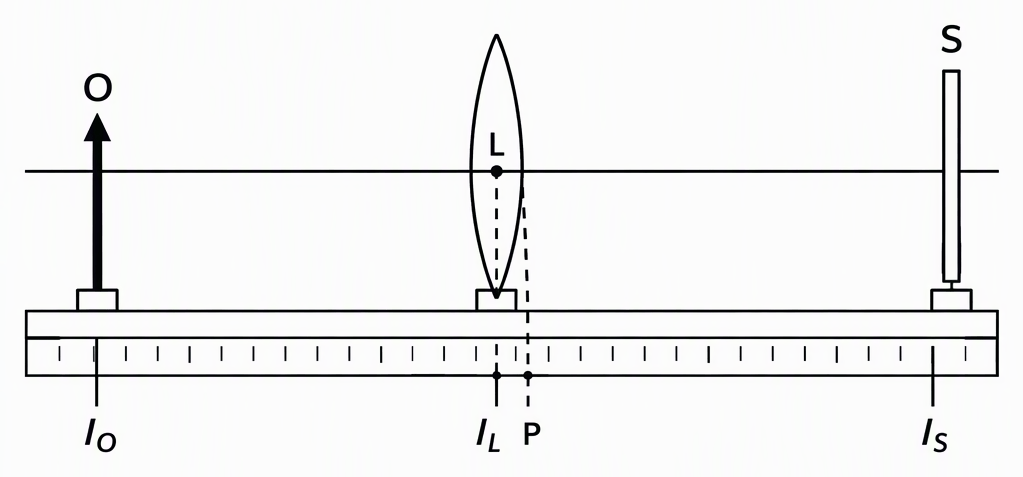
This figure illustrates why option C is correct. It does not add measured distances or a numerical arrangement to the original question.
Step 1 is to separate the readable index from the required physical reference. The carrier index locates a mark on the holder; the optical centre is the lens reference used in the standard thin-lens treatment. Reading the scale accurately does not correct a mismatch between those positions.
How does the mismatch establish option C and rule out the others?
Object and image distances must refer to the lens’s optical centre. Differences between carrier readings may not give those distances, so the reference mismatch must be accounted for before determining focal length.
- Step 2: Identify the required distances. In the standard thin-lens treatment, both object distance and image distance refer to the lens’s optical centre.
- Step 3: Check whether carrier-index readings give those physical distances. If the indices and relevant physical reference positions differ, account for that mismatch before using the distances.
- Step 4: Match this requirement to the apparatus. The final answer is C, optical bench.
Check each option against that requirement:
- A, metre bridge: Not the characteristic index-correction case in the standard setup.
- B, simple pendulum: Not the characteristic case.
- C, optical bench: Carrier index versus optical centre is the relevant mismatch.
- D, resonance tube: Index correction is not the main correction identified in the standard setup.
For A, B and D, the official qualification is “generally not the main required correction.” Their apparatus can still have reference errors, zero errors or other measurement errors.
This is a conceptual MCQ: no numerical readings are supplied, and no calculation is required to establish C. A lens-formula calculation is unnecessary.
For a separate scoring check, if C earns four marks and an incorrect D earns minus one, the difference is given below. This arithmetic does not establish the physics answer.
Why is resonance-tube end correction not the answer?
Resonance-tube end correction concerns the air column’s effective length, not a carrier mark’s position. Selecting D merely because a resonance tube “needs a correction” skips the deciding step: identifying the physical mismatch.
At an open end, the displacement antinode lies slightly beyond the tube’s mouth. The effective vibrating air-column length therefore differs from the measured air-column length inside the tube. End correction accounts for this boundary effect.
Optical-bench index correction instead concerns the carrier’s indicated position versus the relevant optical reference position. It corrects where a distance is referenced, not where a sound-wave antinode forms.
Before choosing an option, name the two positions or lengths being reconciled before naming the correction. Remembering only that an apparatus needs a correction cannot distinguish C from D.
Can you apply the reference-point test to three related questions?
Identify what is read, what is physically required and why they differ. The three questions below are original related practice questions, not additional NEET PYQs. Apply that test to distinguish an index mismatch, a zero error and an end correction.
Should a displaced lens-carrier index be used unchanged?
No, not without accounting for the displacement. Here, the lens carrier’s index is displaced from the optical centre’s projection onto the scale, and the readings are needed for focal-length determination.
The required reference is the optical centre, but the index reports a different position. Establish the offset and account for it before using the object and image distances.
Should a positive vernier zero error be added or subtracted?
Subtract the positive zero error from subsequent readings. The vernier instrument shows a positive reading when the true measured length is zero, so it overreads.
Adding the error would increase the mistake. The correction has the opposite sign to the error:
Here the mismatch is between the instrument’s indication and the true zero. It is not a displacement between a lens carrier and an optical centre.
Does resonance-tube end correction repair an index offset?
No, it accounts for the displacement antinode outside the open end. It does not repair an offset carrier index.
The measured air-column length ends at the tube’s mouth, but the effective vibrating length extends slightly beyond it. End correction reconciles those lengths.
Before checking your answers again, write the relevant pair beside each question:
- Lens carrier: Index position and optical centre’s scale projection.
- Vernier instrument: Indicated zero and true zero.
- Resonance tube: Measured air-column length and effective air-column length.
Next step: photograph a doubt on NEET JEEnius AI and photograph any question you are stuck on and get a step-by-step solution across Physics, Chemistry and Biology (20 free a month).
If that step was the hard part, work through How to Study General Organic Chemistry NEET: Order and MCQs.
Frequently asked questions
Which experiment needs index correction in NEET experimental skills?
For the question comparing a metre bridge, simple pendulum, optical bench and resonance tube, the correct answer is focal-length measurement using an optical bench. The carrier indices may not coincide with the physical reference positions needed to determine object and image distances.
Why is index correction needed on an optical bench?
A lens carrier's readable index may be displaced from the optical centre's projection onto the scale. In the standard thin-lens treatment, object and image distances must refer to the optical centre, so this offset must be accounted for before using the distances.
What is the difference between index correction and end correction?
Optical-bench index correction accounts for a mismatch between a carrier's indicated position and the relevant optical reference position. Resonance-tube end correction accounts for the displacement antinode lying slightly beyond the open end, making the effective vibrating air column longer than the measured column.
Should a positive vernier zero error be added or subtracted?
Subtract a positive vernier zero error from the observed reading because the instrument overreads. Zero correction has the opposite sign to zero error.