
What order should I follow to study GOC for NEET?
- Repair structures before memorising stability orders. Study General Organic Chemistry for NEET by tracking electrons, not collecting rankings. Draw valence-correct structures, identify sigma and pi bonds, mark lone pairs and formal charges, and recognise basic hybridisation. Repair these gaps first: an extra bond or missing lone pair can invalidate your explanation.
Check formal charge: oxygen in hydroxide has six valence electrons, six nonbonding electrons and two bonding electrons. Assign it half the bonding electrons:
- Study inductive effect, then resonance, then hyperconjugation. Inductive displacement acts through sigma bonds and weakens with distance. Resonance needs a conjugated system with suitable overlapping orbitals. Hyperconjugation involves an adjacent sigma bond interacting with a suitable p orbital or pi system.
For each effect, draw where electron density moves. Copying its definition is not enough.
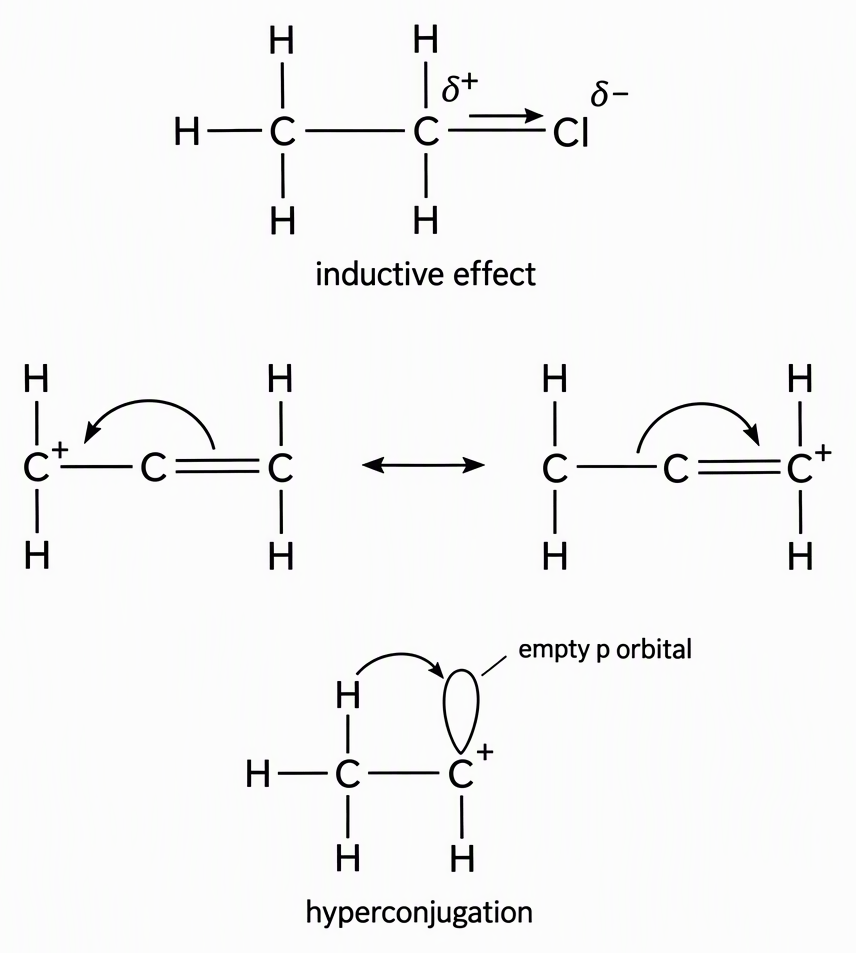
- Connect bond cleavage to electron ownership. Homolytic cleavage gives one bonding electron to each fragment; heterolytic cleavage gives both to one fragment. Then study carbocations, carbanions and radicals by marking charge, electron pairs and unpaired electrons. Electrophiles accept an electron pair; nucleophiles donate one.
- Apply these ideas to acidity and basicity. For acidity, remove the proton and compare the conjugate bases. For basicity, inspect lone-pair availability and the stability of the resulting conjugate acid. Respect any stated solvent or conditions rather than transferring an order from another chemical setting.
- Use one MCQ routine every time. Identify the property, draw the relevant species, check whether each proposed effect is structurally possible, compare the decisive differences, then eliminate options. Choose what to inspect from the question:
- Acidity: inspect the conjugate base.
- Carbocation stability: inspect the positively charged carbon and its neighbours.
- Nucleophile identification: find an available electron pair.
Reject “resonance always beats everything” as a universal shortcut. Check conjugation, the atom bearing charge and whether the structures are genuinely comparable before weighing effects.
- Read, close, redraw, then practise. Read the relevant NCERT explanation, close the book and reproduce the electron reasoning. Solve questions on that concept before attempting mixed sets. A completed lecture is not evidence of mastery.
Keep nomenclature and isomerism as supporting skills: learn enough to identify structures correctly. Keep this sequence centred on electronic effects and their applications.
How do I rank acidity using conjugate bases?
Compare the species left after proton loss, not the neutral molecules. Here, the carboxylic acids are more acidic than phenol, and phenol is more acidic than ethanol. Chlorine separates the two carboxylic acids through its electron-withdrawing inductive effect.
Illustrative single-correct MCQ, not a NEET previous-year question: Which list gives decreasing acidity, from strongest to weakest, under ordinary aqueous comparison?
- A: Chloroacetic acid, acetic acid, phenol, ethanol.
- B: Acetic acid, chloroacetic acid, phenol, ethanol.
- C: Chloroacetic acid, phenol, acetic acid, ethanol.
- D: Phenol, chloroacetic acid, ethanol, acetic acid.
Step 1: Write the conjugate bases in the question’s order.
Step 2: Compare charge distribution. Carboxylates spread negative charge over two oxygen atoms through equivalent major resonance contributors:
Phenoxide also has resonance, but its contributors are not equivalent to those of carboxylate. Contributors placing charge on ring carbons are less favourable than those retaining charge on oxygen. Simply counting resonance structures gives the wrong explanation.
Step 3: Resolve the remaining differences. Chlorine withdraws electron density through sigma bonds, stabilising chloroacetate relative to acetate. Phenoxide gains resonance stabilisation that ethoxide lacks.
Answer: A.
The trap is treating every hydroxyl group as equally acidic. For an acidity order, draw the conjugate bases before selecting an option.
How do I compare carbocations without blindly using primary and tertiary labels?
Check conjugation before counting alkyl groups. Allyl is more stable than n-propyl because its positive charge is delocalised through a continuous p-orbital system. Calling both carbocations “primary” and treating them as equally stable misses the deciding structural difference.
Illustrative single-correct MCQ: Select the decreasing stability order for these carbocations:
- A: n-Propyl, allyl, methyl.
- B: Allyl, n-propyl, methyl.
- C: Allyl, methyl, n-propyl.
- D: Methyl, n-propyl, allyl.
First inspect the allylic system. Its pi bond lies beside the empty p orbital. Move electrons, not atoms, to obtain its contributors:
The atomic skeleton stays fixed. These are contributors to one delocalised species, not separate carbocations switching places.
The n-propyl carbocation lacks this conjugation. Its alkyl neighbour supplies stabilisation through inductive donation and hyperconjugation; methyl has no alkyl neighbour supplying those effects.
Answer: B.
Boundary check: a nearby double bond is not automatically conjugated.
Here, an intervening tetrahedral carbon interrupts p-orbital overlap. Its hybridisation is:
The double bond therefore provides no direct resonance stabilisation. Do not carry this carbocation order over to carbanions.
How do I identify the nucleophile and draw electron movement?
Hydroxide attacks through an oxygen lone pair, and the carbon bonded to bromine is the electrophilic centre. Arrows begin at electrons: one starts at the oxygen lone pair, and another starts at the carbon–bromine bond. Neither begins at the electron-poor carbon.
Illustrative single-correct MCQ: Which statement correctly identifies the attacking species, attacked centre and bond-electron movement?
- A: Hydroxide attacks carbon; the carbon–bromine bonding pair moves to bromine.
- B: Hydroxide attacks bromine; the bonding pair moves to carbon.
- C: Carbon donates an electron pair to hydroxide; bromine leaves.
- D: Hydroxide attacks carbon; carbon and bromine each retain one bonding electron.
Answer: A. Oxygen supplies an available lone pair, making hydroxide the nucleophile. The polar carbon–bromine bond leaves carbon electron-deficient even though carbon has no formal positive charge.
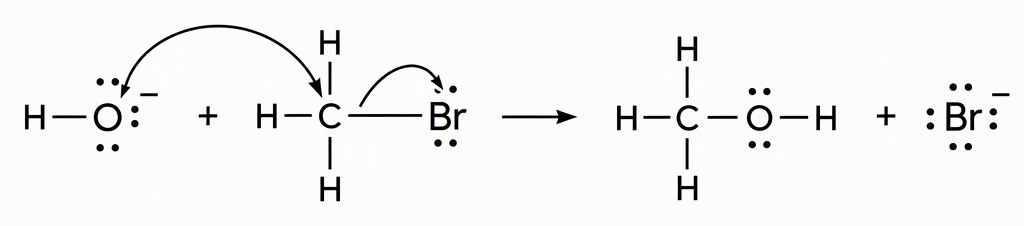
Carbon–bromine cleavage is heterolytic: bromine takes the complete bonding pair. Option D describes homolytic cleavage instead.
Avoid two traps: reversing the attack arrow, and requiring every electrophilic centre to carry a formal positive charge. This step needs no free methyl-carbocation intermediate; the previous stability ranking does not decide this reaction.
Practise a fresh electron-flow question and mark both arrow tails before checking the answer. NEET JEEnius AI’s daily practice problems provide a fresh set on a topic every day, with 20 free attempts a month.
What should I practise after getting a GOC question wrong?
Choose the next topic from the failed reasoning step, not from the chapter name. First-time learners should follow the full sequence below. Class 12 students and droppers should begin with a mixed set, identify the earliest failed prerequisite and repair that gap rather than restart every lecture.
Use this practice order:
- Structure and charge identification.
- Validity of resonance contributors.
- Inductive effect and hyperconjugation.
- Intermediate stability.
- Acidity and basicity.
- Mixed electron-flow questions.
Match each error to a repair:
- Impossible resonance structures: practise conjugation checks, fixed atomic skeletons and valid valence.
- Reversed acidity: redraw conjugate bases and locate their negative charge.
- Wrong attacking species: mark lone pairs and electron-deficient centres before assigning roles.
Use this four-part error-log template, illustrated with the carbocation boundary check:
- Question cue: A double bond appears near a carbocation.
- My incorrect rule: Any nearby double bond gives resonance stabilisation.
- Corrected structural reason: An intervening tetrahedral carbon breaks continuous p-orbital overlap.
- Fresh test: Compare an allylic carbocation with one whose double bond is separated from the charged carbon by a saturated carbon.
Before calling a concept secure, explain why the closest distractor is wrong. Use relevant NCERT examples and exercises, then NEET previous-year questions checked against the current syllabus at neet.nta.nic.in.
Pair unseen questions with deliberate reattempts of logged mistakes; neither replaces the other. For the unseen-question part, NEET JEEnius AI’s practice mode offers topic sets that skip questions already seen, with 60 free sets a month.
Next step: daily practice problems on NEET JEEnius AI and get a fresh set on a topic every day (20 free attempts a month).
Read next: Molecular Basis of Inheritance Practice Questions NEET: 6 MCQs.
Frequently asked questions
In what order should I study GOC for NEET?
Start with valence-correct structures, bonds, lone pairs, formal charges and basic hybridisation. Then study inductive effect, resonance and hyperconjugation, followed by bond cleavage, intermediates, electrophiles and nucleophiles. Apply these ideas to acidity and basicity, practising each concept before attempting mixed MCQs.
How do I compare acidity in GOC questions?
Remove the proton from each species and compare the resulting conjugate bases under the stated conditions. Check charge distribution, resonance and inductive effects rather than counting resonance contributors. In ordinary aqueous comparison, the decreasing acidity order is chloroacetic acid, acetic acid, phenol, then ethanol.
Is an allyl carbocation more stable than a primary carbocation?
The allyl carbocation is more stable than the n-propyl carbocation because conjugation delocalises its positive charge. Both have a formally primary charged carbon, so the primary label alone does not resolve this comparison. Check for continuous p-orbital overlap: an intervening tetrahedral carbon prevents direct resonance stabilisation.
How should I revise GOC after getting questions wrong?
Identify the failed reasoning step and repair that prerequisite instead of restarting every lecture. Log the question cue, your incorrect rule, the corrected structural reason and a fresh test. Pair unseen questions with reattempts of logged mistakes, and explain why the closest distractor is wrong before treating a concept as secure.