
Should I start with chapter MCQs, PYQs or full NEET mocks?
For Molecular Basis of Inheritance practice questions for NEET, start with NCERT-aligned chapter MCQs with explanations to repair conceptual gaps. Use authenticated chapterwise PYQs next for past question framing, and full-length mocks for performance across subjects. A full mock is not an efficient substitute for targeted weak-chapter practice. The free original diagnostic below separates questions from answers. These are original practice questions, not official NEET questions or verified NEET JEEnius AI question-bank entries.
What do free chapter MCQs, PYQs and full-length mocks actually give you?
Chapter MCQs isolate misconceptions, PYQs show past exam wording, and full mocks test subject switching and attempt decisions. Choose by the problem you need to solve, not the size of the collection. None of these formats replaces the other two.
- Best use
- NCERT-aligned original chapter MCQs: Find and repair misconceptions, such as confusing template and coding strands.
- Authenticated chapterwise NEET PYQs: Study past wording and analyse plausible distractors.
- Full-length NEET mocks: Test recall across subjects, time allocation and decisions to attempt or leave questions.
- Chapter focus
- Original chapter MCQs: Target one mechanism or several chapter topics.
- Authenticated PYQs: Cover concepts selected in past papers, not necessarily every topic.
- Full mocks: Cover the syllabus, but need not contain enough questions from this chapter to diagnose it.
- Answer-explanation requirements
- Original chapter MCQs: Check scientific accuracy and alignment with NCERT and the applicable syllabus. A confident-looking key is not evidence.
- Authenticated PYQs: Match questions to the original paper and final official key. Explanations should reject tempting distractors.
- Full mocks: Review individual questions to explain errors; the score alone cannot do this.
- Main limitation
- Original chapter MCQs: Poor wording can introduce ambiguity or unnecessary detail.
- Authenticated PYQs: Remembered answers can resemble understanding. Past questions establish neither future weightage nor complete coverage.
- Full mocks: An overall score can hide a specific misunderstanding.
- What free access includes
- Original chapter MCQs: This article provides six questions and six worked explanations without a signup.
- Authenticated PYQs: External resources’ free-access terms are not verified here. Check access conditions and question provenance.
- Full mocks: For mixed-subject practice, use NEET JEEnius AI’s 30 free full-length mocks a month, each with 180 questions, 720 marks, 180 minutes and a scored per-subject breakdown.
This offer covers full mocks, not a verified chapterwise question bank or PYQ archive. A per-subject breakdown is not chapter-level diagnosis.
Which practice format should I choose for my current difficulty?
Choose by your mistakes, not your class or attempt year. A dropper may need strand-direction practice, while a Class 12 student may be ready for mixed-subject testing. Use the task that exposes your present weakness.
- Class 11 student studying ahead: Learn the material first, then attempt concept-by-concept original MCQs. Difficulty with unfamiliar Class 12 content is not a verdict on your ability.
- Class 12 student confusing template and coding strands, or replication and transcription: Start with targeted chapter questions and explanations.
- Student who explains NCERT mechanisms but misreads unfamiliar wording: Use authenticated chapterwise PYQs and explain why each distractor fails.
- Dropper repeatedly getting remembered PYQs right: Use fresh original questions to check understanding beyond a familiar answer.
- Student accurate chapterwise but weaker when switching subjects: Use full-length mocks, then return to chapter practice for gaps found during review.
Can I try free Molecular Basis of Inheritance practice questions for NEET now?
Attempt these six original, single-correct MCQs before scrolling to the explanations. This sample diagnostic tests distinctions in NCERT mechanisms, not complete chapter coverage. It does not assess every topic, including the Human Genome Project, and cannot predict a NEET score.
Check the official syllabus applicable to your attempt at neet.nta.nic.in. Record each choice and flag any answer you guessed.
1. What conclusion follows from the Hershey–Chase experiment?
Bacteriophages were prepared with radioactive phosphorus labelling DNA or radioactive sulfur labelling protein. After infection, blending and centrifugation, phosphorus radioactivity was mainly associated with the bacterial pellet, while sulfur radioactivity remained mainly in the supernatant. Which conclusion is supported?
- A. Protein entered the bacteria and directed phage multiplication.
- B. DNA was the genetic material in the bacteriophage studied.
- C. DNA replication was proved to be semiconservative.
- D. RNA cannot act as genetic material in any organism.
2. What does semiconservative DNA replication produce?
A double-stranded DNA molecule completes one round of replication. Which description correctly applies to each daughter DNA molecule?
- A. Both strands are newly synthesised.
- B. Both strands are inherited from the parent molecule.
- C. One complete strand is parental and the other is newly synthesised.
- D. Each strand contains alternating parental and newly synthesised segments.
3. Which RNA sequence comes from this template?
The DNA sequence below is the template strand, with its direction labelled. Which RNA sequence is synthesised from it?
- A.
- B.
- C.
- D.
4. Which statement correctly links codons, anticodons and translation?
Consider translation at a sense codon, not a stop codon. Which statement is correct?
- A. A codon lies on tRNA and binds an anticodon on mRNA.
- B. An anticodon lies on tRNA, pairs with an mRNA codon, and helps position the carried amino acid at the ribosome.
- C. A ribosome supplies amino acids without requiring tRNAs.
- D. An mRNA codon directly forms a peptide bond with its amino acid.
5. What happens to the lac repressor when lactose is available?
An E. coli cell has a functional lac operon. Glucose is absent and lactose is available within the cell. At the NCERT level, which change permits transcription of the structural genes?
- A. The inducer binds the operator and permanently removes it.
- B. The inducer binds and inactivates the repressor, preventing it from blocking the operator.
- C. The repressor becomes an enzyme that digests lactose.
- D. RNA polymerase becomes the repressor and binds the operator.
6. Why is repetitive DNA useful in DNA fingerprinting?
DNA fingerprinting uses selected repetitive DNA regions. Which property makes these regions useful for distinguishing individuals?
- A. Their repeat patterns are identical in all individuals.
- B. They always code for proteins unique to each individual.
- C. They show inherited variation, including differences in repeat number.
- D. They occur only in individuals with genetic disorders.
Stop here until you have recorded all six choices. The answers follow.
What are the answers, and why are the tempting distractors wrong?
The key is 1-B, 2-C, 3-A, 4-B, 5-B and 6-C. Count an answer as understood only when you can explain the decisive distinction without looking at the options. A correct guess still needs checking.
1. B: DNA was the genetic material in the bacteriophage studied.
The labelled DNA entered the bacteria, while most labelled protein remained outside. This supported DNA’s genetic role in that phage system.
C is tempting because it names another conclusion about DNA, but semiconservative replication was established through different evidence. The experiment did not rule out RNA as genetic material elsewhere.
2. C: Each daughter molecule contains one parental strand and one new strand.
“Semiconservative” means retaining one complete parental strand in each daughter double helix. Each parental strand provides the template for its new partner.
D describes the dispersive model, with old and new material interspersed within strands. Retaining some old DNA is not enough: the strand arrangement matters.
3. A: RNA is complementary and antiparallel to the template.
RNA polymerase reads the template from its three-prime end towards its five-prime end and synthesises RNA in the opposite direction. RNA uses uracil rather than thymine.
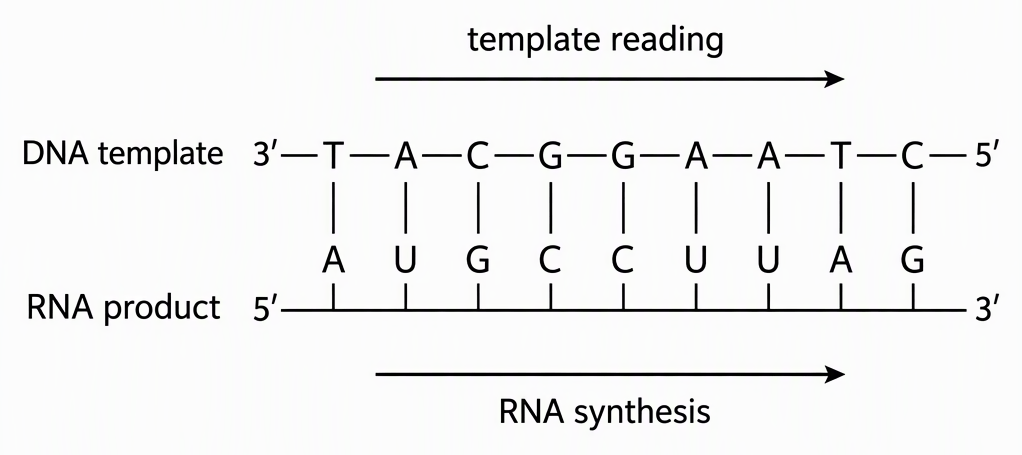
B merely replaces thymine with uracil in the supplied template. That shortcut applies to the corresponding coding strand written in the same direction as the RNA, not to this template.
4. B: The tRNA anticodon pairs with the mRNA codon.
The tRNA acts as an adaptor between the nucleotide message and its carried amino acid. The ribosome is the site of translation and peptide-bond formation.
A reverses the locations of codon and anticodon. D confuses codon recognition with peptide-bond formation between amino acids.
5. B: The inducer inactivates the repressor.
In NCERT’s account, lactose acts as the inducer. Its interaction with the repressor prevents repressor binding to the operator, allowing structural-gene transcription under the stated conditions.
A confuses the target of inducer action. The operator is a DNA site; induction does not remove it.
6. C: Polymorphic repetitive regions show inherited variation.
Differences in repeat number help distinguish DNA samples. This inherited variation is the relevant property of polymorphic repetitive DNA.
B assumes an identifying region must encode a unique protein. Fingerprinting uses DNA variation, not a requirement to code for proteins.
How should I use my mistakes to choose the next practice format?
Repair the cause, then attempt a different question on the same concept. Immediately repeating an item mainly tests memory of its answer. Separate conceptual errors, reading slips and correct guesses in your error record.
- Observed mistake: Wrong Hershey–Chase conclusion.
- Likely gap: Mixing evidence from different experiments.
- Repair task: Write the setup, observation and supported conclusion separately.
- Next practice format: A fresh experiment-based chapter MCQ.
- Observed mistake: Wrong parental-strand arrangement.
- Likely gap: Confusing semiconservative and dispersive replication.
- Repair task: Trace each complete parental strand into a daughter molecule.
- Next practice format: A fresh replication MCQ.
- Observed mistake: Wrong RNA sequence or direction.
- Likely gap: Confusing template, coding strand and complementarity.
- Repair task: Label template direction and RNA synthesis direction before selecting an option.
- Next practice format: Fresh sequence-based chapter MCQs.
- Observed mistake: Swapping codon and anticodon.
- Likely gap: Confusing translation machinery.
- Repair task: State the roles of mRNA, tRNA and the ribosome.
- Next practice format: A fresh translation MCQ.
- Observed mistake: Inducer binds the operator.
- Likely gap: Confusing inducer, repressor and operator.
- Repair task: Explain their relationship aloud before another question.
- Next practice format: A fresh lac operon MCQ with stated conditions.
- Observed mistake: Fingerprinting requires unique proteins.
- Likely gap: Confusing DNA variation with protein coding.
- Repair task: Explain why repeat-number variation is useful.
- Next practice format: A fresh DNA fingerprinting MCQ.
- Observed mistake: Missing “incorrect” or “except” despite knowing the concept.
- Likely gap: A reading slip, not necessarily biology.
- Repair task: Mark the instruction word and restate the task.
- Next practice format: Authenticated PYQs with distractor analysis.
- Observed mistake: Correct answer without a defensible reason.
- Likely gap: Uncertain knowledge masked by guessing.
- Repair task: Explain the answer and reject the strongest alternative.
- Next practice format: A different original question on that concept.
If you score the sample, use the official marking rule: +4 for correct, −1 for wrong and 0 for unattempted. Do not convert this result into a percentile, rank or predicted Biology score.
When should I move to a free full NEET mock?
Move when you can explain correct options, reject plausible distractors and solve fresh versions without remembered answers. If accuracy drops when switching between Biology, Physics and Chemistry, use a full paper to test that difficulty.
The current paper has 180 compulsory single-correct questions in 180 minutes for 720 marks:
- Physics: 45 questions.
- Chemistry: 45 questions.
- Biology: 90 questions.
There is no optional Section B in the current format. Practise the compulsory-question structure, not the discontinued pattern.
Can a per-subject mock score identify my chapter weakness?
No. A Biology score cannot isolate Molecular Basis of Inheritance errors. Review the relevant attempted questions, including correct guesses, to identify mechanisms needing repair.
For integration practice, NEET JEEnius AI offers 30 free full-length mocks a month with a scored per-subject breakdown. Use it to locate the weaker subject, then inspect individual questions for chapter gaps.
Follow this sequence: repair the concept, attempt a fresh chapter question, examine authenticated PYQ framing, then test integration in a full paper.
Next step: full-length mock tests on NEET JEEnius AI and sit a full 180-question, 720-mark, 180-minute paper, 45 Physics, 45 Chemistry and 90 Biology, and get a scored per-subject breakdown (30 free a month).
Related on NEET JEEnius AI: Sex Determination NEET 2026: Grasshopper XX–XO System.
Frequently asked questions
Should I start Molecular Basis of Inheritance with MCQs or PYQs?
Start with NCERT-aligned chapter MCQs and explanations if you have conceptual gaps. Move to authenticated chapterwise PYQs to study past wording and analyse distractors. Use full-length mocks to test subject switching and attempt decisions, not as a substitute for chapter practice.
Are these Molecular Basis of Inheritance questions official NEET PYQs?
No. The article provides six original, single-correct practice MCQs with worked explanations, available without signup. They are not official NEET questions or verified NEET JEEnius AI question-bank entries, and they do not cover the entire chapter.
How should I review wrong answers in Molecular Basis of Inheritance?
Separate conceptual errors, reading slips and correct guesses in your error record. Repair the specific gap, then attempt a different question on the same concept. Count an answer as understood only when you can explain the correct option and reject the strongest distractor.
When should I move from chapter questions to full NEET mocks?
Move when you can explain correct options, reject plausible distractors and solve fresh chapter questions without relying on remembered answers. Full mocks then test recall across subjects, time allocation and attempt decisions. A per-subject score cannot diagnose this chapter by itself; review individual questions for chapter-level gaps.