What is the answer to the First Law of Thermodynamics NEET 2026 question?
Option C, 600 J, is correct: net heat entering the gas equals the triangular loop’s signed area. This First Law of Thermodynamics NEET 2026 question is from Physics, Thermodynamics, in the NEET UG examination re-held on 21 June 2026, Code-50. The question bank classifies it as medium difficulty.
A sample containing one mole of ideal monatomic gas completes a triangular loop on a pressure–volume graph. Find the net heat transferred into the gas during the complete loop.
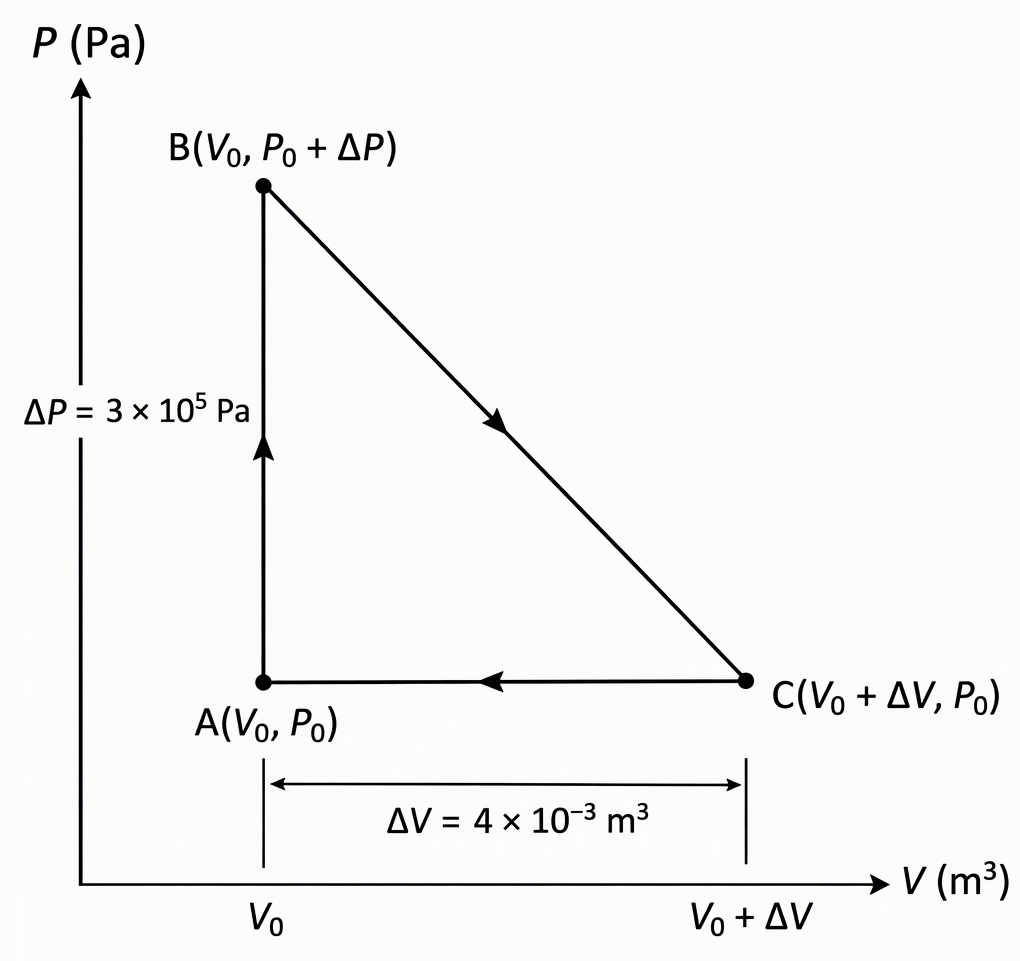
This is a schematic consistent with the supplied dimensions and positive official answer, not a recovered original paper image. The supplied spans are:
The choices are:
Why is the internal-energy change zero over the complete cycle?
A complete cycle returns the gas to its initial thermodynamic state. Internal energy is a state function, so its final value equals its initial value, regardless of what happens along the branches. Start with this argument, as the official solution does, before calculating graph area.
Use the convention that heat entering the gas is positive, and work done by the gas is positive. The first law then gives:
For the ideal monatomic sample, the same result follows because the initial and final temperatures coincide:
Neither “one mole” nor “monatomic” is necessary to establish zero internal-energy change over a complete cycle. Cyclic does not mean isothermal: temperature can change along individual branches, then return to its starting value.
How does the triangular area give 600 J?
The clockwise triangular loop gives positive work of 600 J. Net work is the signed area enclosed by the complete pressure–volume loop, not the area under just one branch. Clockwise traversal means expansion occurs at higher pressures than compression, so the gas does positive net work, consistent with the supplied official answer.
For a triangle, use half the base times the height:
Separate the ordinary numbers from the powers of ten:
The units reduce to joules:
Apply the triangle’s geometric factor:
Thus, option C is correct. The official solution interprets “total heat supplied” as net heat over the cycle, meaning heat entering minus heat leaving.
This calculation does not separately find the sum of positive heat inputs on individual branches. Do not label 600 J as the gross heat absorbed.
How can an unjustified monatomic-gas factor give the wrong answer of 800 J?
An incorrect factor of two-thirds produces option D, 800 J, by replacing geometry with an unrelated gas relation. This is a constructed mistake, not an observed student response or a method attributed to the official solution.
For a monatomic ideal gas:
Neither equation supplies the area coefficient for a triangular loop. The invalid substitution is:
The mistake is transferring a coefficient from a state-variable relation into path-dependent work. The correct coefficient is one-half because the enclosed shape is a triangle, not because of the gas’s degrees of freedom.
Doubling the triangular area does not explain option D. It gives a value that is not a listed choice:
What happens to the net heat if the cycle runs backwards?
Reversing the same loop makes the net heat transferred into the gas negative 600 J. The enclosed area keeps its magnitude, but anticlockwise traversal reverses the sign of the work.
Author-created Thermodynamics practice variation, not another verified PYQ: Find the net heat transferred into the gas when the same triangular loop is traversed anticlockwise.
It remains a complete cycle, so:
With the direction reversed:
This means net rejection of 600 J of heat. The signed heat transfer is negative; its magnitude is 600 J.
When does “one mole of monatomic gas” matter?
The gas description matters when heat must be related to a temperature change, rather than just a cycle’s enclosed area. At fixed volume, the gas does no boundary work, so all the supplied heat increases internal energy.
Author-created Thermodynamics practice variation: If the same one-mole sample receives heat at fixed volume, what are its work, internal-energy change and temperature rise? Denote the supplied heat by:
Since volume stays fixed:
Apply the first law:
Now use the monatomic internal-energy relation:
Monatomic heat capacity determines the temperature rise here. The complete-cycle answer instead came from the enclosed area.
Establish the process, apply the first law, then choose geometry or heat capacity.
Next step: photograph a doubt on NEET JEEnius AI and photograph any question you are stuck on and get a step-by-step solution across Physics, Chemistry and Biology (20 free a month).
Keep going with How to Study Morphology of Flowering Plants NEET: NCERT Method.
Frequently asked questions
What is the answer to the First Law of Thermodynamics NEET 2026 question?
Option C, 600 J, is correct for the clockwise triangular cycle. Over a complete cycle, internal-energy change is zero, so net heat equals net work: Q = W = ½ × (4 × 10⁻³) × (3 × 10⁵) = 600 J. This is net heat entering the gas, not gross heat absorbed.
Why is the change in internal energy zero in a cyclic process?
Internal energy is a state function, and a complete cycle returns the gas to its initial thermodynamic state. Its final and initial internal energies are therefore equal. The temperature may change along individual branches; cyclic does not mean isothermal.
How do I find work done from a triangular P-V graph?
Net work over a complete P-V cycle equals the signed enclosed area. For a triangle, its magnitude is ½ × pressure span × volume span. With work done by the gas taken as positive, clockwise traversal gives positive work and anticlockwise traversal gives negative work.
What happens to net heat if the triangular cycle is reversed?
Reversing the loop changes the sign of net work without changing its magnitude. Internal-energy change remains zero, so the reversed cycle has Q = W = −600 J. The gas therefore rejects 600 J of net heat.
Does the monatomic-gas formula give 800 J for this cycle?
No. Using the factor ⅔ from PV = ⅔U as the triangular area coefficient incorrectly gives 800 J. The correct coefficient is ½ because the loop is triangular; the monatomic-gas relation is relevant when calculating internal-energy or temperature changes.