
How do I turn NCERT morphology into correct NEET answers?
Study NCERT Morphology of Flowering Plants for NEET by identifying the deciding feature before memorising the plant name. Use this sequence: feature → term → example → nearest confusion. Turn each description into a recall prompt, then use its defining rule to eliminate MCQ options.
- Define your scope before making notes. Use the official syllabus for your exam year, available through neet.nta.nic.in, alongside the relevant NCERT edition. A textbook edition alone does not establish the full exam scope. Organise your work under root, stem, leaf, inflorescence, flower, fruit and seed, adding family descriptions wherever prescribed.
- Build a four-part record for each concept. Keep the order fixed: feature, term, example, nearest confusion. Here is one complete entry:
- Feature: Ovules along the ventral suture of a monocarpellary, unilocular ovary.
- Term: Marginal placentation.
- Example: Pea.
- Nearest confusion: Not axile, which has ovules on a central axis in a multilocular ovary.
Cover the term and example, then identify them from the feature. Next, cover the feature and explain why the term fits.
- Study contrasts before long example lists. Record the feature that separates competing answers.
- Root versus stem modifications: Nodes and buds support stem identity. Underground position and food storage do not distinguish them.
- Racemose versus cymose: In racemose inflorescence, the main axis continues growing, with older flowers towards the base and younger ones towards the apex. In cymose, a terminal flower limits main-axis growth, with younger flowers developing below it.
- Placentation versus aestivation: Placentation concerns ovule attachment inside the ovary. Aestivation concerns sepal or petal overlap within a whorl in the bud.
- Stamen cohesion versus adhesion: Cohesion joins stamens to one another. Adhesion joins stamens to another floral whorl.
- Hypogynous, perigynous and epigynous: Other floral parts arise below the ovary, around it on a cup-shaped thalamus, or above it, respectively. NCERT describes the perigynous ovary as half-inferior; distinguish this from the inferior ovary of an epigynous flower.
- Redraw simplified NCERT diagrams from memory. Label only diagnostic features, then check against the source. A locule is an ovary chamber; an ovule is a structure within it. The ovary belongs to the gynoecium; the thalamus bears the floral parts.
- Recall examples in both directions. Practise “pea → marginal placentation and vexillary aestivation”, then “marginal placentation → pea”. Always name the trait category: one plant can illustrate several traits, so “pea → marginal” alone is incomplete.
- Apply the same sequence to every MCQ. Mark the command word, identify the feature tested, retrieve its defining rule, and eliminate options using that rule. Log wrong answers and correct guesses as definition, example, diagram or question-reading errors.
These tools organise close NCERT reading. They do not replace it with a shortlist of supposedly important lines.
Why is potato a stem but sweet potato a root?
Potato has buds at nodes, while sweet potato is a modified adventitious root. Their shared storage function does not establish organ identity. Choose the structural evidence before retrieving a familiar label.
Original practice question, not a NEET PYQ
Potato and sweet potato are, respectively:
- A. Modified root and modified stem.
- B. Modified stem and modified root.
- C. Both modified stems.
- D. Both modified roots.
Correct answer: B. Apply the method: mark “respectively” to preserve the order. The tested feature is organ identity, not underground position or food storage.
Potato is a stem tuber. Its eyes represent buds at nodes, providing the diagnostic evidence for stem identity. Sweet potato stores food in a modified adventitious root.
Option D is tempting because both organs grow underground and store food. Neither feature proves root identity.
Make these recall cards:
- Potato → stem tuber → eyes/buds.
- Sweet potato → modified adventitious root → food storage.
For the second card, storage describes the modification’s function. It is not proof of root identity.
How do I find an incorrectly matched placentation pair?
Check ovule attachment before relying on the plant name or chamber count. Marginal, axile and parietal describe attachment patterns. Reject familiar correct pairs when the command asks for a mismatch.
Original practice question, not a NEET PYQ
Which pair is incorrectly matched?
- A. Pea: marginal.
- B. Tomato: axile.
- C. Lemon: parietal.
- D. Mustard: parietal.
“INCORRECTLY” means find one mismatch. Retrieve the definitions first:
- Marginal: Ovules lie along the ventral suture of a monocarpellary, unilocular ovary.
- Axile: Ovules attach to a central axis in a multilocular ovary.
- Parietal: Ovules attach to the inner wall or peripheral region of the ovary.
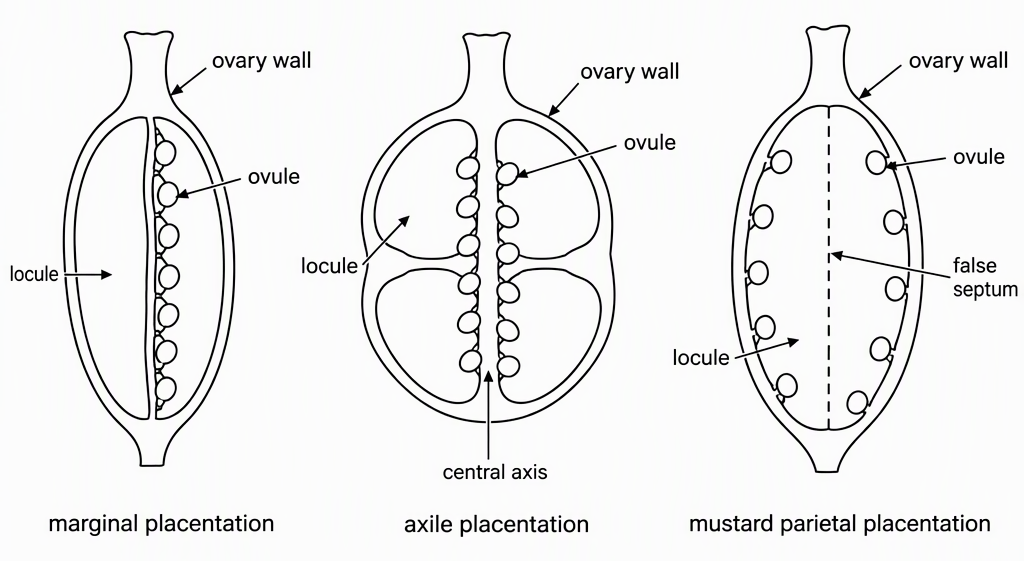
Check every option:
- A: Pea has marginal placentation. Correct pair, eliminate.
- B: Tomato has axile placentation. Correct pair, eliminate.
- C: Lemon has axile, not parietal placentation. Correct answer: C.
- D: Mustard has parietal placentation. Its false septum can make the ovary appear two-chambered; chamber count must not override attachment.
Error-log repair: “Lemon → axile; mustard → parietal despite a false septum.”
How do I identify aestivation from a petal-overlap description?
A largest posterior petal covering two lateral petals, which cover two anterior petals, identifies vexillary aestivation. The overlap description is enough to solve the question without a plant name.
Original practice question, not a NEET PYQ
In a five-petalled flower bud, the largest posterior petal overlaps two lateral petals, which overlap the two smallest anterior petals. Identify the aestivation:
- A. Valvate.
- B. Twisted.
- C. Imbricate.
- D. Vexillary.
Decode the order as standard → wings → keel. Each arrow means “overlaps”, not “develops into”.
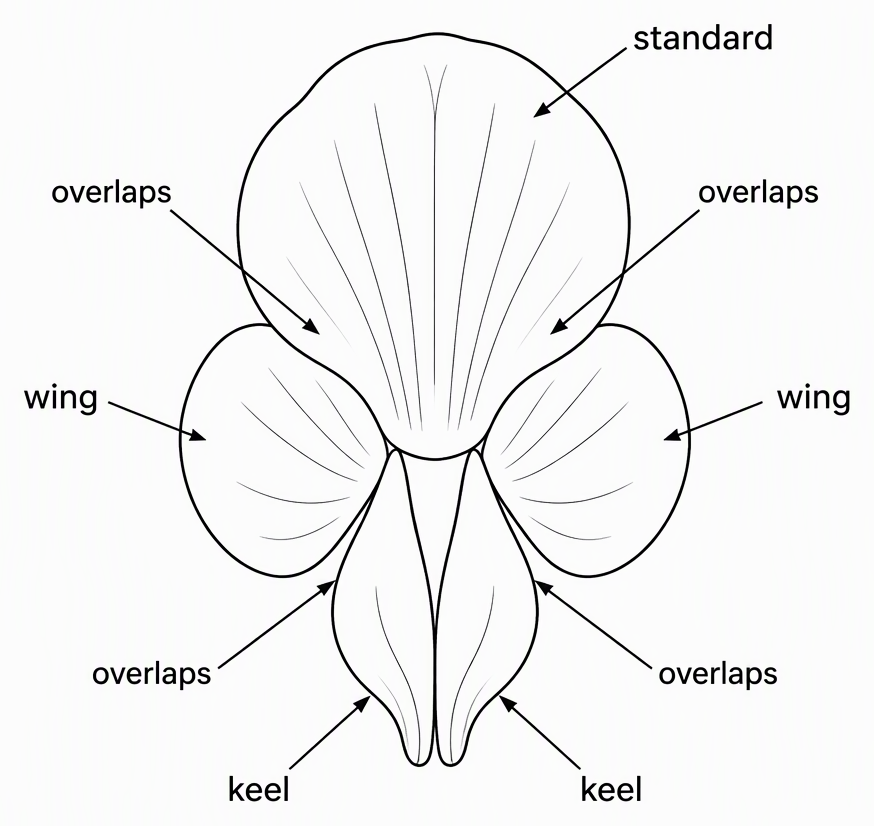
Correct answer: D. Pea and bean show this arrangement.
Eliminate A because valvate margins touch without overlapping. Eliminate B because twisted aestivation has each petal overlapping the next in a consistent direction.
Vexillary is a specialised imbricate arrangement. The specific standard–wings–keel pattern makes vexillary the best answer when both terms appear as options.
Transfer prompt: Name pea’s placentation, then its aestivation. Retrieve marginal placentation and vexillary aestivation, keeping ovule attachment separate from petal overlap.
What should I practise next, and when should I move on?
Repair one confusion, then mix it with earlier topics. Move on when you can state the deciding feature, give the NCERT example and explain why the nearest alternative is wrong.
Use this practice order:
- Organ modifications and leaf features.
- Inflorescence.
- Floral terminology and ovary position.
- Placentation and aestivation.
- Fruit and seed.
- Prescribed family descriptions, floral formulae and diagrams.
For each cluster, answer definition prompts, retrieve examples in both directions, then attempt diagram or description questions. Finally, mix it with earlier clusters.
For floral formulae, translate each symbol into words before memorising the whole formula. Use your source’s notation key to distinguish fusion within a whorl from attachment between whorls and read ovary position.
Try a next-day and one-week closed-book review as a suggested routine, not a guaranteed memory interval. Revisit guessed-correct answers as well as errors.
Suppose two of these three original answers are correct and one is wrong. Under NEET marking:
If that wrong answer were corrected:
After these original examples, use Free NEET PYQs: Verify Papers, Keys and Chapterwise Sets to find verified previous-year practice.
For unseen questions, NEET JEEnius AI’s practice mode provides topic sets that skip questions already seen, with 60 free sets a month. Use those sets to test transfer, but separately reopen your error log and re-answer old mistakes: skipped questions do not revise themselves.
Frequently asked questions
How should I study Morphology of Flowering Plants for NEET?
Check the official syllabus for your exam year alongside the relevant NCERT edition. Build each concept in the order feature → term → example → nearest confusion. Recall examples in both directions, redraw diagnostic diagrams and use defining rules to eliminate MCQ options.
Why is potato a stem but sweet potato a root?
Potato is a stem tuber whose eyes represent buds at nodes, providing evidence of stem identity. Sweet potato is a modified adventitious root. Underground position and food storage do not distinguish roots from stems.
How do I distinguish marginal, axile and parietal placentation?
Marginal placentation has ovules along the ventral suture of a monocarpellary, unilocular ovary, as in pea. Axile placentation has ovules on a central axis in a multilocular ovary, as in tomato and lemon. Parietal placentation has ovules attached to the inner wall or peripheral region; mustard remains parietal despite its false septum.
How do I identify vexillary aestivation in an MCQ?
Look for a largest posterior petal overlapping two lateral petals, which overlap the two smallest anterior petals: standard → wings → keel. Pea and bean show this arrangement. Vexillary is a specialised imbricate arrangement, so choose the more specific term when this pattern is described.
How should I revise morphology after finishing the chapter?
Try closed-book reviews the next day and after one week, treating these as a suggested routine rather than guaranteed memory intervals. Revisit wrong answers and correct guesses, classifying errors as definition, example, diagram or question-reading errors. Move on from a confusion when you can state the deciding feature, give the NCERT example and explain why the nearest alternative is wrong.