
Which free NEET PYQs should I use first?
For free NEET PYQs, choose a verified complete paper with its matching final answer key for historical exam practice, and chapterwise PYQs for fixing a specific chapter. A current-pattern mock serves a different purpose: rehearsal under today’s rules, not access to an actual previous-year paper. Before choosing a source, check that it provides usable questions and answers, not just a free preview.
No single format wins for every task. Revising Chemical Bonding needs targeted questions; analysing a historical paper needs the complete paper; checking pacing needs timed rehearsal.
This article provides a selection and verification method, not downloadable papers. The platform’s tagged question count does not establish that its entire PYQ collection is free.
How do complete PDFs, chapterwise PYQs and full-length mocks compare?
Choose complete PDFs for historical paper analysis, chapterwise collections for targeted revision and mocks for timed rehearsal. Check each format against the criteria below before building a study plan around it. Third-party access restrictions depend on the source.
- Best use
- Verified complete previous-year paper PDFs: Analyse and attempt a whole historical paper.
- Third-party chapterwise PYQ collections: Revise a specific chapter.
- NEET JEEnius AI full-length mocks: Practise under the current pattern.
- Is it an actual historical paper?
- PDFs: Yes, after verifying the year, sitting, paper code and completeness.
- Chapterwise collections: Selected questions, not an intact paper.
- Mocks: Not previous-year papers or verified PYQ-only tests.
- Where do the answers come from?
- PDFs: Require the matching official final key. A key gives answers, not worked solutions.
- Chapterwise collections: Check source labels, key provenance and explanations.
- Mocks: Scoring is verified; historical final-key provenance is not established.
- Can I solve offline or print it?
- PDFs: Yes, once downloaded and checked for readability.
- Chapterwise collections: Download and printing access are source-dependent.
- Mocks: Printable or offline access is not established by the verified offer.
- Does it fit the current pattern?
- PDFs: Only if the historical paper matches the current format.
- Chapterwise collections: Check syllabus relevance; these are not full-paper simulations.
- Mocks: 180 questions, 720 marks, 180 minutes, with 45 Physics, 45 Chemistry and 90 Biology questions.
- How is it scored?
- PDFs: Manually, using the matching final key and applicable marking rules.
- Chapterwise collections: Manual or source-provided scoring.
- Mocks: A scored per-subject breakdown.
- What is verified as free?
- PDFs: Check access at the individual source.
- Chapterwise collections: Login requirements, download limits and solution access are source-dependent.
- Mocks: NEET JEEnius AI offers 30 free full-length mocks a month.
Which format should Class 11, Class 12 students and droppers choose?
Start with chapterwise PYQs if your syllabus is incomplete; add complete papers as your coverage grows. If you know the concepts but lose marks through timing or answer-recording errors, prioritise timed rehearsal. An unfinished-syllabus full-paper score is not a verdict on ability.
- Class 11, just finished a chapter: Choose chapterwise PYQs from completed material. Review errors before adding another chapter rather than judging yourself on questions you have not studied.
- Class 12, balancing both years: Use chapterwise sets for weak Class 11 topics and current chapters. Reserve complete papers for broader revision checkpoints, separating unstudied content from mistakes in familiar material.
- Dropper with substantial coverage: Use verified complete papers to analyse historical questions. Use current-pattern mocks to test pacing, question selection and execution.
- Concepts understood, but timing or marking keeps failing: Prioritise a timed current-pattern paper with an OMR-style answer-recording routine. Include answer transfer within the time limit.
- Shared phone or unreliable internet: Prefer a verified printable PDF. Download the matching key too, though verifying its authenticity or resolving disputes may still require online access.
- Parent considering a purchase: Check whether the gap is explanations, accountability or testing before buying a paid PYQ book. Another collection does not replace reviewing mistakes.
How can I find free papers and reject unreliable copies?
Start with NTA’s official NEET examination pages at neet.nta.nic.in and available archives for papers, notices and final answer keys. Older material may require checking the relevant historical examination authority. Use search results to locate copies, then verify the source rather than trusting the first result.
Try these searches:
- NEET [year] question paper [language] [paper code] PDF
- NEET [year] final answer key NTA
A coaching-hosted scan may be usable if it matches the identified paper and official key. Accept it for planned practice only after these checks:
- Identity: Year and sitting are identified.
- Match: Paper code and language match the key or its official mapping.
- Coverage: All pages and questions are present.
- Readability: Diagrams, units, options and subscripts are legible.
- Answers: The key is final, not provisional, with applicable official corrections checked.
- Access: Download limits, login requirements and paid solution restrictions are disclosed.
For 2026 material, sitting-level provenance is essential. Check the applicable official notices and final key; neither “2026” in a filename nor a plausible question count proves authenticity.
Memory-based reconstructions must be labelled as reconstructions, and coaching solutions as coaching explanations. Neither should silently replace an official paper or final key. Where answers differ, use the matching official final key for scoring.
Open the actual file before scheduling practice. A “free paper” may contain only samples or withhold solutions behind payment.
Does a large PYQ question bank contain complete NEET papers?
No. A tagged question total does not prove that a collection contains complete papers. The platform holds 5,444 tagged questions across years labelled 2000–2026. This describes corpus coverage, not a promise of complete papers, unique questions or free access.
- 2019: 179 tagged questions. This count does not certify that every question from an identified sitting and code is present.
- 2025: 167 tagged questions. The official paper pattern has 180 questions. The smaller tagged count cannot support a complete-paper claim.
- 2026: 537 tagged questions. This does not mean the examination contained 537 questions. The supplied data does not establish the reason for that count.
Even a count matching the official paper length would not prove completeness. Check question identities, source labels and repeated or missing entries. Material dating back to 2000 also needs its original examination provenance checked; not all of it was conducted under the NEET name.
The supplied weightage summary cannot support a reliable five-year comparison. Its entries cover 2021–2026, six calendar years, and even state “6 of the last 5 years”. Do not turn these inconsistent figures into chapter predictions.
Numeric difficulty labels are undefined, so difficulty percentages would be misleading. Check source, coverage and tagging before trusting a large headline total.
How can I use old papers without practising an outdated pattern?
Study older papers for their questions; use a matching complete paper or clearly labelled current-pattern mock for current-format rehearsal. The current pattern is 180 compulsory single-correct MCQs in 180 minutes for 720 marks. An authentic older paper may still use instructions that no longer apply.
The subject split is:
- Physics: 45 questions, 180 marks.
- Chemistry: 45 questions, 180 marks.
- Biology: 90 questions, 360 marks, comprising 45 Botany and 45 Zoology questions.
A correct answer earns 4 marks, a wrong answer loses 1 mark, and an unattempted question earns 0. Calculate the score as:
The optional Section B format used from 2021 to 2024 was discontinued from 2025. Solving those papers is useful, but choosing questions under their old instructions rehearses a different decision process.
Check archived questions against the current official syllabus at neet.nta.nic.in. A question’s presence in an authentic historical paper does not prove that its topic remains examinable.
Manually trimming an older paper creates a practice set, not an exact simulation. It does not preserve the paper’s original difficulty or make the score directly comparable with an intact current-pattern paper.
The examination remained offline pen-and-paper OMR through 2026. A possible computer-based transition from 2027 is not confirmed. Follow the applicable official notice and practise answer recording under the confirmed format.
What free practice routine should I follow after choosing a resource?
For chapter practice, revise the concept, attempt PYQs without solutions, check a reliable key and record why each wrong or guessed answer occurred. Repair that specific gap before retesting. Use free NEET PYQs to identify and correct mistakes, not just increase your attempted-question count.
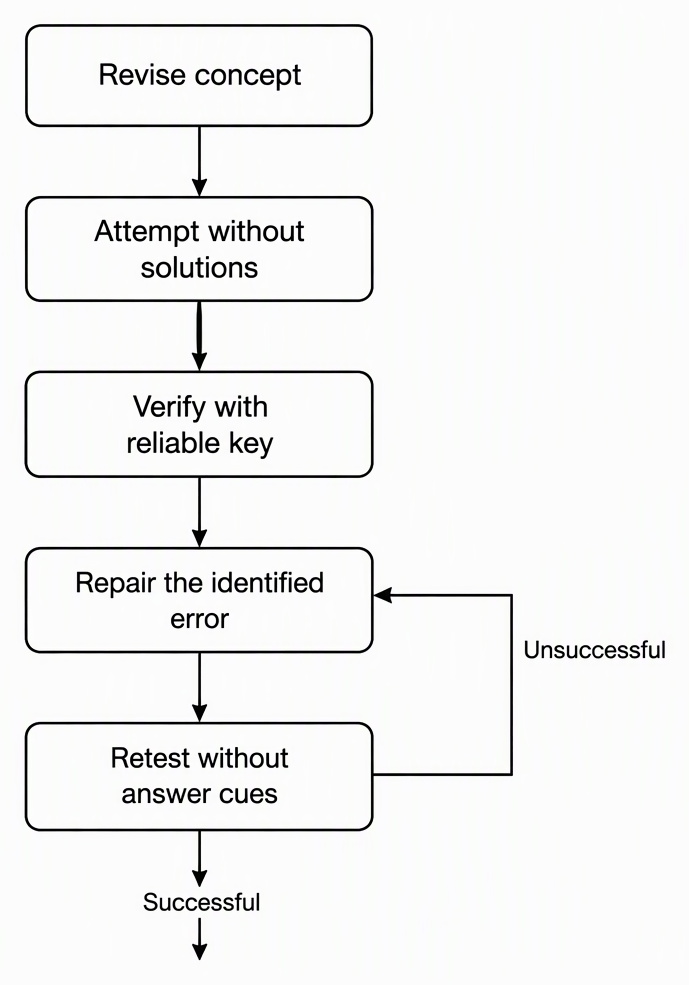
Use four error labels:
- Concept gap: You could not explain the principle needed.
- Recall gap: You missed a fact, formula or condition.
- Calculation error: Your method was sound, but arithmetic, units or algebra failed.
- Reading or answer-marking error: You missed a qualifier, selected the wrong option or transferred it incorrectly.
After repairing the gap, attempt the question again without answer cues. Recognising the steps while rereading a solution is not a successful retest.
For full-paper practice, enforce the 180-minute limit, including answer recording, and use the official marking scheme. Review errors by subject, not just the total score.
Choose teaching for concept gaps and testing for pacing problems; Free NEET Preparation App: Mocks or YouTube Lessons? explains that choice. For current-pattern testing, NEET JEEnius AI’s 30 free full-length mocks per month are an option, not free PYQ downloads or verified PYQ-only tests.
Get a verified PDF for paper practice, a source-labelled chapterwise collection for revision and a current-pattern mock for rehearsal. More downloads are not a substitute for reviewing mistakes.
Frequently asked questions
Where can I find reliable free NEET PYQ PDFs?
Start with NTA’s official NEET pages at neet.nta.nic.in and available archives for papers and final answer keys. Before using a copy, verify its year, sitting, paper code, language, completeness and readability against the matching official final key. Open the file to check that it contains the full paper rather than a free sample.
Should I solve chapterwise NEET PYQs or complete papers first?
Start with chapterwise PYQs from completed topics if your syllabus is incomplete. Add verified complete papers as your coverage grows, separating unstudied questions from errors in familiar material. Use current-pattern mocks when pacing and answer recording are the main problems.
Are NEET JEEnius AI’s free mocks actual previous-year papers?
No. NEET JEEnius AI offers 30 free full-length mocks per month for current-pattern rehearsal, not verified historical papers or PYQ-only tests. Each mock follows the stated format of 180 questions, 720 marks and 180 minutes.
Can I use NEET papers from 2021 to 2024 for timed practice?
Use them to study historical questions, but their optional Section B instructions differ from the compulsory-question format introduced in 2025. For current-format rehearsal, choose a matching complete paper or a clearly labelled current-pattern mock. Manually trimming an older paper creates a practice set, not an exact simulation.