Frog morphology NEET 2026: which features identify the male?
Option (4), B and D, is correct: vocal sacs and the copulatory pad on the first forelimb digit distinguish males in this frog morphology NEET 2026 question. Select features that separate males from females, not features merely present in males.
This Biology question belongs to Structural Organisation in Animals and Plants. The question bank tags it medium and sets an expected solving time of 30 seconds, not an observed student average.
- A: Prominent, protruding eyes.
- B: Vocal sacs.
- C: Webbing between the toes.
- D: A copulatory pad on the first forelimb digit.
- E: Olive-green skin bearing irregular dark patches.
Choose from:
Mark one numbered option, not two separate statement labels.
How do you classify all five frog features?
In the syllabus comparison, A, C and E are shared by male and female frogs, while B and D identify males in the supplied official solution. Check each external feature against the female before selecting an option. Presence in a male alone is not enough.
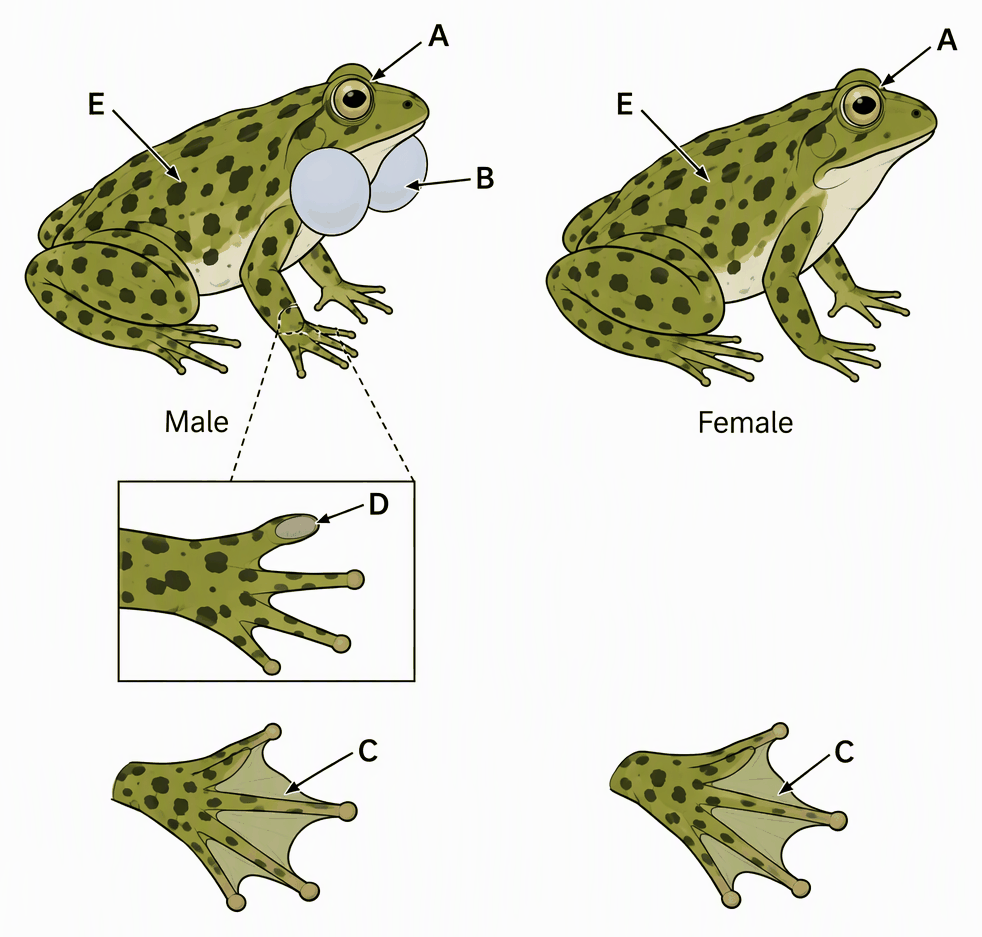
- Statement A, bulging eyes: The official solution classifies these as present in both sexes. Distinguishes a male: No.
- Statement B, vocal sacs: The supplied solution identifies these as male-specific structures. Distinguishes a male: Yes.
- Statement C, webbed digits of the feet: These occur in both sexes. Distinguishes a male: No. Webbing describes the frog’s feet but does not establish its sex.
- Statement D, copulatory pad: The pad on the first digit of the forelimb identifies males in the supplied solution. Distinguishes a male: Yes.
- Statement E, olive-green skin with irregular dark spots: This appearance occurs in both sexes. Distinguishes a male: No.
Retain the complete location in D: first digit of the forelimb. “A pad on a digit” leaves out the limb and does not rule out a hindlimb distractor.
Keep this classification within the syllabus model used by the question. It is not a claim about every frog species.
Why does only option (4) survive the check?
Only B and D independently identify the male. Every other combination contains at least one shared feature, so it fails the condition in the stem.
Final answer: option (4), vocal sacs and the copulatory pad on the first forelimb digit.
Apply this check to any combination question: each statement in a combination must satisfy the stem independently.
Why does option (1) fail even though males have webbed feet?
Webbed feet occur in females too, so recognising vocal sacs as a male feature does not validate option (1), B and C. B passes the test; C fails it.
The mistaken inference is: male frogs have webbed feet, therefore webbed feet identify male frogs. Females also have webbed feet, so that observation cannot separate the sexes.
Ask: “Would this feature also be present in the female?” For C, the answer is yes, so reject it.
With four marks for a correct answer and a one mark penalty for an incorrect answer, choosing option (4) rather than option (1) gives this score difference:
Check the second statement before marking the option, even when the first is correct.
Can you apply the same test to three related frog questions?
Use the classification above, but check what each stem asks: location, shared features or whether a claim is true. These are original practice questions, not additional verified NEET PYQs.
Question 1: Where does the male-identifying copulatory pad occur?
The pad occurs on the first digit of the forelimb. Both the digit and the limb must match.
Answer: (2). Option (1) keeps “first digit” but names the wrong limb.
Question 2: Which pair contains only features shared by both sexes?
Bulging eyes and webbed toes are shared. This reverses the original task: select shared features, not distinguishing ones.
Answer: (3). Both features occur in males and females. Every other pair includes a vocal sac or copulatory pad.
Question 3: Does olive-green spotted skin identify a male frog?
No, this appearance occurs in both sexes. Use that fact to evaluate the assertion and reason.
- Assertion: Olive-green skin with irregular dark spots identifies a male frog.
- Reason: This appearance occurs in both sexes.
Choose the correct relationship:
Answer: (4). The assertion is false and the reason is true: a shared appearance cannot distinguish males from females.
Find more chapterwise NEET PYQs and worked solutions
Frequently asked questions
Which features distinguish male frogs from female frogs in NEET?
In the syllabus model used by this question, vocal sacs and the copulatory pad on the first forelimb digit distinguish males from females. These are statements B and D, making option (4) correct. Bulging eyes, webbed toes and olive-green skin with irregular dark spots are shared features.
Where is the copulatory pad located in a male frog?
The copulatory pad occurs on the first digit of the forelimb. Retain both the digit and the limb when answering: the first hindlimb digit is incorrect.
Why do webbed feet not identify a male frog?
Webbed feet occur in both male and female frogs in the syllabus comparison, so they cannot distinguish the sexes. Option (1), B and C, therefore fails even though B, vocal sacs, is correct. Every statement in a combination must independently satisfy the question.