What was asked in the gametogenesis NEET 2022 question?
The correct answer to the gametogenesis NEET 2022 question is option A: (b), (c) and (e) only. This hard Biology MCQ from NEET 2022 came from the Reproduction chapter and had an expected solving time of 90 seconds. It asked which statements apply specifically to spermatogenesis, not to oogenesis.
The five statements can be restated as follows:
- (a) The process produces haploid gametes.
- (b) Gamete differentiation takes place after meiosis has finished.
- (c) Cells from a continuously dividing stem-cell population keep entering meiosis.
- (d) LH and FSH released from the anterior pituitary control the process.
- (e) The process begins at puberty.
The answer combinations were:
Some statements are biologically correct but apply to both processes. Such statements must be excluded because the question asks for features specific to spermatogenesis.
How can I solve this question within 90 seconds?
Use three checkpoints: when the process starts, whether new germ cells keep entering meiosis, and whether differentiation occurs before or after meiotic completion. Separate shared features from male-specific features before checking the options. This removes statements (a) and (d) immediately.
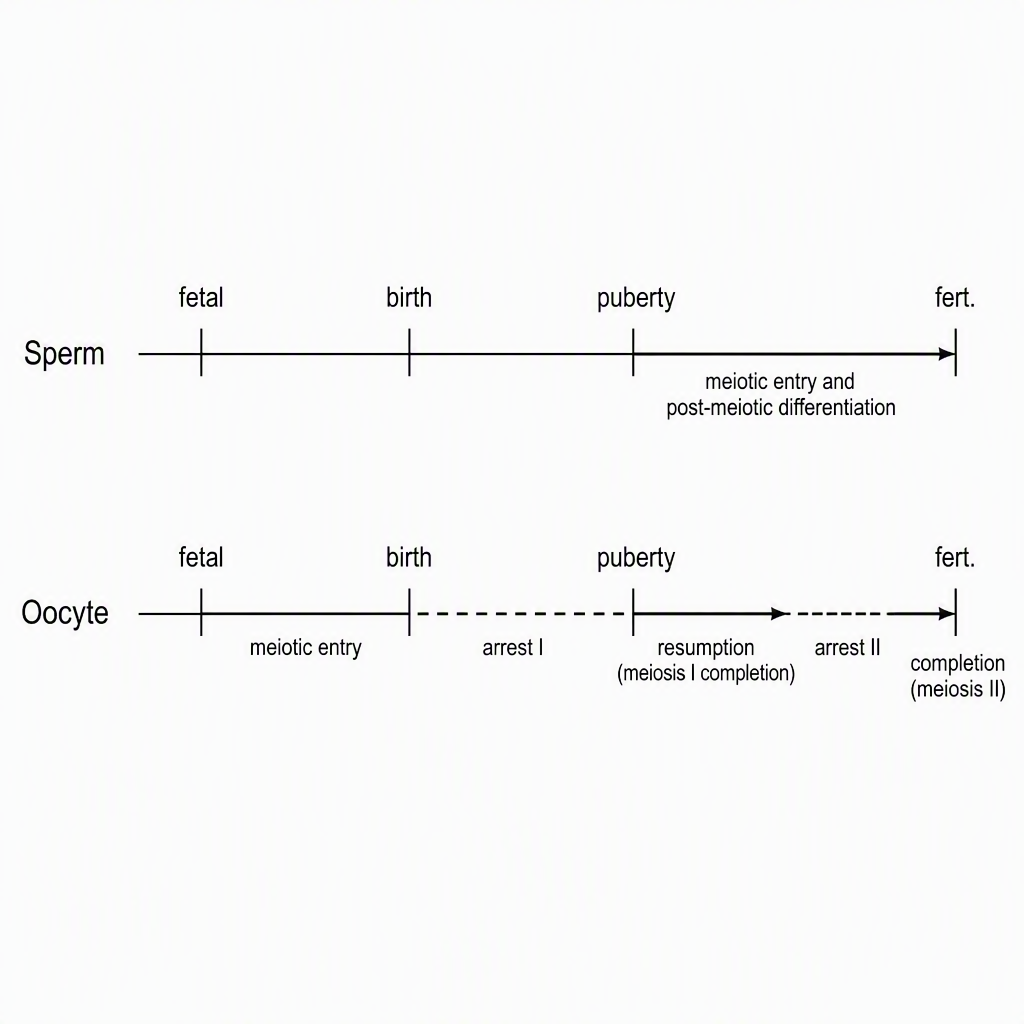
Apply these three checkpoints:
- Initiation: Does the process begin in fetal life or at puberty?
- Continuous meiotic entry: Does a dividing stem-cell population keep supplying cells for meiosis after birth?
- Differentiation: Does differentiation occur after meiosis or while meiosis is still incomplete?
Two features are shared:
- Haploidy: Both processes ultimately form haploid gametes.
- LH-FSH control: Both are regulated by gonadotropins from the anterior pituitary.
Statements based only on haploidy or LH-FSH regulation cannot qualify. This is a conceptual timeline question, not one solved by remembering hormone names alone.
Why are statements (b), (c) and (e) correct?
Test every statement against both timelines. Statements (a) and (d) are true for both spermatogenesis and oogenesis, so exclude them. Statements (b), (c) and (e) describe differences specific to spermatogenesis in this question.
Why must statement (a) be excluded?
Both sperm and the female gamete are haploid because meiosis reduces the chromosome number. Haploidy does not distinguish spermatogenesis from oogenesis.
Verdict: True for both, therefore exclude.
Why must statement (b) be included?
In spermatogenesis, meiosis produces spermatids. These spermatids then differentiate into spermatozoa through spermiogenesis, so differentiation occurs after the meiotic divisions are complete.
In oogenesis, oocyte growth and differentiation begin while meiosis is incomplete. The secondary oocyte remains arrested at metaphase II, and meiosis is completed only after fertilisation.
Verdict: Specific to spermatogenesis in this comparison, therefore include.
Why must statement (c) be included?
Spermatogonia continue dividing mitotically during reproductive life. Some descendants keep entering meiosis and developing into sperm.
Oogonia enter meiosis during fetal life. After birth, there is no equivalent continuously dividing stem-cell population supplying new primary oocytes.
Verdict: Applies to spermatogenesis but not oogenesis, therefore include.
Why must statement (d) be excluded?
LH and FSH secreted by the anterior pituitary regulate both gametogenic processes. Their actions differ between males and females, but the hormonal control named in the statement is shared.
Verdict: True for both, therefore exclude.
Why must statement (e) be included?
Spermatogenesis begins at puberty. Oogenesis begins during fetal development, when oogonia enter meiosis and form primary oocytes.
Puberty causes selected arrested primary oocytes to resume development. It does not mark the initiation of oogenesis.
Verdict: Applies specifically to spermatogenesis, therefore include.
How do all five statements compare?
The complete statement-by-statement comparison is:
- Statement (a)
- Spermatogenesis: Produces haploid sperm.
- Oogenesis: Produces a haploid female gamete.
- Final verdict: Shared, exclude.
- Statement (b)
- Spermatogenesis: Spermiogenesis occurs after meiosis.
- Oogenesis: Differentiation starts before meiosis is fully completed.
- Final verdict: Include.
- Statement (c)
- Spermatogenesis: Mitotically dividing spermatogonia continuously supply cells for meiosis.
- Oogenesis: Oogonia enter meiosis during fetal life, with no equivalent continuous post-birth supply.
- Final verdict: Include.
- Statement (d)
- Spermatogenesis: Controlled by anterior-pituitary LH and FSH.
- Oogenesis: Also controlled by anterior-pituitary LH and FSH.
- Final verdict: Shared, exclude.
- Statement (e)
- Spermatogenesis: Begins at puberty.
- Oogenesis: Begins during fetal development.
- Final verdict: Include.
What is the correct answer to the gametogenesis NEET 2022 question?
The correct combination is (b), (c) and (e) only, which gives option A. Statements (a) and (d) are shared by both processes, while (b), (c) and (e) distinguish spermatogenesis from oogenesis.
Use this one-line memory pattern:
After meiosis, continuous supply, puberty equals spermatogenesis-specific in this question.
Do not memorise option A alone. If the options are rearranged, the timeline still gives the answer.
Why does the wrong method lead to option C?
Selecting option C means accepting (b) and (c) but incorrectly rejecting (e). This happens when the initiation of oogenesis is confused with the resumption of oocyte maturation and ovarian cyclic activity at puberty.
Oogenesis starts during fetal life when oogonia enter meiosis. Primary oocytes then remain arrested in prophase I. After puberty, selected primary oocytes resume development during ovarian cycles.
Keep these events separate:
- Initiation: Oogonia enter meiosis during fetal life.
- Resumption: Selected primary oocytes continue development after puberty.
- Completion: Meiosis II finishes after fertilisation.
Initiation, resumption and completion are three different biological events. Treating puberty as the initiation of oogenesis changes the answer from A to C.
Which related gametogenesis questions should I practise?
Practise questions that test initiation, meiotic products and meiotic arrest. These three distinctions cover the same timeline logic used in the gametogenesis NEET 2022 question.
When do spermatogenesis and oogenesis begin?
Answer: Spermatogenesis begins at puberty, while oogenesis begins during fetal life.
Brief solution: Active sperm production starts at puberty. Oogonia enter meiosis before birth and become arrested primary oocytes.
What do one primary spermatocyte and one primary oocyte ultimately produce?
Answer: One primary spermatocyte produces four functional spermatozoa. One primary oocyte produces one functional ovum, along with polar bodies.
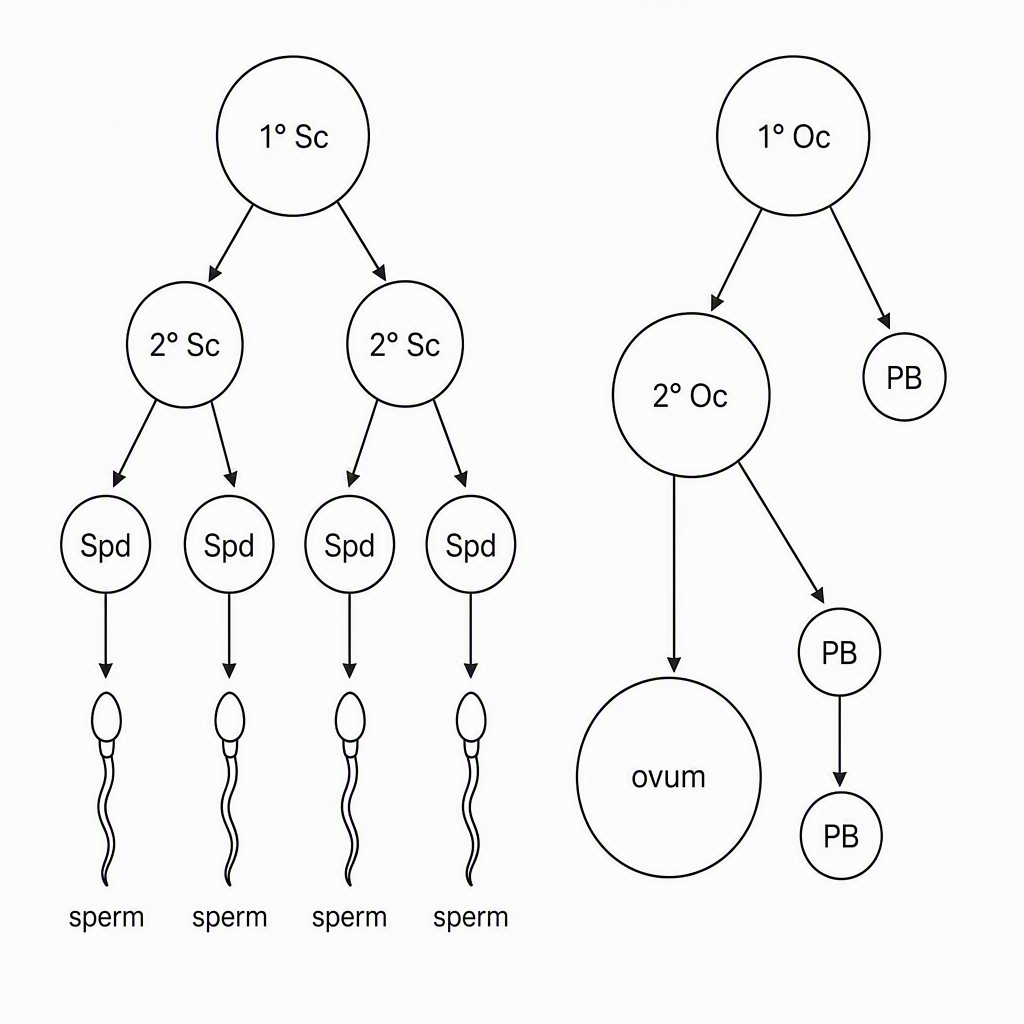
Brief solution: One primary spermatocyte forms two secondary spermatocytes, which form four spermatids. All four differentiate into spermatozoa. In oogenesis, unequal cytokinesis preserves most of the cytoplasm in one functional gamete, while the other meiotic products form polar bodies.
Where are primary and secondary oocytes arrested?
Answer: Primary oocytes are arrested in prophase I. Secondary oocytes are arrested in metaphase II.
Brief solution: A selected primary oocyte completes meiosis I around ovulation. The resulting secondary oocyte enters meiosis II but completes it only after fertilisation.
For another statement-based Biology PYQ, work through Lac Operon NEET 2022: Correct Answer and Mutation Logic by testing each statement independently before checking the combinations.
Frequently asked questions
What is the correct answer to the gametogenesis NEET 2022 question?
The correct answer is option A: (b), (c) and (e) only. Statements (a) and (d) apply to both spermatogenesis and oogenesis, so they must be excluded.
Why is puberty specific to spermatogenesis in this question?
Spermatogenesis begins at puberty, whereas oogenesis begins during fetal life. Puberty resumes the development of selected arrested primary oocytes; it does not initiate oogenesis.
Why is gamete differentiation after meiosis included?
In spermatogenesis, meiosis produces spermatids, which differentiate into spermatozoa through spermiogenesis. In oogenesis, growth and differentiation begin while meiosis is still incomplete.
Do LH and FSH control both spermatogenesis and oogenesis?
Yes. Anterior-pituitary LH and FSH regulate both male and female gametogenesis, although their specific actions differ. Therefore, this feature cannot distinguish spermatogenesis from oogenesis.
How can I solve this gametogenesis question quickly?
Check three points: when the process starts, whether germ cells continuously enter meiosis, and when differentiation occurs. Eliminate haploidy and LH-FSH control because both processes share these features.