
What seven steps should I use to study Kinetic Theory for NEET?
Study Kinetic Theory for NEET by identifying what stays fixed before choosing a formula. Temperature alone does not tell you what happens to pressure, speed or mean free path. Build one formula map, then use the seven steps below on each MCQ.
Step 1: Read NCERT with a checklist, not a copying task.
Cover ideal-gas assumptions, pressure from molecular motion, temperature and translational energy, molecular speeds, equipartition, specific heats and mean free path. Check assumptions such as negligible molecular volume, elastic collisions and negligible intermolecular forces except during collisions.
Make one compact formula map, grouped by the quantity asked. Do not turn it into a copy of the chapter.
Step 2: Settle the notation before practising.
Moles and molecules are different counts. Molar mass and the mass of one molecule are different masses:
Connect the molar and molecular forms:
Avogadro’s constant connects the two counting systems; the gas constant and Boltzmann constant apply to molar and molecular quantities respectively. Never substitute a molecule count into a formula requiring moles.
Step 3: Label the target and underline the constraints.
Classify every question as pressure, speed, energy, heat capacity or mean free path. Underline whether gas identity, temperature, volume, molecule count or pressure stays fixed.
“Sealed” fixes molecule count for a non-reacting gas. “Rigid” fixes volume. Neither word means constant pressure.
Step 4: Select the relation by the target.
Keep separate entries for pressure, speed, per-molecule energy and total translational energy. Select by the quantity asked, not by which formula looks familiar.
- Pressure, using mass density:
- Rms speed, using absolute temperature and molar mass:
- Mean translational energy per molecule:
- Total translational energy:
Isotropic random motion shares mean squared speed equally among three perpendicular directions. That gives the one-third factor in pressure; keep the full pressure derivation outside this working map.
Keep most probable and average speeds beside rms speed:
Mean velocity is zero in an equilibrium gas with no bulk flow. Mean speed is not zero.
Step 5: Choose active degrees of freedom before calculating internal energy.
Count the active degrees of freedom first. For an ideal gas with that count fixed, use:
These heat capacities are molar. When using one fixed heat capacity, the active degrees of freedom must remain unchanged throughout the temperature interval.
Step 6: Write a ratio before inserting numbers.
For the same gas, rms speed scales with the square root of absolute temperature. At the same temperature, it scales inversely with the square root of molar mass.
Convert Celsius to kelvin. With the SI gas constant, use:
For mean free path, use the molecular collision diameter and number density:
Check whether number density or pressure is fixed before claiming a temperature dependence. Also check whether collision diameter is treated as constant.
Step 7: Check, tag and repair.
Check dimensions and physical direction. A heavier molecule at the same temperature should not have a greater rms speed.
Tag each error as formula selection, fixed-quantity identification, unit conversion or arithmetic. Revise the cause, not the whole chapter.
Do helium and oxygen have the same molecular speed at the same temperature?
Helium has greater rms speed, but both gases have equal mean translational kinetic energy per molecule. Temperature fixes that average energy, not molecular speed. The lighter molecule needs a greater mean squared speed to have the same mean translational energy.
Author-created practice question: Helium and oxygen are at 300 K. Their supplied molar masses are:
Find their rms-speed ratio and compare mean translational energies per molecule.
- Targets: speed ratio and energy comparison.
- Fixed quantity: temperature.
- Changing quantity: molecular mass.
Write the speed ratio first:
Consistent molar-mass units cancel here. Conversion to SI units is unnecessary for this ratio, though necessary for an absolute speed using the SI gas constant.
For energy:
The tempting wrong answer is equal speed. Kinetic energy also depends on molecular mass:
Do not extend this result to equal total internal energy for equal amounts of helium and oxygen. Their active degrees of freedom can differ.
For fresh comparison questions, NEET JEEnius AI’s practice mode offers topic sets that skip questions already seen, with 60 free sets a month.
What changes when a gas is heated in a sealed, rigid vessel?
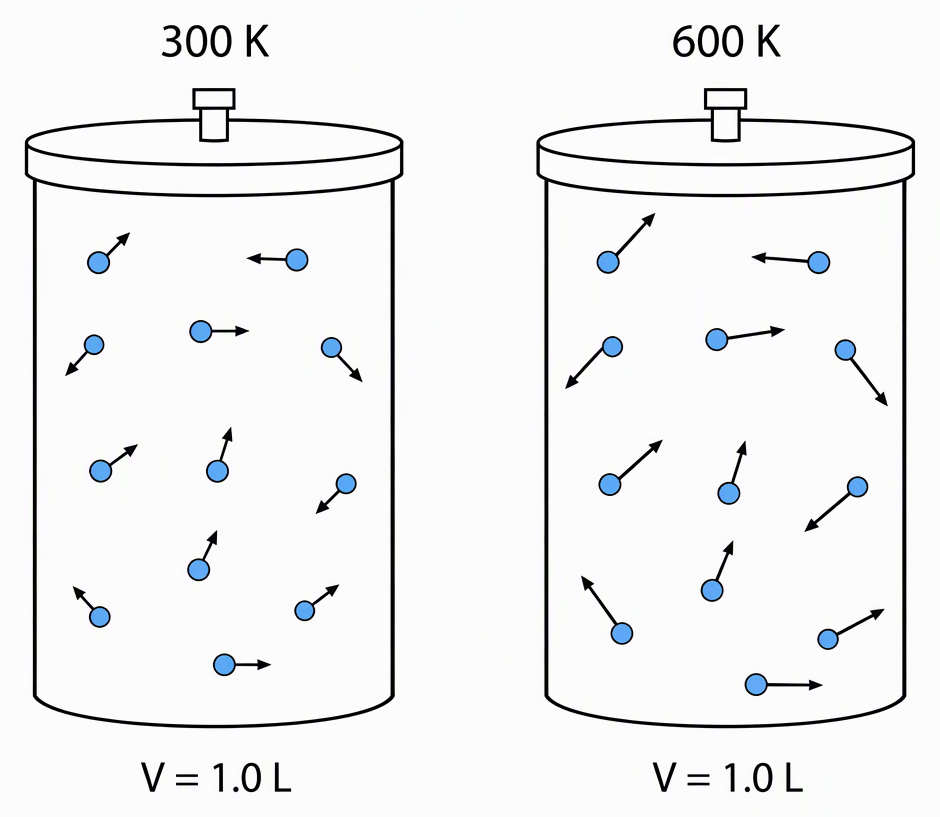
For a fixed amount of ideal gas, pressure rises in proportion to absolute temperature, rms speed rises with its square root, and mean free path stays unchanged when collision diameter is constant. The mean-free-path result follows from unchanged number density, not from temperature alone.
Author-created practice question: A fixed amount of ideal gas in a sealed, rigid vessel is heated from 27°C to 327°C. Find final-to-initial ratios of pressure, rms speed and mean free path, taking collision diameter as constant.
List invariants first:
- Molecule count remains fixed because the vessel is sealed.
- Volume remains fixed because it is rigid.
- Molar mass and collision diameter remain fixed.
Both mass density and number density therefore remain unchanged. Heating changes molecular speeds without changing the number of molecules per unit volume.
Convert temperatures before taking ratios:
The Celsius ratio is invalid:
Apply the fixed quantities:
Cross-check at fixed collision diameter: both absolute temperature and pressure double.
At constant pressure instead, mean free path would increase in proportion to absolute temperature, with collision diameter still fixed. “Temperature increases” is insufficient information without the constraints.
How do I choose degrees of freedom before calculating heat?
Count active modes before choosing heat capacity. For the stated diatomic model, three translational and two rotational degrees of freedom contribute to internal energy. Using only translational energy misses the rotational contribution and underestimates the heat required.
Author-created practice question: Two moles of ideal diatomic gas are heated at constant volume from 300 K to 400 K. Vibrational modes are inactive. Find the internal-energy change, heat supplied and heat-capacity ratio.
Assume the translational and rotational modes remain active throughout the interval:
The molar heat capacities and their ratio are:
Now calculate, keeping the mole factors:
With the supplied gas constant:
For this closed, rigid system, considering only pressure-volume work:
The heat supplied is also approximately 4.16 kJ. No energy leaves through pressure-volume work because the vessel does not expand.
The wrong calculation for total internal-energy change is:
It gives only the translational-energy change and misses rotation. A monatomic ideal-gas model instead has:
Do not assign the same degrees of freedom to every gas at every temperature. Read the model and active-mode conditions first.
What should I practise next to stop choosing the wrong formula?
Start with a 12-question diagnostic, then repair only the concepts your errors reveal. This is a study prescription, not a claim about chapter weightage. Choose this sequence over another full reading followed by unclassified MCQs: it separates formula-selection errors from calculation errors.
Divide the diagnostic equally:
- Three questions on speed and translational energy.
- Three on pressure and density.
- Three on equipartition and specific heats.
- Three on mean free path.
Before calculating, write target, fixed quantities and governing relation. Put wrong answers and guessed-right answers in the same error log. A correct option reached without a defensible relation is not evidence of readiness.
Use your error tags to choose the repair:
- Formula selection: distinguish the competing quantities, such as internal energy and translational energy.
- Fixed-quantity identification: rewrite the vessel or process constraints.
- Unit conversion: practise the relevant kelvin or molar-mass conversion.
- Arithmetic: redo the ratio before using decimals.
Then solve a fresh question with changed conditions: same temperature versus same speed, constant volume versus constant pressure, or monatomic versus diatomic. For number-density confusion, use Mean free path: number-density ratio explained.
As a suggested routine, reconstruct the formula map closed-book the next day, then attempt a fresh mixed set after targeted repair. These intervals organise practice; they do not guarantee retention.
Check readiness through observable actions: explain the invariant, select the relation without notes, separate molecular from molar quantities and reject a plausible wrong answer. If any action still needs prompting, repair that specific gap.
For that next-day attempt, NEET JEEnius AI’s daily practice problems provide a fresh topic set every day, with 20 free attempts a month. Write the constraints before opening the calculation.
Next step: daily practice problems on NEET JEEnius AI and get a fresh set on a topic every day (20 free attempts a month).
Frequently asked questions
How should I study Kinetic Theory for NEET?
Read NCERT with a checklist and build one compact formula map organised by the quantity asked. Before each MCQ, identify the target, fixed quantities and governing relation, then write ratios before substituting numbers. Use a 12-question diagnostic across speeds and energy, pressure and density, specific heats, and mean free path to identify gaps.
Do helium and oxygen have the same speed at the same temperature?
No: helium has a greater rms speed because its molar mass is lower. At the same temperature, helium's rms speed is 2√2 times oxygen's, using molar masses of 4 and 32 g/mol. Both gases have equal mean translational kinetic energy per molecule, not necessarily equal total internal energy for equal amounts.
Does mean free path increase when temperature increases?
It depends on what stays fixed. In a sealed, rigid vessel containing a fixed amount of ideal gas, mean free path stays unchanged if collision diameter is constant because number density does not change. At constant pressure and fixed collision diameter, mean free path increases in proportion to absolute temperature.
How many degrees of freedom should I use for a diatomic gas?
Use five when three translational and two rotational degrees of freedom are active and vibrational modes are inactive. This gives molar heat capacities C_V = 5R/2 and C_P = 7R/2, with gamma = 7/5. Check the stated model and temperature interval before assuming these modes remain unchanged.