
How should I study Microbes in Human Welfare for NEET MCQs?
Study Microbes in Human Welfare for NEET through microbe–product–use links, not isolated scientific names. Build two tools: a retrieval grid for associations and process chains for sewage treatment and biogas. Use them to catch options that contain familiar words but connect them incorrectly.
- Divide NCERT into six retrieval headings.
Use household products, industrial products, sewage treatment, biogas, biocontrol and biofertilisers. These organise facts, not six separate sets of lengthy notes.
Read each application group, then record its organism–product–use links. Check names and associations against the NCERT edition you are using rather than adding unrelated microbiology.
- Build a four-column retrieval grid.
On paper, use the columns organism or microbial group, product or action, application, and closest confusion. Leave unsupported cells blank: a mixed microbial process does not always belong to one species.
- Lactobacillus and other lactic acid bacteria: curd formation; household food preparation; not yeast.
- Saccharomyces cerevisiae: fermentation; bread making and alcoholic fermentation; not streptokinase production.
- Monascus purpureus: statins; lowering blood cholesterol; not cyclosporin A.
- Trichoderma polysporum: cyclosporin A; immunosuppression; not statins.
- Streptococcus: streptokinase; clot removal; not bread making.
- Retrieve every row in both directions.
Cover the product and use, then recall them from the organism. Next, cover the organism and retrieve it from the product or application.
Underline the distinct roles of producer, product and application in your handwritten entries. “Immunosuppression” names the use, not the producer. If you recognise the use but cannot name the producer, that row needs another retrieval attempt.
- Convert sewage treatment and biogas production into arrow chains.
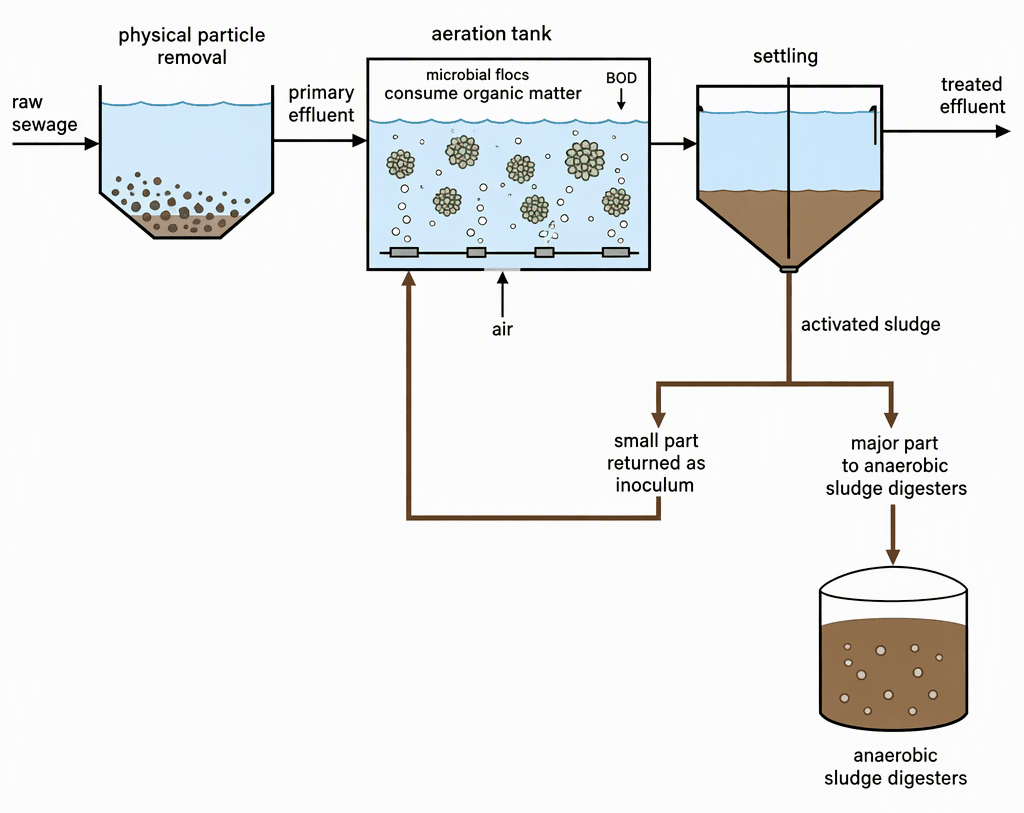
For sewage, separate physical primary treatment, aerobic biological treatment and anaerobic sludge digestion. Label the oxygen condition wherever microbial activity changes.
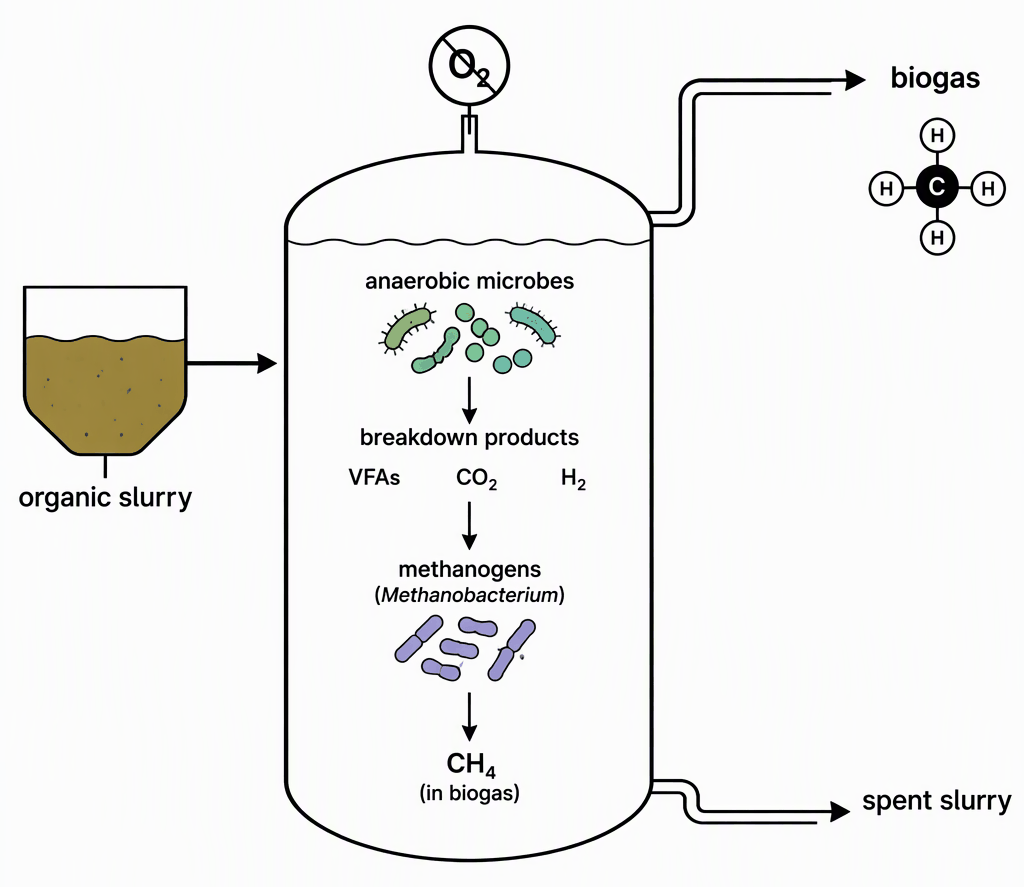
For biogas, retain anaerobic decomposition and methanogens such as Methanobacterium. Keep the community process separate from the example organism: methanogens act on suitable breakdown products, not every stage of raw waste decomposition.
- Add a contrast strip beside the grid.
Put easily confused associations beside each other. State the difference in function or stage:
- Trichoderma polysporum: cyclosporin A production, versus Trichoderma species: biocontrol.
- Glomus: phosphorus absorption through mycorrhiza, versus nitrogen-fixing microbes.
- Microbial flocs: bacterial aggregates associated with fungal filaments, versus activated sludge: the sediment after flocs settle.
- Use the same checking sequence in every MCQ.
Identify whether the question tests an association, sequence or application. Mark NOT or incorrect prominently when it appears in the stem.
Retrieve the relevant row or chain, then check every clause in each option. Reject an option as soon as one link fails. A familiar organism name does not make its assigned product or function correct.
How do I catch a swapped microbial product in an MCQ?
Check the producer–product pair first, then verify the use. A three-link association is correct only when both connections hold. Recognising the organism or the application alone is not enough.
Original single-correct practice example, not a previous-year NEET question
Which organism–product–use association is correct?
- A. Monascus purpureus: cyclosporin A: immunosuppression.
- B. Trichoderma polysporum: statins: lowering cholesterol.
- C. Streptococcus: streptokinase: removal of blood clots.
- D. Saccharomyces cerevisiae: streptokinase: bread making.
Correct answer: C.
Recognise the three-link structure, then retrieve each producer–product pair. Only after that should you check whether the product has the stated use.
- Reject A: Monascus purpureus produces statins, not cyclosporin A.
- Reject B: Trichoderma polysporum produces cyclosporin A, not statins. A and B have exchanged products.
- Accept C: Streptococcus produces streptokinase, which is used for clot removal.
- Reject D: Saccharomyces cerevisiae is associated with bread making, but streptokinase is the wrong middle link.
A familiar organism or a correct application cannot rescue an option with a broken middle link. In A and B, the product–use pairs are correct, but the producers are wrong.
Cover the explanation and answer:
- Which microbe produces statins?
- Which produces cyclosporin A?
How do I solve sewage-treatment questions without mixing up the stages?
Check the treatment stage and oxygen condition. Primary treatment removes particles physically; aerobic biological treatment consumes organic matter; most settled sludge then undergoes anaerobic digestion. BOD is the oxygen required by aerobic microorganisms to oxidise organic matter in a water sample, not the dissolved oxygen already present.
Original single-correct practice question
Which statement about sewage treatment is correct?
- A. Primary treatment mainly removes dissolved organic matter using aerobic microbes.
- B. Aeration supports microbial flocs that consume organic matter and reduce BOD.
- C. Activated sludge is formed during primary filtration.
- D. Methanogens carry out the aerobic breakdown of sewage in the aeration tank.
Correct answer: B.
Reconstruct the chain before checking the options. Flocs contain bacteria associated with fungal filaments; activated sludge is the sediment formed after those flocs settle.
- Reject A: aerobic biological activity is not physical primary treatment.
- Accept B: consuming organic matter reduces BOD.
- Reject C: activated sludge forms after biological treatment and settling.
- Reject D: methanogens require anaerobic conditions.
Complete the chain: a small part of activated sludge returns as inoculum; the major part enters anaerobic sludge digesters.
How do I distinguish biofertilisers from biocontrol agents?
Check the agricultural application, classify the organism or association, then verify its exact function. Biofertilisers improve nutrient availability; biocontrol agents control pests or pathogens. Not every useful soil microbe fixes nitrogen, and not every beneficial microbe is a biofertiliser.
Original single-correct practice question
Which association is correct?
- A. Glomus: symbiotic nitrogen fixation in legume nodules.
- B. Rhizobium: phosphorus absorption through fungal mycorrhiza.
- C. Bacillus thuringiensis: free-living nitrogen fixation.
- D. Glomus: mycorrhizal association that helps plants absorb phosphorus.
Correct answer: D.
The options test nutrient support against pest control. Classify Glomus as a mycorrhizal fungus, Rhizobium as a nitrogen-fixing bacterium and Bacillus thuringiensis as a microbial pest-control agent, then check the functions:
- Reject A: Rhizobium fixes nitrogen symbiotically in legume root nodules.
- Reject B: Glomus forms mycorrhizal associations that help phosphorus absorption.
- Reject C: Bacillus thuringiensis is used in microbial pest control.
- Accept D: both the association and its function match Glomus.
Keep this nitrogen-fixer contrast beside your grid:
- Azotobacter and Azospirillum: free-living nitrogen-fixing bacteria.
- Anabaena and Nostoc: nitrogen-fixing cyanobacteria.
- Rhizobium: symbiotic nitrogen fixation in legume root nodules.
Do not copy the whole explanation into an error log. Record the corrected association and its competing wrong link: “Glomus: mycorrhiza and phosphorus absorption; not legume-nodule nitrogen fixation.”
What should I practise after these worked examples?
Close the book, rebuild the organism–product–use grid and redraw the sewage and biogas chains. Check only missing or incorrect links against NCERT.
Practise in this order:
- Direct associations: organism to product or function.
- Reverse associations: product or function to organism.
- Process-order questions.
- Single-correct statements with swapped names or functions.
Extend your grid:
- Aspergillus niger: citric acid.
- Acetobacter aceti: acetic acid.
- Propionibacterium sharmanii: large holes in Swiss cheese.
- Penicillium roqueforti: Roquefort cheese ripening.
- Trichoderma: biocontrol against plant pathogens, not a biofertiliser function.
- Baculoviruses: narrow-spectrum biological control agents, not biofertilisers.
Match the correction task to the error instead of rereading everything:
- Name recall: cover and retrieve the name in both directions.
- Product or use swap: write the correct pair beside the confused pair.
- Process order: redraw the chain with oxygen conditions.
- Missed stem wording: mark the negative word before checking options.
Suppose you answer two of the three examples correctly and one incorrectly. Using NEET’s marking scheme:
Leaving that incorrect response unattempted would instead give:
This comparison assumes you already know which answer was wrong; it is not a blanket rule to skip uncertain questions. Identify the failed link before attempting another question of that type.
Test readiness by explaining why every distractor is wrong and retrieving its corrected association without reopening notes. A guessed correct answer does not demonstrate secure recall: cover the options and retrieve the link again.
Next step: daily practice problems on NEET JEEnius AI and get a fresh set on a topic every day (20 free attempts a month).
If that step was the hard part, work through Blood Composition NEET 2026: Counts from 8000 WBCs.
Frequently asked questions
How do I remember microbes and their products for NEET?
Build a four-column grid with the organism or microbial group, product or action, application and closest confusion. Practise recall in both directions: organism to product, then product to organism. Check missing or incorrect links against your NCERT edition rather than rereading the whole chapter.
How do I avoid confusing statins and cyclosporin A?
Monascus purpureus produces statins, which lower blood cholesterol. Trichoderma polysporum produces cyclosporin A, an immunosuppressant. In an MCQ, verify the producer–product pair before checking the use; a correct use cannot rescue a wrong producer.
Why does BOD decrease during sewage treatment?
During aerobic biological treatment, microbial flocs consume organic matter, reducing BOD. BOD is the oxygen required by aerobic microorganisms to oxidise organic matter in a water sample, not the dissolved oxygen already present. Keep this stage separate from physical primary treatment and anaerobic sludge digestion.
What is the difference between biofertilisers and biocontrol agents?
Biofertilisers improve nutrient availability, while biocontrol agents control pests or pathogens. Glomus forms mycorrhizal associations that help plants absorb phosphorus, whereas Rhizobium fixes nitrogen symbiotically in legume root nodules. Bacillus thuringiensis is a microbial pest-control agent, not a nitrogen-fixing biofertiliser.